Kino Lorber has collected The Counsellor, Blazing Magnum, and Weapons of Death – all underseen 70s Italian Crime thrillers into the Italo-Crime Collection, a new 4K UHD box set filled with extras.
The Films
The Counsellor
The Counsellor is what I love about Italian genre films (aka Italian knockoff films). They are both in conversation with and arguing with the films they very liberally take from. In the case of The Counsellor, Alberto De Martino is ripping off The Godfather. As Godfather ripoffs go this one is a pretty effective one. Having seen more than a few imitators in my time De Martino’s tale of betrayal within a Crime Family does the right thing… it throws much of what made Coppola’s epic out the window. The Counsellor is more of an action thriller than it is a critique of America and the nuclear family.
Instead of Al Pacino, we get Tomás Milián as Thomas Accardo, a fresh-out-of-prison mafioso who’s trying to stay out of the lifestyle that killed his father. In place of Marlon Brando, we have Martin Balsam as the “godfather” (they never call him that), Don Antonio, who starts a war of jealousy because he lets Accardo go. As we know, no one can ever leave the family. Murder and car chases aplenty, and an entire finale set in Italy.
Milián and Balsam are highly effective as the “father and son” of the film. Seeing them take down a warehouse full of goons will make any cineaste cackle with joy. In fact, all of the action set pieces are great and make effective use of real-life locations in San Francisco, Albuquerque, and Sicily. The standout being the finale that takes place during a Sicilian parade. De Martino understands how to shoot a film beyond the action scenes. His sense of composition for the widescreen frame is effective in the dramatic scenes as well, using it for maximum effect.
The film mixes everything up to produce something that’s lean, mean, and super effective. This one is catnip for anyone who loves the vibes of Italian Crime cinema.
Blazing Magnum
Blazing Magnum is exactly what you think it is. A Dirty Harry knockoff. This one stars Stuart Whitman doing his best Clint Eastwood. Though Whitman starring as a cop who doesn’t play by the rules is where the similarities end. The film is part Poliziotteschi, part Giallo, and all nonsense insanity that feels exactly like the kind of late-night WTF film that makes you question if you are awake or sleeping. This may not be director Alberto De Martino best film, but it’s certainly his wildest.
Canadian police Captain Tony Saitta (Whittman) is in the middle of chasing down bank robbers when his sister Louise (Carole Hunnicutt) dies under the most mysterious circumstances. Nothing is going to stop Saitta from investigating who’s responsible. His only lead is the blind witness Julie (Tasia Farrow), whom the killer is trying to kill. As the suspects pile up (Martin Landau, as the doctor treating his sister, being one of them), so do the bodies, leading to a showdown between cop and killer with Julie’s life in the balance.
The cast is stellar in this one, with Whittman, Landau, Farrow, Carole Laure, and John Saxon all having larger parts than one expects. Whittman is actually great as the gruff Harry Callahan photocopy. In fact, no one really phones it in here. Which is surprising considering how all convolutedly silly it is. No one blinks or winks at the camera, just all the self-seriousness in the world, which adds to how arched it all is.
Again, director Alberto De Martino elevates this lurid piece of knockoff cinema to something stylish and altogether fascinating. The execution of the action scenes and the scenes of tension are, without regard, excellent. The highlight is a car chase taken straight out of Bullitt that has to be the single best car chase in a film that you’ve never seen.
Blazing Magnum is truly a wild piece of procedural mania ending the way that every Dirty Harry knockoff should with its rogue cop blazing away his. 44 Magnum.
Weapons of Death
If you spend enough time in the realm of Italian knockoff cinema of the 1970s and 1980s, you know one definitive truth … Some shit is about to go down if Henry Silva shows up. The shit definitely goes down in director Mario Caiano’s Weapons of Death. The semi-sequel to Umberto Lenzi’s Poliziotteschi classic Violent Naples.
Silva plays Santoro, another drug-dealing criminal mastermind taking the city of Naples for all its worth. The police are unable to arrest Santoro because he’s not only smart but under the protection of Don Alfredo. Commissioner Belli (Leonard Mann) faces corruption on all fronts, unable to trust anyone, and puts together an unconventional team including a taxicab driver to take Santoro down. Belli and Santoro begin a war on the streets of Naples that takes no prisoners.
Director Umberto Lenzi isn’t the only casualty from the original classic. Maurizio Merli, who played Commissioner Betti (see, they changed the “tt” to “ll”) has been replaced by Leonard Mann. Mann is good but is no Merli (at least in ViolentNaples). Though both director Mario Caiano and star Mann prove to be effective, albeit “blunt force trauma” solution replacements. Though it’s Henry Silva who’s the upgrade and makes this a worthy successor to the original. Silva relishes every moment he’s on screen, playing up the bad and the cool to 11.
From the great bank robbery that opens the film to the tense and tragic final train station chase, director Caiano makes sure that every single action scene is adroitly executed with a sense of existential brutality that’s fitting of the most sobering of 1970s crime films. From castrations of sex offenders to pedicide, Weapons of Death does not mess around. It never lingers on these events, moving forward to the next crime or action scene. Not all dour and gloom, Weapons of Death does find time to have some fun with its own artful Dodger-like street urchin who, amongst other petty crimes, steals a Ferrari, leading the cops on a chase around Naples.
Weapons of Death makes sure to up the ante in true sequel form and lives up to its predecessor.
The Transfers
Each film has all-new UHD SDR Masters, sourced from 4K Scans of the 35mm Original Camera Negatives. The work here is impressive. All look beautiful and are excellent examples of European Genre Cinema making the transition to 4K. They are all solid representations of the films. There are minor scratches and dirt that occasionally show in all three, but it’s minor as compared to how the films look overall. The films, beyond that, have that wonderfully gritty cinematic look that all Italian genre cinema shot in scope (more than likely the favored Technoscope) had in the 60s and 70s. The fact that these three films do not have HDR is honestly of no consequence; they’re still great transfers. Kino continues to provide great upgraded picture (and sound) on their 4K releases.
The Extras
They include the following;
DISC 1 (THE COUNSELLOR 4KUHD):
NEW Audio Commentary by Film Historians Steve Mitchell and Troy Howarth
In Original Italian and English Dub with Optional English Subtitles
DISC 2 (BLAZING MAGNUM | WEAPONS OF DEATH 4KUHD):
NEW Audio Commentary for BLAZING MAGNUM by Film Historians Steve Mitchell and Troy Howarth
NEW Audio Commentary FOR WEAPONS OF DEATH by Film Historians Steve Mitchell, Nathaniel Thompson and Troy Howarth
In Original Italian and English Dub with Optional English Subtitles
DISC 3 (SHADOWS IN AN EMPTY ROOM and BONUS FEATURES BLU-RAY):
Shadows in an Empty Room (Alternate Cut of Blazing Magnum Released by American International Pictures)
The Counsellor: Video Essay by William Webb
Blazing Magnum: Alberto De Martino’s Magnum Memories
Blazing Magnum: Kim Newman on Blazing Magnum
Weapons of Death:Napoli Spara! Revisited: Archival Interview with Actor Leonard Mann
Weapons of Death: Naples Under Fire: Archival Interview with Director Mario Caiano
Weapons of Death: Video Essay by William Webb
Weapons of Death: English Opening and Closing Credits
Theatrical Trailers for The Counsellor, Blazing Magnum (Newly Restored in 4K), Shadows in an Empty Room and Weapons of Death
Optional English Subtitles (Shadows in an Empty Room)
The first all-new Audio Commentary for The Counsellor by Film Historians Steve Mitchell and Troy Howarth. The duo opens with Troy discussing the fact that he has a book about De Martino out soon, before other credentials, before diving into this film. Some of the details include the unique nature of the film with locations (shot in San Francisco, Santa Fe, and eventually Italy); a great discussion about hairpieces; the touchstones that earmark De Martino’s film and what separates them from other Italian filmmakers; the cameo of Sacheen Littlefeather (and also what she’s known for); the work and career of star Martin Balsam and his work in Italy; the tradition of English-speaking actors going to Italy to star in Italian productions and how this was not necessarily a shameful experience and Italy was very respectful towards the stars and examples of various big budget productions at the time; the work and career of Tomas Milian; the career and films of director Anthony De Martino – including a discussion of his style here and collaborators; a discussion of the various actors (their careers and histories) that appear in the film; and much more.
The second all-new Audio Commentary for Blazing Magnum by Film Historians Steve Mitchell and Troy Howarth opens with a discussion of the multiple titles (four in total) and the fact that this is the 23rd film of De Martino’s career as a director. Some of the details include the locations in America (specifically in Canada in Montreal); this is unique as this is an all-English-speaking cast in an Italian production; the production schedule of the film; how the tax breaks that were enacted to make it easier for Italians to come to Canada; how Fulci’s White Fang adaptation also helped Italians and was financed by Canadian money and other films that were co-financed by Canadians; the work and career of Stuart Whitman; the work and career of Tisa Farrow – specifically a discussion of how most of her work was done in Italy; the work and career of co-star John Saxon; the work of director Joe D’Amato who here was working as a cinematographer; the work and career of Martin Landau including a personal aside from both Mitchell and Howarth; the ways that De Martino found ways to make the production look bigger than he had; the most iconic and troubling scene of the film the fight scene between Whitman’s character and the transvestites; the reasons why Stuart Whitman ended up making this film; a discussion of the various tones and subgenres the film delves into; a discussion of the various actors (their careers and histories) that appear in the film; and much more.
The third all-new Audio Commentary for Weapons of Death by Film Historians Steve Mitchell, Nathaniel Thompson, and Troy Howarth begins with the trio’s introduction before diving into the opening score by Francesco De Masi. Some of the details include how this particular film is unique among the Poliziotteschi genre; the danger both in stunts and other possible issues that could have arisen during these productions; a discussion of the career and personal history of star Henry Silva; the advertising for the film at the time and how they tried to cash in on the success of Violent Naples (a classic of the genre); the work and career of director Mario Caiano; a great side discussion of the various types of crime films and how they’re based a lot in the region they take place; the work and career of Leonard Mann; a larger discussion of the various action scenes and stunt work throughout; a discussion of the various actors (their careers and histories) that appear in the film; and much more.
Shadows in an Empty Room (99:24) – this is an alternate cut of Blazing Magnum that was made and released by American International Pictures (aka AIP). Interesting for sure, but feels like it was cut to make a more streamlined Dirty Harry ripoff. By cutting out all the “odd angles” and more Italian sensibilities, the film is essentially robbed of what makes it such a great melding of the Giallo and Poliziotteschi subgenres. That isn’t to say it doesn’t present its own sort of unique quirks, but it definitely pales in comparison to the original Italian cut of the film that’s presented in 4K. Note: The transfer presented here is a solid presentation, though it’s nowhere near as luminous as the 4K presentation.
The Counsellor: Video Essay by William Webb (6:17) – in the video essay, Webb discusses the rise of the Mafia movie after the success of The Godfather during the political strife of the years of lead in Italy and where The Counsellor fits in with the subgenre of crime films in Italy. Webb goes on to discuss The Counsellor’s director Albert De Martino, story, stars, visual style, location shoot, and much more.
Blazing Magnum: Alberto De Martino’s Magnum Memories (13:04) – this archival interview with the director opens with why he was labelled “the most American of Italian directors”. De Martino goes on to discuss his early life and his father’s work as a makeup artist in Italian films of the early 1940s; how that led to a small acting role as a child that convinced him to become a director; his early work in sound and editing that eventually led to being an AD and then eventually to feature films; working with Joe D’Amato (who was a cinematographer at the time) on Blazing Magnum; and much more. In Italian with English subtitles.
Blazing Magnum: Kim Newman on Blazing Magnum (22:07) – in his archival interview, Newman, the critic, discusses the rise of the Poliziotteschi and Giallo film movements and their melding in Blazing Magnum. After setting the context of the genres, Newman goes on to discuss the film in detail, highlighting the style, the use of Canada as a location (not substituting for an American city), outrageous storytelling, the cast ( including Stuart Whitman, John Saxon, Martin Landau, Tisa Farrow, and others), the crew, the action, including the iconic car chase scene, and much more.
Weapons of Death: Napoli Spara! Revisited: Archival Interview with Actor Leonard Mann (17:48) – in this archival interview with the actor opens with a discussion of the change in the 70s in Italy because of the change in political climate. Mann goes on to discuss his favorite films he starred in during his time in Italy; filming of Weapons of Deathduring this time – including how it was set up, the stunt work; why he feels that these films have been reassessed and revitalized; and much more.
Weapons of Death: Naples Under Fire: Archival Interview with Director Mario Caiano (15:10) – in this archival interview with Caiano opens with how he got his start in Italy eventually becoming a film director. Caiano goes on to discuss the political upheaval that the film was made in and how it informed the story and style; the different styles that are imposed on Westerns as opposed to Crime films in Italy and why they do so; a discussion of the various iconic scenes of violence (including the decapitation and the castration scenes, among others); and much more. In Italian with English Subtitles.
Weapons of Death: Video Essay by William Webb (5:25) – in this archival video essay, Webb discusses the Poliziotteschi genre and how this was exemplified by Weapons of Death. Webb dissects the subgenre, the story, the action in the film, the direction and acting, the tropes of the genre and how the film either works them in or subverts them, the connections to the current atmosphere in Italy, and much more.
Weapons of Death: English Opening and Closing Credits (3:09)
Rounding out the special features are Theatrical Trailers for The Counsellor (4:13); Blazing Magnum [Newly Restored in 4K] (3:32); Weapons of Death (3:30); Taking of Pelham One Two Three (2:33); Sands of the Kalahari (2:52); Assassination (2:59); Violent City (3:54);
The Final Thought
Fans of Euro-Crime/Polizzeticchi films will need this in your library. Highest Possible Recommendation!!
Kino Lorber’s 4K UHD Edition of Italo-Crime Collection is out now.

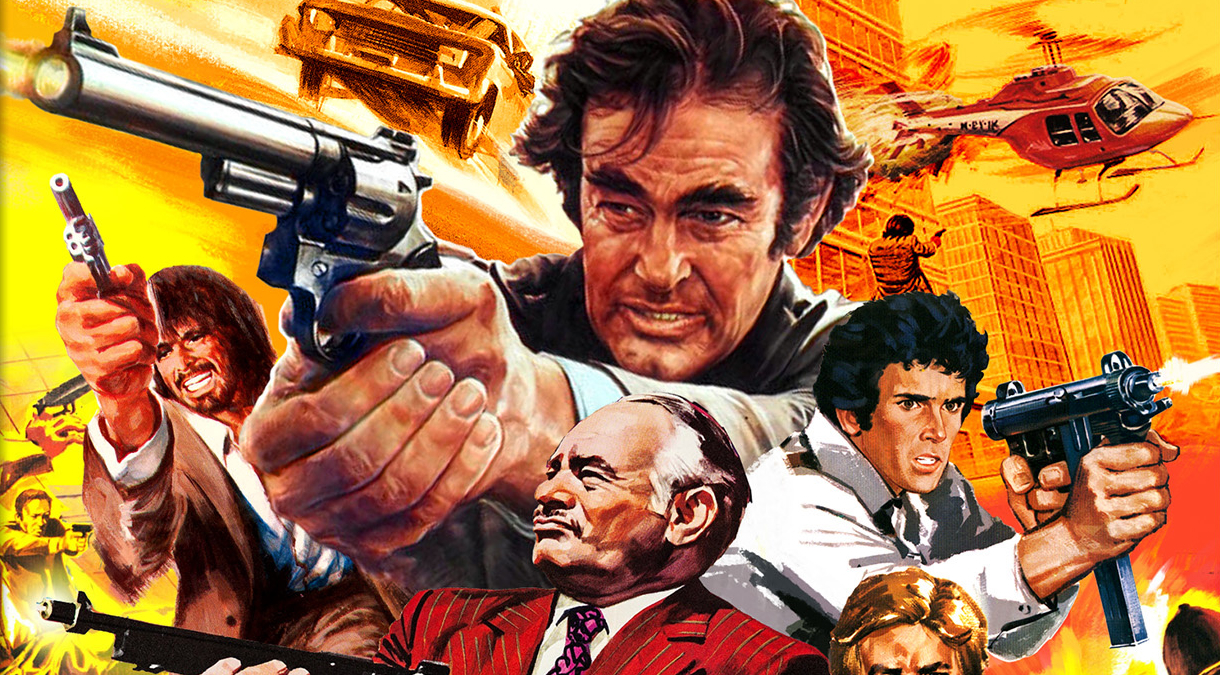
Kino Lorber has collected The Counsellor, Blazing Magnum, and Weapons of Death – all underseen 70s Italian Crime thrillers into the Italo-Crime Collection, a new 4K UHD box set filled with extras.
The Films
The Counsellor
The Counsellor is what I love about Italian genre films (aka Italian knockoff films). They are both in conversation with and arguing with the films they very liberally take from. In the case of The Counsellor, Alberto De Martino is ripping off The Godfather. As Godfather ripoffs go this one is a pretty effective one. Having seen more than a few imitators in my time De Martino’s tale of betrayal within a Crime Family does the right thing… it throws much of what made Coppola’s epic out the window. The Counsellor is more of an action thriller than it is a critique of America and the nuclear family.
Instead of Al Pacino, we get Tomás Milián as Thomas Accardo, a fresh-out-of-prison mafioso who’s trying to stay out of the lifestyle that killed his father. In place of Marlon Brando, we have Martin Balsam as the “godfather” (they never call him that), Don Antonio, who starts a war of jealousy because he lets Accardo go. As we know, no one can ever leave the family. Murder and car chases aplenty, and an entire finale set in Italy.
Milián and Balsam are highly effective as the “father and son” of the film. Seeing them take down a warehouse full of goons will make any cineaste cackle with joy. In fact, all of the action set pieces are great and make effective use of real-life locations in San Francisco, Albuquerque, and Sicily. The standout being the finale that takes place during a Sicilian parade. De Martino understands how to shoot a film beyond the action scenes. His sense of composition for the widescreen frame is effective in the dramatic scenes as well, using it for maximum effect.
The film mixes everything up to produce something that’s lean, mean, and super effective. This one is catnip for anyone who loves the vibes of Italian Crime cinema.
Blazing Magnum
Blazing Magnum is exactly what you think it is. A Dirty Harry knockoff. This one stars Stuart Whitman doing his best Clint Eastwood. Though Whitman starring as a cop who doesn’t play by the rules is where the similarities end. The film is part Poliziotteschi, part Giallo, and all nonsense insanity that feels exactly like the kind of late-night WTF film that makes you question if you are awake or sleeping. This may not be director Alberto De Martino best film, but it’s certainly his wildest.
Canadian police Captain Tony Saitta (Whittman) is in the middle of chasing down bank robbers when his sister Louise (Carole Hunnicutt) dies under the most mysterious circumstances. Nothing is going to stop Saitta from investigating who’s responsible. His only lead is the blind witness Julie (Tasia Farrow), whom the killer is trying to kill. As the suspects pile up (Martin Landau, as the doctor treating his sister, being one of them), so do the bodies, leading to a showdown between cop and killer with Julie’s life in the balance.
The cast is stellar in this one, with Whittman, Landau, Farrow, Carole Laure, and John Saxon all having larger parts than one expects. Whittman is actually great as the gruff Harry Callahan photocopy. In fact, no one really phones it in here. Which is surprising considering how all convolutedly silly it is. No one blinks or winks at the camera, just all the self-seriousness in the world, which adds to how arched it all is.
Again, director Alberto De Martino elevates this lurid piece of knockoff cinema to something stylish and altogether fascinating. The execution of the action scenes and the scenes of tension are, without regard, excellent. The highlight is a car chase taken straight out of Bullitt that has to be the single best car chase in a film that you’ve never seen.
Blazing Magnum is truly a wild piece of procedural mania ending the way that every Dirty Harry knockoff should with its rogue cop blazing away his. 44 Magnum.
Weapons of Death
If you spend enough time in the realm of Italian knockoff cinema of the 1970s and 1980s, you know one definitive truth … Some shit is about to go down if Henry Silva shows up. The shit definitely goes down in director Mario Caiano’s Weapons of Death. The semi-sequel to Umberto Lenzi’s Poliziotteschi classic Violent Naples.
Silva plays Santoro, another drug-dealing criminal mastermind taking the city of Naples for all its worth. The police are unable to arrest Santoro because he’s not only smart but under the protection of Don Alfredo. Commissioner Belli (Leonard Mann) faces corruption on all fronts, unable to trust anyone, and puts together an unconventional team including a taxicab driver to take Santoro down. Belli and Santoro begin a war on the streets of Naples that takes no prisoners.
Director Umberto Lenzi isn’t the only casualty from the original classic. Maurizio Merli, who played Commissioner Betti (see, they changed the “tt” to “ll”) has been replaced by Leonard Mann. Mann is good but is no Merli (at least in Violent Naples). Though both director Mario Caiano and star Mann prove to be effective, albeit “blunt force trauma” solution replacements. Though it’s Henry Silva who’s the upgrade and makes this a worthy successor to the original. Silva relishes every moment he’s on screen, playing up the bad and the cool to 11.
From the great bank robbery that opens the film to the tense and tragic final train station chase, director Caiano makes sure that every single action scene is adroitly executed with a sense of existential brutality that’s fitting of the most sobering of 1970s crime films. From castrations of sex offenders to pedicide, Weapons of Death does not mess around. It never lingers on these events, moving forward to the next crime or action scene. Not all dour and gloom, Weapons of Death does find time to have some fun with its own artful Dodger-like street urchin who, amongst other petty crimes, steals a Ferrari, leading the cops on a chase around Naples.
Weapons of Death makes sure to up the ante in true sequel form and lives up to its predecessor.
The Transfers
Each film has all-new UHD SDR Masters, sourced from 4K Scans of the 35mm Original Camera Negatives. The work here is impressive. All look beautiful and are excellent examples of European Genre Cinema making the transition to 4K. They are all solid representations of the films. There are minor scratches and dirt that occasionally show in all three, but it’s minor as compared to how the films look overall. The films, beyond that, have that wonderfully gritty cinematic look that all Italian genre cinema shot in scope (more than likely the favored Technoscope) had in the 60s and 70s. The fact that these three films do not have HDR is honestly of no consequence; they’re still great transfers. Kino continues to provide great upgraded picture (and sound) on their 4K releases.
The Extras
They include the following;
DISC 1 (THE COUNSELLOR 4KUHD):
DISC 2 (BLAZING MAGNUM | WEAPONS OF DEATH 4KUHD):
DISC 3 (SHADOWS IN AN EMPTY ROOM and BONUS FEATURES BLU-RAY):
The first all-new Audio Commentary for The Counsellor by Film Historians Steve Mitchell and Troy Howarth. The duo opens with Troy discussing the fact that he has a book about De Martino out soon, before other credentials, before diving into this film. Some of the details include the unique nature of the film with locations (shot in San Francisco, Santa Fe, and eventually Italy); a great discussion about hairpieces; the touchstones that earmark De Martino’s film and what separates them from other Italian filmmakers; the cameo of Sacheen Littlefeather (and also what she’s known for); the work and career of star Martin Balsam and his work in Italy; the tradition of English-speaking actors going to Italy to star in Italian productions and how this was not necessarily a shameful experience and Italy was very respectful towards the stars and examples of various big budget productions at the time; the work and career of Tomas Milian; the career and films of director Anthony De Martino – including a discussion of his style here and collaborators; a discussion of the various actors (their careers and histories) that appear in the film; and much more.
The second all-new Audio Commentary for Blazing Magnum by Film Historians Steve Mitchell and Troy Howarth opens with a discussion of the multiple titles (four in total) and the fact that this is the 23rd film of De Martino’s career as a director. Some of the details include the locations in America (specifically in Canada in Montreal); this is unique as this is an all-English-speaking cast in an Italian production; the production schedule of the film; how the tax breaks that were enacted to make it easier for Italians to come to Canada; how Fulci’s White Fang adaptation also helped Italians and was financed by Canadian money and other films that were co-financed by Canadians; the work and career of Stuart Whitman; the work and career of Tisa Farrow – specifically a discussion of how most of her work was done in Italy; the work and career of co-star John Saxon; the work of director Joe D’Amato who here was working as a cinematographer; the work and career of Martin Landau including a personal aside from both Mitchell and Howarth; the ways that De Martino found ways to make the production look bigger than he had; the most iconic and troubling scene of the film the fight scene between Whitman’s character and the transvestites; the reasons why Stuart Whitman ended up making this film; a discussion of the various tones and subgenres the film delves into; a discussion of the various actors (their careers and histories) that appear in the film; and much more.
The third all-new Audio Commentary for Weapons of Death by Film Historians Steve Mitchell, Nathaniel Thompson, and Troy Howarth begins with the trio’s introduction before diving into the opening score by Francesco De Masi. Some of the details include how this particular film is unique among the Poliziotteschi genre; the danger both in stunts and other possible issues that could have arisen during these productions; a discussion of the career and personal history of star Henry Silva; the advertising for the film at the time and how they tried to cash in on the success of Violent Naples (a classic of the genre); the work and career of director Mario Caiano; a great side discussion of the various types of crime films and how they’re based a lot in the region they take place; the work and career of Leonard Mann; a larger discussion of the various action scenes and stunt work throughout; a discussion of the various actors (their careers and histories) that appear in the film; and much more.
Shadows in an Empty Room (99:24) – this is an alternate cut of Blazing Magnum that was made and released by American International Pictures (aka AIP). Interesting for sure, but feels like it was cut to make a more streamlined Dirty Harry ripoff. By cutting out all the “odd angles” and more Italian sensibilities, the film is essentially robbed of what makes it such a great melding of the Giallo and Poliziotteschi subgenres. That isn’t to say it doesn’t present its own sort of unique quirks, but it definitely pales in comparison to the original Italian cut of the film that’s presented in 4K. Note: The transfer presented here is a solid presentation, though it’s nowhere near as luminous as the 4K presentation.
The Counsellor: Video Essay by William Webb (6:17) – in the video essay, Webb discusses the rise of the Mafia movie after the success of The Godfather during the political strife of the years of lead in Italy and where The Counsellor fits in with the subgenre of crime films in Italy. Webb goes on to discuss The Counsellor’s director Albert De Martino, story, stars, visual style, location shoot, and much more.
Blazing Magnum: Alberto De Martino’s Magnum Memories (13:04) – this archival interview with the director opens with why he was labelled “the most American of Italian directors”. De Martino goes on to discuss his early life and his father’s work as a makeup artist in Italian films of the early 1940s; how that led to a small acting role as a child that convinced him to become a director; his early work in sound and editing that eventually led to being an AD and then eventually to feature films; working with Joe D’Amato (who was a cinematographer at the time) on Blazing Magnum; and much more. In Italian with English subtitles.
Blazing Magnum: Kim Newman on Blazing Magnum (22:07) – in his archival interview, Newman, the critic, discusses the rise of the Poliziotteschi and Giallo film movements and their melding in Blazing Magnum. After setting the context of the genres, Newman goes on to discuss the film in detail, highlighting the style, the use of Canada as a location (not substituting for an American city), outrageous storytelling, the cast ( including Stuart Whitman, John Saxon, Martin Landau, Tisa Farrow, and others), the crew, the action, including the iconic car chase scene, and much more.
Weapons of Death: Napoli Spara! Revisited: Archival Interview with Actor Leonard Mann (17:48) – in this archival interview with the actor opens with a discussion of the change in the 70s in Italy because of the change in political climate. Mann goes on to discuss his favorite films he starred in during his time in Italy; filming of Weapons of Deathduring this time – including how it was set up, the stunt work; why he feels that these films have been reassessed and revitalized; and much more.
Weapons of Death: Naples Under Fire: Archival Interview with Director Mario Caiano (15:10) – in this archival interview with Caiano opens with how he got his start in Italy eventually becoming a film director. Caiano goes on to discuss the political upheaval that the film was made in and how it informed the story and style; the different styles that are imposed on Westerns as opposed to Crime films in Italy and why they do so; a discussion of the various iconic scenes of violence (including the decapitation and the castration scenes, among others); and much more. In Italian with English Subtitles.
Weapons of Death: Video Essay by William Webb (5:25) – in this archival video essay, Webb discusses the Poliziotteschi genre and how this was exemplified by Weapons of Death. Webb dissects the subgenre, the story, the action in the film, the direction and acting, the tropes of the genre and how the film either works them in or subverts them, the connections to the current atmosphere in Italy, and much more.
Weapons of Death: English Opening and Closing Credits (3:09)
Rounding out the special features are Theatrical Trailers for The Counsellor (4:13); Blazing Magnum [Newly Restored in 4K] (3:32); Weapons of Death (3:30); Taking of Pelham One Two Three (2:33); Sands of the Kalahari (2:52); Assassination (2:59); Violent City (3:54);
The Final Thought
Fans of Euro-Crime/Polizzeticchi films will need this in your library. Highest Possible Recommendation!!
Kino Lorber’s 4K UHD Edition of Italo-Crime Collection is out now.
Share this:
Like this:
Discover more from The Movie Isle
Subscribe to get the latest posts sent to your email.