“I’m the man”, David Carradine as Bill, Kill Bill Vol. 2.
David Carradine was/is the man. For many of us, he was an entry point into the bigger world of martial arts cinema. My father had knee surgery back in the early 80s that forced him out of work for two months over a summer. That time was indelibly ingrained into my young psyche. Partially because it was the only time I ever really spent with my father one-on-one. It was during this time my father introduced me to Kung-Fu. Every day at 11:00 a.m., we would sit and watch reruns on KTLA. Carradine, as Kwai Chang Caine, would, as Jules so eloquently put it, “walk the earth” in search of meaning and invariably have to use his skills to help those in need. Carradine and Kung-Fu would lead eventually to Bruce Lee to Jackie Chan to the world of martial arts cinema writ large that even now this reviewer is obsessed with.
Circle of Iron, aka The Silent Flute, is the strangest and most fascinating of martial arts films. Not only is it one of the “white dudes doing martial arts” films (the apex of which was during the late 80s into the early 90s with figures like Norris, JCVD, Segal ruling the box office as second-tier stars), but its philosophical tone and themes are such that they make it not an action movie but a film about self-enlightenment. It should shock no one to learn that Bruce Lee originally conceived of this idea to speak to the true meaning of martial arts and his Jeet Kune Do. It was not a weapon but a tool of self-discovery.
The film’s main character, Cord (Jeff Cooper), starts off on a journey that one thinks is the prototypical hero’s journey where trials will test his fighting skills. Yes, Circle of Iron does do that, but what is interesting is how the story, and specifically the characters that David Carradine plays, undercut that typical journey, giving us Lee’s ultimate message of transcending the physical to attain spiritual enlightenment.
It’s fitting that Cooper, as an action lead, doesn’t land the way he should, oftentimes being an off-putting lead. It’s Carradine’s movie and a spiritual cousin to his work in Kung-Fu. Carradine plays a triptych of characters that either test or mentor Cord on his journey to find Zetan, and the book of enlightenment is as fascinating as he ever was in a film. Carradine’s Blind Man’s pontifications on the world that fall on Cord’s deaf ears are what give the film its oomph. Those moments, far more than the fight sequences or Cord’s journey, make Circle of Iron truly an arresting piece of filmmaking.
The Transfer
Circle of Iron is presented in a brand-new restoration, scanned in 4K 16-bit from its original camera negative, with Dolby Vision HDR. This is another stunner from Blue Underground. The boutique label has given this unique martial arts fantasy a meticulous and nearly flawless restoration. There is nary a scratch or blemish through the entire runtime. The color reproduction is stunning, the Dolby Vision HDR adding subtlety and depth to the color spectrum. One just needs to watch the opening moments, which feature a beautiful sunrise as the credits play, to see the reference-quality HDR and restoration produced by the label. The image is sharp, while still retaining the grain structure and overall filmic look created by cinematographer Ronnie Taylor. Blue Underground continues to be the gold standard in restoration and preservation of beloved (and sometimes not so beloved) cult film titles.
The Extras
They include the following;
4K UHD Disc:
Audio Commentary #1 with Director Richard Moore
NEW! Audio Commentary #2 with Film Historian Frank Djeng and Chris Poggiali
Alternate Opening
Trailers
Blu-ray Disc:
Audio Commentary #1 with Director Richard Moore
NEW! Audio Commentary #2 with Film Historian Frank Djeng and Chris Poggiali
Playing The Silent Flute – Interview with Star David Carradine
NEW! Circle Of Success – Interview with Co-Star Anthony De Longis
The Producer – Interview with Co-Producer Paul Maslansky
Karate Master – Interview with Martial Arts Coordinator Joe Lewis
Audio Interview with Co-Writer Stirling Silliphant
Trailers
TV Spots
NEW! Poster & Still Gallery
The first of two Audio Commentaries is an archival track with Director Richard Moore hosted by David Gregory. They open with the two titles and why it changed from The Silent Flute to Circle of Iron. Some of the other details include how he became attached to the project; how Jeff Cooper was cast – mainly because of his relationship and martial arts work with David Carradine; how the film was already cast minus minor roles when he was hired; working with director of photography Ronnie Taylor being a director of photography himself; the contact lenses that Carradine wore as the blind character and how uncomfortable they were; his lack of knowledge of the martial arts genre in film; the contribution of actor and stuntman Tony De Longis; his lack of involvement in the post-production process; Carradine breaking his nose twice and the scenes that he broke it; the collaboration and process of the fight scenes; the second unit photography he directed himself; a larger discussion of the various stars that make appearances in the film and how long they shot on the production for; a detailed discussion of the production including shooting in and around Israel – including the tense political situations that are still ongoing; and much more.
The second Audio Commentary is an all-new track with Film Historian Frank Djeng and Chris Poggiali opens with their credentials before diving into credits and how Bruce Lee was originally supposed to star but didn’t and how it is one of the most unique martial arts films ever produced. Some of the details include how screenwriter Stirling Silliphant was Bruce Lee’s “favorite student”; a discussion of the career and personal life of Silliphant and his ties to Lee; the fight sequences originally choreographed by Kam Yuen (who worked with Carradine on Kung-Fu) and their lacking and the reshoots supervised by fight choreographer Joe Lewis; Djeng’s feelings and talking points about how this is not really a martial arts movie but a philosophical fantasy with martial arts in it; a side discussion of Kung-Fuand how it was a hit in Hong Kong; a history of Bruce Lee’s development of this project and how he wanted Steve McQueen to star and the reasons why he never attached himself, James Coburn’s attachment, their contributions to the story and the writing of the script by Silliphant, and much more; a discussion of the original screenplay and the finished film; a discussion throughout about the various locations the production used in Israel; discussion throughout the commentary track about the various actors and their work here and throughout their career – keep your notes app open you’ll want to write some of the films down; and much more.
Alternate Opening (3:06) – an opening title card in both memory of Bruce Lee (who developed the original story the film is based on) and giving context for Western audiences who at the time may have been unfamiliar with Zen beliefs before the alternate title Circle of Iron is presented and the full credits.
Playing The Silent Flute – Interview with Star David Carradine (13:58) – in the archival interview with the actor begins with how he first heard about the project. Carradine goes on to discuss the development history of the project that eventually led to him starring; his nose being broken twice in four days (once by Kam Yuen, the other by Jeff Cooper); what he loves about the film; some great tidbits about his time working on Kung-fu; filming in Israel and stories from the production; how he made the bamboo flutes and their connections to Kung-fu production; and much more.
Circle Of Success: Remembering a Martial Arts Masterwork (18:06) –the all-new interview with the actor/stunt performer Anthony De Longis opens with how he began his career on stage in Los Angeles, which eventually led to his work as a stunt choreographer and actor. De Longis goes on to discuss how he became involved with martial arts, sword fighting, et. al., and his mentors; how he got the role in the film; working with David Carradine and stories from the production; his favorite fight he contributed to in the film; and much more.
The Producer – Interview with Co-Producer Paul Maslansky (28:47) – the archival interview with the co-producer begins with his early life before getting into film and eventually producing film. Maslansky goes on to discuss how working in Italy on another film led to producing his first horror film, the Christopher Lee film The Castle of Horror; his early work with directors like Michael Reeves, Gary Sherman, and others in Europe; coming back to America in the 1970s and working with Sam Arkoff and directing the horror film Sugar Hill, finding that he did not want to direct but rather keep producing; making Hard Times with Charles Bronson and james Coburn, Race with the Devil, Damnation Alley and much more; eventually leading to Circle of Iron producing with Sandy Howard; the issues of working on location in Israel; and much more.
Karate Master – Interview with Martial Arts Coordinator Joe Lewis (31:04) – the archival interview with the coordinator begins with his early life obsessed with weightlifting, enlisting in the Marine Corps and eventually studying martial arts in Japan, achieving multiple black belts and competitions. Lewis goes on to discuss meeting Bruce Lee and eventually working with Lee; what he learned from Lee during his time being trained with him; how he was hired onto Circle of Iron; the work he did and the various luminaries he hired to do the various fights, including Mike Stone; some great unfiltered stories from the set; and much more.
Audio Interview with Co-Writer Stirling Silliphant (25:26) – in this archival audio interview, writer Stirling Silliphant discusses his training with Bruce Lee in the 1960s. The interview was done by John Corcoran in 1980 for Kick Magazine; it is filled with great anecdotes including one about Frank Sinatra and Bruce Lee at a party, the expense of training with Lee, the inability to believe that Lee thought that he was going to be a superstar, and much more. The featurette also includes text from Silliphant on the film’s development and a host of behind-the-scenes photos of Lee, Silliphant, and others from the era.
US Trailer (1:59) – Uses the alternate title Circle of Iron with voiceover selling Bruce Lee.
International Trailer (3:05) – Trailer uses the original title The Silent Flute.
TV Spots – submenu allows you to access all three and play individually or all together with the Play All option.
TV Spot #1 (0:33)
TV Spot #2 (0:33)
TV Spot #3 (0:34)
Poster & Still Gallery – the gallery consists of 88 images that range from Poster Art, Production Stills (both color and black & white), Home Video Art, and even the novelization, magazine covers, and script covers.
Easter Egg (on the Blu-ray) which you can find by accessing the special features menu and pressing up (you’ll see a sundial icon light up) and get a brief clip of Anthony De Longis talking about training a superstar from the 1990s, including VHS footage from that superstar on set performing.
The Final Thought
Blue Underground gives us another truly great 4K UHD Upgrade filled with extras. Highest Possible Recommendations!!

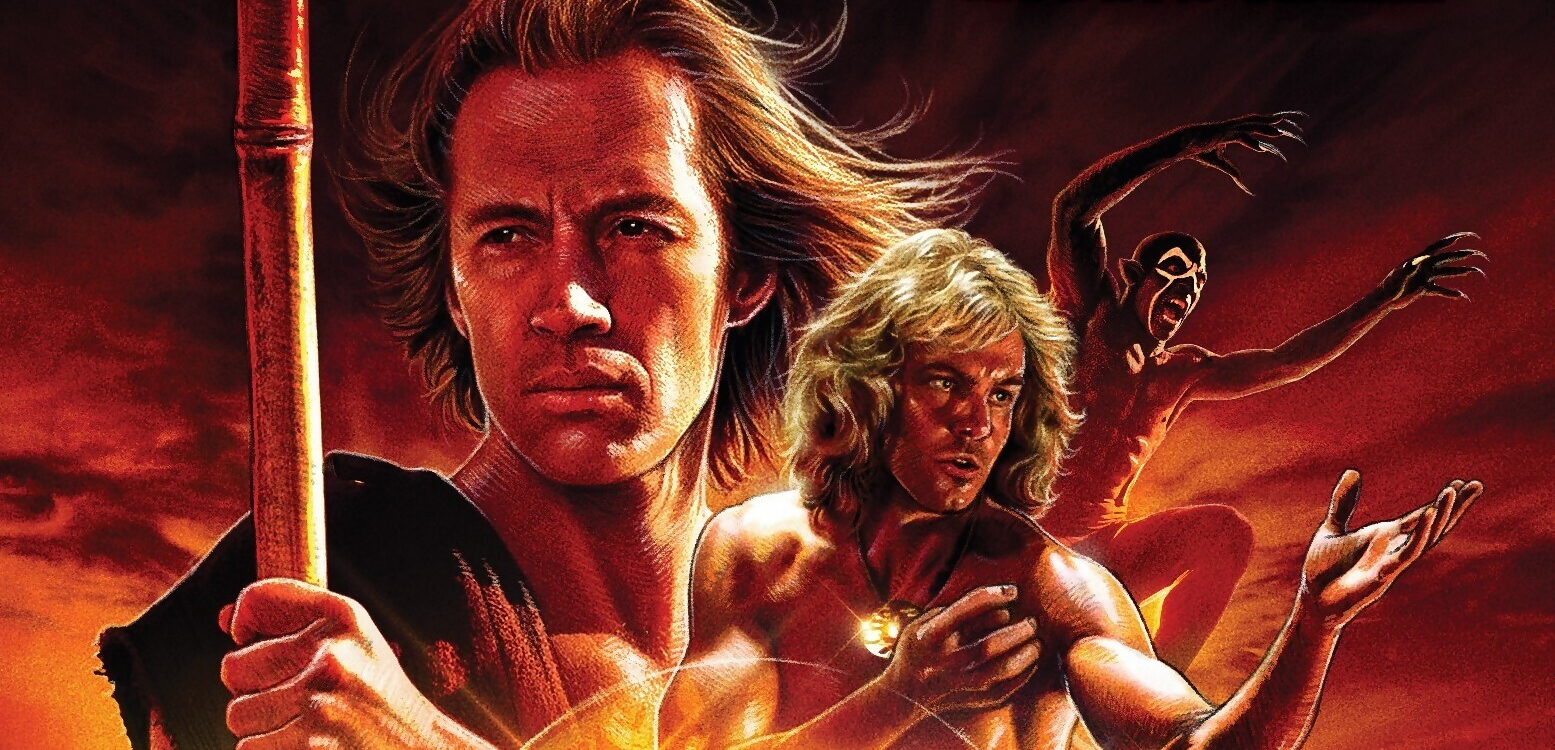
David Carradine stars in Circle of Iron; Blue Underground has beautifully restored the film, releasing it in a limited-edition 4K UHD Steelbook filled with extras.
The Film
“I’m the man”, David Carradine as Bill, Kill Bill Vol. 2.
David Carradine was/is the man. For many of us, he was an entry point into the bigger world of martial arts cinema. My father had knee surgery back in the early 80s that forced him out of work for two months over a summer. That time was indelibly ingrained into my young psyche. Partially because it was the only time I ever really spent with my father one-on-one. It was during this time my father introduced me to Kung-Fu. Every day at 11:00 a.m., we would sit and watch reruns on KTLA. Carradine, as Kwai Chang Caine, would, as Jules so eloquently put it, “walk the earth” in search of meaning and invariably have to use his skills to help those in need. Carradine and Kung-Fu would lead eventually to Bruce Lee to Jackie Chan to the world of martial arts cinema writ large that even now this reviewer is obsessed with.
Circle of Iron, aka The Silent Flute, is the strangest and most fascinating of martial arts films. Not only is it one of the “white dudes doing martial arts” films (the apex of which was during the late 80s into the early 90s with figures like Norris, JCVD, Segal ruling the box office as second-tier stars), but its philosophical tone and themes are such that they make it not an action movie but a film about self-enlightenment. It should shock no one to learn that Bruce Lee originally conceived of this idea to speak to the true meaning of martial arts and his Jeet Kune Do. It was not a weapon but a tool of self-discovery.
The film’s main character, Cord (Jeff Cooper), starts off on a journey that one thinks is the prototypical hero’s journey where trials will test his fighting skills. Yes, Circle of Iron does do that, but what is interesting is how the story, and specifically the characters that David Carradine plays, undercut that typical journey, giving us Lee’s ultimate message of transcending the physical to attain spiritual enlightenment.
It’s fitting that Cooper, as an action lead, doesn’t land the way he should, oftentimes being an off-putting lead. It’s Carradine’s movie and a spiritual cousin to his work in Kung-Fu. Carradine plays a triptych of characters that either test or mentor Cord on his journey to find Zetan, and the book of enlightenment is as fascinating as he ever was in a film. Carradine’s Blind Man’s pontifications on the world that fall on Cord’s deaf ears are what give the film its oomph. Those moments, far more than the fight sequences or Cord’s journey, make Circle of Iron truly an arresting piece of filmmaking.
The Transfer
Circle of Iron is presented in a brand-new restoration, scanned in 4K 16-bit from its original camera negative, with Dolby Vision HDR. This is another stunner from Blue Underground. The boutique label has given this unique martial arts fantasy a meticulous and nearly flawless restoration. There is nary a scratch or blemish through the entire runtime. The color reproduction is stunning, the Dolby Vision HDR adding subtlety and depth to the color spectrum. One just needs to watch the opening moments, which feature a beautiful sunrise as the credits play, to see the reference-quality HDR and restoration produced by the label. The image is sharp, while still retaining the grain structure and overall filmic look created by cinematographer Ronnie Taylor. Blue Underground continues to be the gold standard in restoration and preservation of beloved (and sometimes not so beloved) cult film titles.
The Extras
They include the following;
4K UHD Disc:
Blu-ray Disc:
The first of two Audio Commentaries is an archival track with Director Richard Moore hosted by David Gregory. They open with the two titles and why it changed from The Silent Flute to Circle of Iron. Some of the other details include how he became attached to the project; how Jeff Cooper was cast – mainly because of his relationship and martial arts work with David Carradine; how the film was already cast minus minor roles when he was hired; working with director of photography Ronnie Taylor being a director of photography himself; the contact lenses that Carradine wore as the blind character and how uncomfortable they were; his lack of knowledge of the martial arts genre in film; the contribution of actor and stuntman Tony De Longis; his lack of involvement in the post-production process; Carradine breaking his nose twice and the scenes that he broke it; the collaboration and process of the fight scenes; the second unit photography he directed himself; a larger discussion of the various stars that make appearances in the film and how long they shot on the production for; a detailed discussion of the production including shooting in and around Israel – including the tense political situations that are still ongoing; and much more.
The second Audio Commentary is an all-new track with Film Historian Frank Djeng and Chris Poggiali opens with their credentials before diving into credits and how Bruce Lee was originally supposed to star but didn’t and how it is one of the most unique martial arts films ever produced. Some of the details include how screenwriter Stirling Silliphant was Bruce Lee’s “favorite student”; a discussion of the career and personal life of Silliphant and his ties to Lee; the fight sequences originally choreographed by Kam Yuen (who worked with Carradine on Kung-Fu) and their lacking and the reshoots supervised by fight choreographer Joe Lewis; Djeng’s feelings and talking points about how this is not really a martial arts movie but a philosophical fantasy with martial arts in it; a side discussion of Kung-Fuand how it was a hit in Hong Kong; a history of Bruce Lee’s development of this project and how he wanted Steve McQueen to star and the reasons why he never attached himself, James Coburn’s attachment, their contributions to the story and the writing of the script by Silliphant, and much more; a discussion of the original screenplay and the finished film; a discussion throughout about the various locations the production used in Israel; discussion throughout the commentary track about the various actors and their work here and throughout their career – keep your notes app open you’ll want to write some of the films down; and much more.
Alternate Opening (3:06) – an opening title card in both memory of Bruce Lee (who developed the original story the film is based on) and giving context for Western audiences who at the time may have been unfamiliar with Zen beliefs before the alternate title Circle of Iron is presented and the full credits.
Playing The Silent Flute – Interview with Star David Carradine (13:58) – in the archival interview with the actor begins with how he first heard about the project. Carradine goes on to discuss the development history of the project that eventually led to him starring; his nose being broken twice in four days (once by Kam Yuen, the other by Jeff Cooper); what he loves about the film; some great tidbits about his time working on Kung-fu; filming in Israel and stories from the production; how he made the bamboo flutes and their connections to Kung-fu production; and much more.
Circle Of Success: Remembering a Martial Arts Masterwork (18:06) –the all-new interview with the actor/stunt performer Anthony De Longis opens with how he began his career on stage in Los Angeles, which eventually led to his work as a stunt choreographer and actor. De Longis goes on to discuss how he became involved with martial arts, sword fighting, et. al., and his mentors; how he got the role in the film; working with David Carradine and stories from the production; his favorite fight he contributed to in the film; and much more.
The Producer – Interview with Co-Producer Paul Maslansky (28:47) – the archival interview with the co-producer begins with his early life before getting into film and eventually producing film. Maslansky goes on to discuss how working in Italy on another film led to producing his first horror film, the Christopher Lee film The Castle of Horror; his early work with directors like Michael Reeves, Gary Sherman, and others in Europe; coming back to America in the 1970s and working with Sam Arkoff and directing the horror film Sugar Hill, finding that he did not want to direct but rather keep producing; making Hard Times with Charles Bronson and james Coburn, Race with the Devil, Damnation Alley and much more; eventually leading to Circle of Iron producing with Sandy Howard; the issues of working on location in Israel; and much more.
Karate Master – Interview with Martial Arts Coordinator Joe Lewis (31:04) – the archival interview with the coordinator begins with his early life obsessed with weightlifting, enlisting in the Marine Corps and eventually studying martial arts in Japan, achieving multiple black belts and competitions. Lewis goes on to discuss meeting Bruce Lee and eventually working with Lee; what he learned from Lee during his time being trained with him; how he was hired onto Circle of Iron; the work he did and the various luminaries he hired to do the various fights, including Mike Stone; some great unfiltered stories from the set; and much more.
Audio Interview with Co-Writer Stirling Silliphant (25:26) – in this archival audio interview, writer Stirling Silliphant discusses his training with Bruce Lee in the 1960s. The interview was done by John Corcoran in 1980 for Kick Magazine; it is filled with great anecdotes including one about Frank Sinatra and Bruce Lee at a party, the expense of training with Lee, the inability to believe that Lee thought that he was going to be a superstar, and much more. The featurette also includes text from Silliphant on the film’s development and a host of behind-the-scenes photos of Lee, Silliphant, and others from the era.
US Trailer (1:59) – Uses the alternate title Circle of Iron with voiceover selling Bruce Lee.
International Trailer (3:05) – Trailer uses the original title The Silent Flute.
TV Spots – submenu allows you to access all three and play individually or all together with the Play All option.
Poster & Still Gallery – the gallery consists of 88 images that range from Poster Art, Production Stills (both color and black & white), Home Video Art, and even the novelization, magazine covers, and script covers.
Easter Egg (on the Blu-ray) which you can find by accessing the special features menu and pressing up (you’ll see a sundial icon light up) and get a brief clip of Anthony De Longis talking about training a superstar from the 1990s, including VHS footage from that superstar on set performing.
The Final Thought
Blue Underground gives us another truly great 4K UHD Upgrade filled with extras. Highest Possible Recommendations!!
Blue Underground’s Limited Edition 4K UHD + Blu-ray Steelbook Edition of Circle of Iron is out now.
Share this:
Like this:
Discover more from The Movie Isle
Subscribe to get the latest posts sent to your email.