The exact moment when Cannon Films became CANNON FILMS and the 1980s started to gain its identity. The film that everyone, of a certain age, either remembers with fondness or disdain. No matter what you think of Cannon figureheads Golan and Globus, the sheer willpower and moxie it took to push from jokes to an actual force to be reckoned with is staggering. So much so, it has been covered in documentaries and books. Enter the Ninja is the sort of subject case study in the lunacy that is Cannon Films.
A ninja movie (at least the Hollywood ones) wouldn’t be complete if it weren’t about a … white dude? Yes, not just any white dude but one played by FRANCO NERO. Nero going from Lancelot to Django to Ninja seems like a natural progression. But not just any Ninja, a Vietnam vet who was so good he bested Sho Kosugi during his final Ninja test. Let me repeat that – because Sho Kosugi is the ninja of ninjas – Franco Nero plays a Ninja so good he bested Sho Kosugi during his final Ninja test. I guess they wanted to ensure that audiences thought Nero was the NINJA (all in caps). Nero’s Cole, after completing his training, wants nothing more than a peaceful life. Really dude? You trained as a ninja, and you just want to kick it in the Philippines? At least Kosugi’s Black Ninja would have used the Ninja License (yes, they give Nero a license) to teach other dudes to be Ninja.
Well, Cole goes off to the Philippines, where he finds himself in an ever increasingly difficult situation with his best friend, alcoholic and all-around cuckold about town Frank (Alex Courtney) and Frank’s shotgun-wielding wife Mary-Ann (Susan George). Frank’s the kind of idiot that the Springsteen song “Glory Days” was making fun of. Mary-Ann, his wife, is the one burdened with all the work and has an eye for Cole. Well, there’s some sort of land war with Charles Venarius (Christopher George at his non-animals-attack best), who wants their land because of what else … oil (this was surely research material for Paul Thomas Anderson during his There Will be Blood preproduction).
Cole and Frank get their kick-ass on to which causes Venarius to “find his own ninja,” which he does. Does it surprise anyone that it’s Sho Kosugi’s Hasegawa? Well, it shouldn’t. Cole vows vengeance after Hasegawa kills Frank and kidnaps Mary-Ann, becoming both literally and figuratively the white ninja. It all ends as you think it does, with the face-off and ultimate happy ending for Cole. Not so much for the Filipino people who’ve been duped by both the “good” white people and the “bad” white people.
Every decision made by director/producer Golan in Enter the Dragon is wrong in some way or fashion. That doesn’t necessarily make the film unwatchable. It’s quite the opposite. The film, because of Golan’s lack of any kind of taste or understanding of storytelling, creates a wild film experience one won’t soon forget. Like his equally terrible but compulsively watchable The Apple, there is nothing that even approaches competence.
Anything that is competently done, like action scenes, is more attributed to the stunt team, cinematographer, and editor. Even the action scenes seem determined to be ruined by Golan’s sense of story and what he thinks is entertainment. It’s these WTF moments that unintentionally give the film energy, but not for the better. There’s no tongue-in-cheek flavor to the film, a sense of play; Golan’s direction is such that he means everything. E-V-E-R-Y-T-H-I-N-G is sincerely meant. Even the ending with Nero looking directly at the camera and winking.
Enter the Ninja isn’t a good film. Though it is a highly entertaining one. Watch it with your favorite libation and friends. A movie to both cheer and mock that should be played at the highest possible decibel and on the biggest screen. Enter the Ninja is cinema at its trashiest and stupidest. The very definition of B-Movie buttery popcorn goodness.
Revenge of the Ninja
I cannot overstate Revenge of the Ninja is, as entertaining as the original Enter the Ninja, but for entirely different reasons. By Golan handing off directing responsibilities to the much more capable Sam Firstenberg, Revenge of the Ninja becomes the film original should have been. Trading the eye-winking Franco Nero for the first film’s villain, Sho Kosugi, the film elevates itself to the top tier of ninja films of the 1980s. Kosugi literally wrote the book on Ninjas even before he was cast as the baddie of the original. Here, having him as the hero makes perfect sense and works like gangbusters.
The plot is as thin as it gets, though somehow it retains that patented Cannon wildness. Drug-dealing White Ninja (Keith Vitali) is trying to get paid by the Italian mob, and when he doesn’t begin his white ninja war on the mob, all the while using his Real Ninja friend (Kosugi) as a front. When the mob takes the real ninja’s son, it begins an all-out war that no one can handle. It all ends on a rooftop with Real Ninja and White Ninja battling with all manner of tricks, including lasers!
Any film that makes a 6-year-old one of its primary action leads, having him do his own stunts, is on another level. A level you’ll only ever see in the 1980s. Though when the 6-year-old is Kosugi’s own son, Kane Kosugi, who was already an accomplished black belt, it does make sense in the cocaine fueled excess of the 1980s.
It isn’t just kids doing stunts, mind you. Revenge of the Ninja has that truly dangerous energy that was fueled by Columbian White and the excess of Golan and Globus. Set pieces feel like they’re ripped from an outtake gone wrong from a Jackie Chan film of the era. Watch the mid-film chase scene inspired by the Raiders of the Lost Ark car chase. Though here, Kosugi, quite literally, jumps onto a speeding VW Bus and proceeds to hang on to the side and top without any rigging. One can watch this multiple times to check for rigging, and harnesses won’t find it.
Though this isn’t the wildest of the action scenes in the film. Luckily, Firstenberg and company save the most delirious Jedi/Harry Potter/Ninja shenanigans for the final boss fight. No piece of trickery or fuckery was spared in this battle to end all battles. One cannot properly describe the number of dummies, darts, lasers, and mind tricks these two warriors use. This is the power and beauty of Revenge of the Ninja. One cannot just explain it. One must experience it.
Until one has experienced Revenge of the Ninja, one cannot be a fan of Ninja movies.
Ninja III: The Domination
Much like Revenge of the Ninja and Enter the Ninja are entertaining films, but for entirely different reasons, Ninja III: The Domination is as well. Part Ninja Film. Part Possession film. Part Exorcism film. Part Flashdance. A fevered dream fueled by what feels like cocaine and bad ideas is a masterwork of what a Cannon Film was.
When part-time Jazzercise instructor and full-time telephone pole repair woman Christie (Lucinda Dickey) crosses paths with a dying Ninja, she is his only hope. The Ninja transfers his spirit into her body before dying, or more accurately, being gunned down by half the Phoenix Police Department. Now possessed by the Ninja’s vengeance spirit, Christie fights an internal struggle to be herself and avenge the Ninja’s death. Though, as the prior films have told us, only a Ninja can kill a Ninja. Christie’s only hope comes in the form of Goro (Sho Kosugi), a Ninja for good.
Director Sam Firstenberg somehow manages to make all of these pieces work as a cohesive whole. Much of the reason for this is Ninja III: The Domination is breathlessly paced at 92 minutes. There is no time to question anything that happens in the film because, before one realizes it, the next bizarre event has transpired.
An audience doesn’t have time to question the creepiest stalker Cop of all time in Billy Secord (Jordan Bennett) because, before one realizes he’s a stalker, Christie has invited him over to her apartment for V8 juice. Even when one questions why she takes a shower and begins to make sexual advances towards Secord, she’s pouring said V8 juice all over her body. It all doesn’t make sense, but it’s strung together by Firstenberg and editor Michael J. Duthie so quickly between truly deranged crackerjack action sequences that there isn’t much an audience can do but hang on for dear life.
One that requires no prior knowledge of the original two. In fact, the film has nothing story-wise in common with the original two, other than Ninjas and Sho Kosugi, who doesn’t even play the same role in all three.
Ninja III: The Domination is the best kind of 80s action sequel. The kind that sets out to top its predecessors which it fails to do so. Revenge of the Ninja is the best of the series by a long shot. Though it makes up for its failure in sheer lunacy and audacity. One thing is for certain: there is no film like Ninja III: The Domination. Not by a long shot.
The Transfers
Enter the Ninja
The all-new HDR/Dolby Vision Master – From a 4K Scan of the 35mm Original Camera Negative is another exemplary transfer for a Cannon Film. Enter the Ninja has truly been given an upgrade in 4K UHD, even when compared to the recent Blu-ray release from Kino Lorber. The transfer is consistently sharp and attractive. There isn’t a blemish, scratch, or fleck of dirt on the flawless transfer. The grain structure, the clarity, and the color are all perfectly balanced, resulting in another excellent reference-quality disc for Kino Lorber and their 4K UHD releases.
Revenge of the Ninja
The all-new HDR/Dolby Vision Master – From a 4K Scan of the 35mm Original Camera Negative, like Enter the Ninja, is an excellent transfer. The 4K UHD disc is a remarkable upgrade even when compared to the recent Blu-ray release from Kino. The use of Dolby Vision encoding is an example of how subtle UHD is and how close it gets us to the theatrical experience it can. There isn’t a blemish, scratch, or fleck of dirt on the transfer. The grain structure, the clarity, and color are all perfectly balanced, resulting in another near-reference quality disc for Kino Lorber.
Ninja III: The Domination
The all-new HDR/Dolby Vision Master – From a 4K Scan of the 35mm Original Camera Negative is another winner from Kino Lorber. Ninja III: The Domination was released by Shout Factory back in 2018 on Blu-ray. This appears to be a new master from that same 4K Scan of the OCN. That said, this new master is an upgrade in every sense of the word. The color, image sharpness, and black levels benefit from the 4K UHD treatment. The image is immaculate without a scratch or blemish throughout the runtime. The HDR/Dolby Vision encoding adds a layer of detail that Blu-ray just can’t produce. This is another big win for Kino Lorber.
The Extras
IMPORTANT NOTE: Kino Lorber has done a new pressing for the Blu-ray included in these sets, which includes the new Masters that were done for the 4K UHD releases. These are not the previous editions that they released in 2023.
They include the following;
DISC 1 (ENTER THE NINJA – 4KUHD):
Audio Commentary by Action Film Historians Mike Leeder and Arne Venema
DISC 2 (ENTER THE NINJA – BLU-RAY):
Audio Commentary by Action Film Historians Mike Leeder and Arne Venema
Theatrical Trailer
DISC 3 (REVENGE OF THE NINJA – 4KUHD):
Audio Commentary by Director Sam Firstenberg and Stunt Coordinator Steven Lambert
Audio Commentary by Action Film Historians Mike Leeder and Arne Venema
DISC 4 (REVENGE OF THE NINJA – BLU-RAY):
Audio Commentary by Director Sam Firstenberg and Stunt Coordinator Steven Lambert
Audio Commentary by Action Film Historians Mike Leeder and Arne Venema
Intro by Sam Firstenberg
Behind-the-Scenes Photo Gallery
Theatrical Trailer
DISC 5 (NINJA III: THE DOMINATION – 4KUHD):
Audio Commentary by Director Sam Firstenberg and Stunt Coordinator Steve Lambert, Moderated by Robert Galluzo
Isolated Score Selections and Audio Interviews with Composer Misha Segal and Production Designer Elliot Ellentuck
DISC 6 (NINJA III: THE DOMINATION – BLU-RAY):
Audio Commentary by Director Sam Firstenberg and Stunt Coordinator Steve Lambert, Moderated by Robert Galluzo
Isolated Score Selections and Audio Interviews with Composer Misha Segal and Production Designer Elliot Ellentuck
Dancing With Death: Interview with Actress Lucinda Dickey
Secord’s Struggle: Interview with Actor Jordan Bennett
Birth of the Ninja: Interview with Producer and Stuntman Alan Amiel
Theatrical Trailer
Enter the Ninja
The all-new Audio Commentary by Action Film Historians Mike Leeder and Arne Venema opens with their excited introduction to the film’s opening credit sequence and their first experience with Ninja’s on screen. Some of the details include the origins of the project from screenwriter and original star Mike Stone – who was replaced with Franco Nero; the original production – how Golan fired the original director and hired himself; how they were able to cast Franco Nero; the multi-colored Ninja how it was originated here; a great/hilarious story of Leeder’s personal experience with trying to be a ninja as a teenager; the rise of the “Ninja Masters” in the 1980s; a discussion of star Franco Nero’s personal history, career, and work here; the various ninja movies – including some wild sounding entries; the work here and her career of Susan George – including a discussion of Straw Dogs; a hilarious discussion of Nero’s use of nunchucks; a discussion of the Lemon Popsicles series – which were directed by Golan – how they set up Golan and Globus to move to US and purchase Cannon; the dubbing of all the actors – specifically Nero’s being upset they did not use his usual dubbing actor; a conversation about Sam Firstenberg vs Menahem Golan as action directors; the reason why Golan directed Enter the Ninja; the work and personal history of Christopher George; the stunt doubling of Franco Nero; the work of editor Mark Goldblatt – and a discussion of his editing and directing career beyond Enter the Ninja; a side discussion of Takeshi Miike favorite film; a lengthy discussion of the work and the career of Sho Kosugi – including a great personal anecdotes about Kosugi; a lengthy discussion of the work and the career of Mike Stone – including a wild story about Stone and why he moved from America and the Philippines that involved Elvis; why so many Ninja movies came out and were developed during this era beyond the success of the this film; and much more. It cannot be stated enough that Leeder and Venema are the best at what they do and their track for Enter the Ninja is no exception. The wealth of information, humor, and anecdotes – both personal and from the production – is as enlightening and entertaining as any in the movie itself. Required listening.
Rounding out the special features are trailers for Enter the Ninja (2:54); Revenge of the Ninja (1:40); Ninja III: The Domination (1:36); Pray for Death(2:16); Rage of Honor (1:37); Blind Fury(1:25); The Octagon (2:29); Sudden Death (2:16); Fright (1:23); The Mercenary (1:54)
Revenge of the Ninja
Intro by Sam Firstenberg (3:16) – discusses how he knew nothing about directing action but given the chance by Golan and Globus – and many who helped him learn the ropes to bring this cult classic to the big screen. Firstenberg refreshingly applaudes all the above-the-line and below-the-line crew who were so vital to making this film.
The first of two Audio Commentaries is by Director Sam Firstenberg and Stunt Coordinator Steven Lambert moderated by Code Red’s Bill Olsen begins with their different responsibilities on the film and the opening moments and how they were filmed in Los Angeles for Japan. Some of the other details include just how many ninjas that Lambert played – including doubling for star Sho Kosugi; how Kosugi’s students were enlisted many playing background ninjas; the fact that Kosugi’s voice was dubbed; the jokes that Kosugi and Lambert would play on Firstenberg; working with child actor Kane Kosugi; filming in both Los Angeles, New York City, and Salt Lake City; the troubles with the MPAA to secure an R-rating; a larger discussion about Golan and Globus – how the approached producing films; a larger discussion of what was added back into the Blu-ray release that was cut to secure R-Rating; a larger discussion of the various actors that appear in the film; a larger discussion of the various stunts and action set pieces and how they were accomplished – including some great anecdotes from the production; and much more. The track is a lively informative affair. Anyone that loved the film will enjoy this commentary track that’s much more informational than your average commentary track.
The second Audio Commentary is an all-new track provided by Action Film Historians Mike Leeder and Arne Venema. The duo wastes no time in enthusiastically discussing the opening moments of the film before diving into a massively entertaining and informative commentary track. Some of the other details include some great ties to the recent Mortal Kombat film and the opening scene; how the martial arts and stunts differ than the Hong Kong style that was popular at the time; a discussion of lead actor Sho Kosugi – including some great factoids and the legend he and Cannon built about him; a larger discussion of both the original production’s wildness and how they pivoted in the sequel with some adroit and daring choices; the work of Sam Firstenberg throughout – including discussion of Firstenberg’s run on the American Ninja series; the work of Kane Kosugi – including a discussion of his action scenes and a discussion of his father’s training him; a great discussion of the differences between Ninja and Samurai; a great side discussion of Cyclone – because Ashley Ferrare appears in it; interesting reason why Kosugi assisted with Choreography; a discussion of the early life of Kosugi; a larger discussion of the various action set pieces; a larger discussion about the various actors that appear; a larger discussion – hilariously – pointing out ‘Western’ Ninjas; and much more. The dynamic duo have done it again. Any action junkie knows that Leeder and Venema deliver on any of their commentary track with a combination of researched information about the production, the genre, and personal asides from their experiences in field – all leading to a track that rivals entertainment value of the film itself.
Behind-the-Scenes Photo Gallery (3:03) – the gallery consists of 35 photos that play automatically over the score from the film.
The archival Audio Commentary by Director Sam Firstenberg and Stunt Coordinator Steve Lambert, moderated by Robert Galluzo, begins with introductions before diving into how this was not their first collaboration, but Revenge of the Ninja was. Some of the other details include how Poltergeist was a heavy influence on the film and why; the script development process; a larger discussion of the various action set pieces and how they were accomplished, along with some great anecdotes from the production about these scenes; and much more.
The second track is a commentary of sorts. There is an Isolated Score with selections and Audio Interviews with Composer Misha Segal and Production Designer Elliot Ellentuck. The interviews are conducted by Blu-ray producer Michael Flesher. Each of the participants discusses how they got into their respective careers, their work both here and in other projects, and more. The score and interviews are edited together so you’ll hear a track or two and then hear sections of the interviews.
Dancing With Death with Lucinda Dickey (18:25) – this archival interview, ported over from the previous Shout Factory release, opens with Dickey discussing her first job in Grease 2. Dickey goes on to discuss her audition and how she got the part, working with director Sam Firstenberg, the rushed nature of the production, the fact that she did not read a script the first week of production because they didn’t have one, the training they did for the action scenes, working with actor Jordan Bennett, a discussion of how involved she was in the action scene, a discussion of the iconic V8 scene, how the possession scene was accomplished, and much more.
Secord’s Struggle with Jordan Bennett (10:26) – this archival interview, ported over from the previous Shout Factory release, with actor Jordan Bennett begins with discussing how he began his career in the Catskills and eventually came to Los Angeles after a successful run on Broadway. Bennett goes on to discuss how he was cast in the film, working with director Sam Firstenberg, the ridealongs he did with cops in Phoenix before the shoot, anecdotes from the production, the iconic V8 juice scene, and much more.
Birth of the Ninja with Producer and Stuntman Alan Amiel (11:48) – this archival interview, ported over from the previous Shout Factory release, with Producer and Stuntman Alan Amiel begins with how he could pursue his dream of being an actor because of his economic circumstances. Amiel goes on to discuss how he got into stunts and action through martial arts, how he wrote the script with Mike Stone of the first film, how Golan and Globus bought the script, working and collaborating with Sho Kosugi making both the sequel and the third film, and much more.

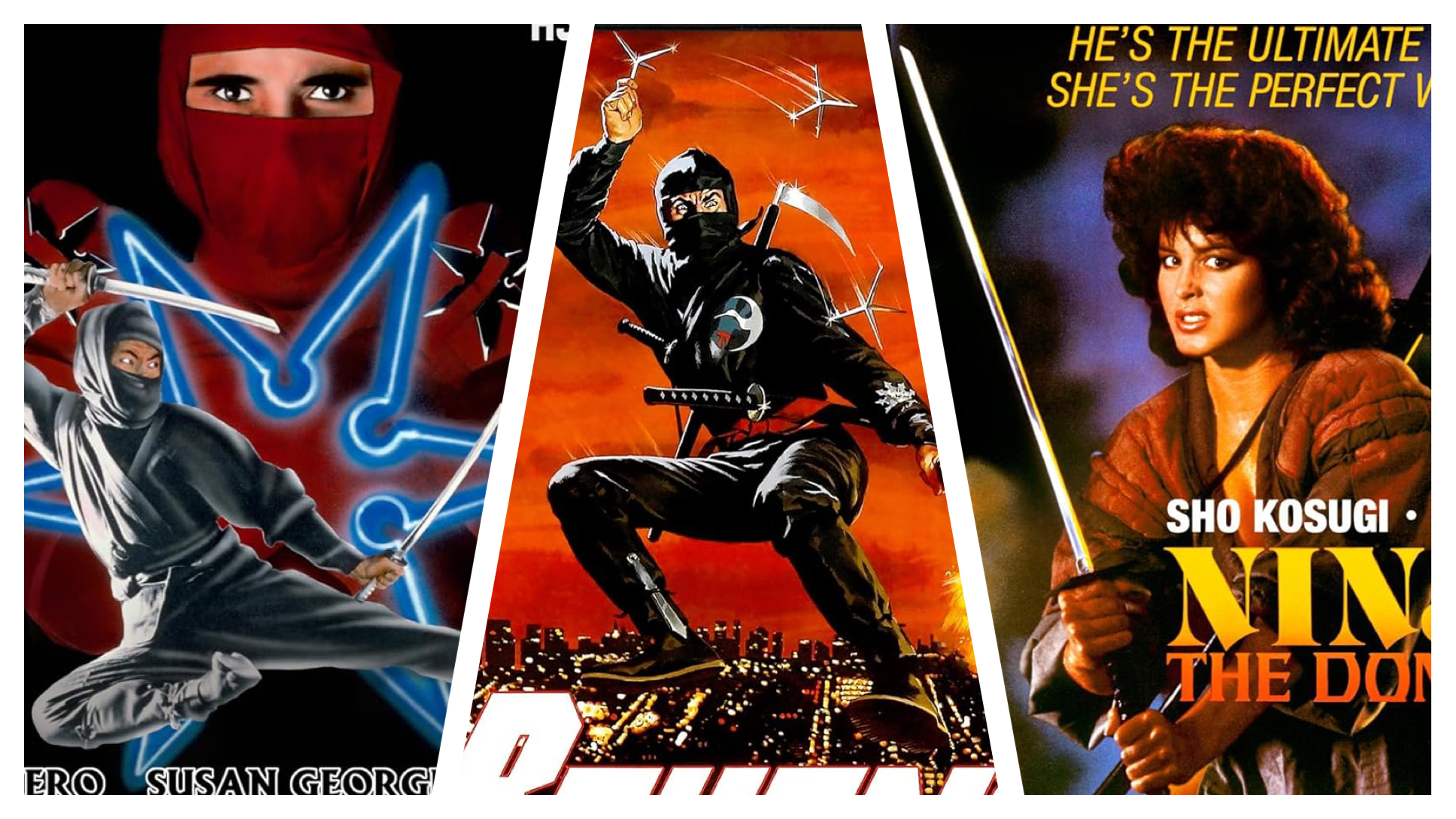
The Ninja Trilogy – the action series that brought the shadow assassins to the 1980s has been given 4K UHD upgrades thanks to Kino Lorber!
The Film
Enter the Ninja
The exact moment when Cannon Films became CANNON FILMS and the 1980s started to gain its identity. The film that everyone, of a certain age, either remembers with fondness or disdain. No matter what you think of Cannon figureheads Golan and Globus, the sheer willpower and moxie it took to push from jokes to an actual force to be reckoned with is staggering. So much so, it has been covered in documentaries and books. Enter the Ninja is the sort of subject case study in the lunacy that is Cannon Films.
A ninja movie (at least the Hollywood ones) wouldn’t be complete if it weren’t about a … white dude? Yes, not just any white dude but one played by FRANCO NERO. Nero going from Lancelot to Django to Ninja seems like a natural progression. But not just any Ninja, a Vietnam vet who was so good he bested Sho Kosugi during his final Ninja test. Let me repeat that – because Sho Kosugi is the ninja of ninjas – Franco Nero plays a Ninja so good he bested Sho Kosugi during his final Ninja test. I guess they wanted to ensure that audiences thought Nero was the NINJA (all in caps). Nero’s Cole, after completing his training, wants nothing more than a peaceful life. Really dude? You trained as a ninja, and you just want to kick it in the Philippines? At least Kosugi’s Black Ninja would have used the Ninja License (yes, they give Nero a license) to teach other dudes to be Ninja.
Well, Cole goes off to the Philippines, where he finds himself in an ever increasingly difficult situation with his best friend, alcoholic and all-around cuckold about town Frank (Alex Courtney) and Frank’s shotgun-wielding wife Mary-Ann (Susan George). Frank’s the kind of idiot that the Springsteen song “Glory Days” was making fun of. Mary-Ann, his wife, is the one burdened with all the work and has an eye for Cole. Well, there’s some sort of land war with Charles Venarius (Christopher George at his non-animals-attack best), who wants their land because of what else … oil (this was surely research material for Paul Thomas Anderson during his There Will be Blood preproduction).
Cole and Frank get their kick-ass on to which causes Venarius to “find his own ninja,” which he does. Does it surprise anyone that it’s Sho Kosugi’s Hasegawa? Well, it shouldn’t. Cole vows vengeance after Hasegawa kills Frank and kidnaps Mary-Ann, becoming both literally and figuratively the white ninja. It all ends as you think it does, with the face-off and ultimate happy ending for Cole. Not so much for the Filipino people who’ve been duped by both the “good” white people and the “bad” white people.
Every decision made by director/producer Golan in Enter the Dragon is wrong in some way or fashion. That doesn’t necessarily make the film unwatchable. It’s quite the opposite. The film, because of Golan’s lack of any kind of taste or understanding of storytelling, creates a wild film experience one won’t soon forget. Like his equally terrible but compulsively watchable The Apple, there is nothing that even approaches competence.
Anything that is competently done, like action scenes, is more attributed to the stunt team, cinematographer, and editor. Even the action scenes seem determined to be ruined by Golan’s sense of story and what he thinks is entertainment. It’s these WTF moments that unintentionally give the film energy, but not for the better. There’s no tongue-in-cheek flavor to the film, a sense of play; Golan’s direction is such that he means everything. E-V-E-R-Y-T-H-I-N-G is sincerely meant. Even the ending with Nero looking directly at the camera and winking.
Enter the Ninja isn’t a good film. Though it is a highly entertaining one. Watch it with your favorite libation and friends. A movie to both cheer and mock that should be played at the highest possible decibel and on the biggest screen. Enter the Ninja is cinema at its trashiest and stupidest. The very definition of B-Movie buttery popcorn goodness.
Revenge of the Ninja
I cannot overstate Revenge of the Ninja is, as entertaining as the original Enter the Ninja, but for entirely different reasons. By Golan handing off directing responsibilities to the much more capable Sam Firstenberg, Revenge of the Ninja becomes the film original should have been. Trading the eye-winking Franco Nero for the first film’s villain, Sho Kosugi, the film elevates itself to the top tier of ninja films of the 1980s. Kosugi literally wrote the book on Ninjas even before he was cast as the baddie of the original. Here, having him as the hero makes perfect sense and works like gangbusters.
The plot is as thin as it gets, though somehow it retains that patented Cannon wildness. Drug-dealing White Ninja (Keith Vitali) is trying to get paid by the Italian mob, and when he doesn’t begin his white ninja war on the mob, all the while using his Real Ninja friend (Kosugi) as a front. When the mob takes the real ninja’s son, it begins an all-out war that no one can handle. It all ends on a rooftop with Real Ninja and White Ninja battling with all manner of tricks, including lasers!
Any film that makes a 6-year-old one of its primary action leads, having him do his own stunts, is on another level. A level you’ll only ever see in the 1980s. Though when the 6-year-old is Kosugi’s own son, Kane Kosugi, who was already an accomplished black belt, it does make sense in the cocaine fueled excess of the 1980s.
It isn’t just kids doing stunts, mind you. Revenge of the Ninja has that truly dangerous energy that was fueled by Columbian White and the excess of Golan and Globus. Set pieces feel like they’re ripped from an outtake gone wrong from a Jackie Chan film of the era. Watch the mid-film chase scene inspired by the Raiders of the Lost Ark car chase. Though here, Kosugi, quite literally, jumps onto a speeding VW Bus and proceeds to hang on to the side and top without any rigging. One can watch this multiple times to check for rigging, and harnesses won’t find it.
Though this isn’t the wildest of the action scenes in the film. Luckily, Firstenberg and company save the most delirious Jedi/Harry Potter/Ninja shenanigans for the final boss fight. No piece of trickery or fuckery was spared in this battle to end all battles. One cannot properly describe the number of dummies, darts, lasers, and mind tricks these two warriors use. This is the power and beauty of Revenge of the Ninja. One cannot just explain it. One must experience it.
Until one has experienced Revenge of the Ninja, one cannot be a fan of Ninja movies.
Ninja III: The Domination
Much like Revenge of the Ninja and Enter the Ninja are entertaining films, but for entirely different reasons, Ninja III: The Domination is as well. Part Ninja Film. Part Possession film. Part Exorcism film. Part Flashdance. A fevered dream fueled by what feels like cocaine and bad ideas is a masterwork of what a Cannon Film was.
When part-time Jazzercise instructor and full-time telephone pole repair woman Christie (Lucinda Dickey) crosses paths with a dying Ninja, she is his only hope. The Ninja transfers his spirit into her body before dying, or more accurately, being gunned down by half the Phoenix Police Department. Now possessed by the Ninja’s vengeance spirit, Christie fights an internal struggle to be herself and avenge the Ninja’s death. Though, as the prior films have told us, only a Ninja can kill a Ninja. Christie’s only hope comes in the form of Goro (Sho Kosugi), a Ninja for good.
Director Sam Firstenberg somehow manages to make all of these pieces work as a cohesive whole. Much of the reason for this is Ninja III: The Domination is breathlessly paced at 92 minutes. There is no time to question anything that happens in the film because, before one realizes it, the next bizarre event has transpired.
An audience doesn’t have time to question the creepiest stalker Cop of all time in Billy Secord (Jordan Bennett) because, before one realizes he’s a stalker, Christie has invited him over to her apartment for V8 juice. Even when one questions why she takes a shower and begins to make sexual advances towards Secord, she’s pouring said V8 juice all over her body. It all doesn’t make sense, but it’s strung together by Firstenberg and editor Michael J. Duthie so quickly between truly deranged crackerjack action sequences that there isn’t much an audience can do but hang on for dear life.
One that requires no prior knowledge of the original two. In fact, the film has nothing story-wise in common with the original two, other than Ninjas and Sho Kosugi, who doesn’t even play the same role in all three.
Ninja III: The Domination is the best kind of 80s action sequel. The kind that sets out to top its predecessors which it fails to do so. Revenge of the Ninja is the best of the series by a long shot. Though it makes up for its failure in sheer lunacy and audacity. One thing is for certain: there is no film like Ninja III: The Domination. Not by a long shot.
The Transfers
Enter the Ninja
The all-new HDR/Dolby Vision Master – From a 4K Scan of the 35mm Original Camera Negative is another exemplary transfer for a Cannon Film. Enter the Ninja has truly been given an upgrade in 4K UHD, even when compared to the recent Blu-ray release from Kino Lorber. The transfer is consistently sharp and attractive. There isn’t a blemish, scratch, or fleck of dirt on the flawless transfer. The grain structure, the clarity, and the color are all perfectly balanced, resulting in another excellent reference-quality disc for Kino Lorber and their 4K UHD releases.
Revenge of the Ninja
The all-new HDR/Dolby Vision Master – From a 4K Scan of the 35mm Original Camera Negative, like Enter the Ninja, is an excellent transfer. The 4K UHD disc is a remarkable upgrade even when compared to the recent Blu-ray release from Kino. The use of Dolby Vision encoding is an example of how subtle UHD is and how close it gets us to the theatrical experience it can. There isn’t a blemish, scratch, or fleck of dirt on the transfer. The grain structure, the clarity, and color are all perfectly balanced, resulting in another near-reference quality disc for Kino Lorber.
Ninja III: The Domination
The all-new HDR/Dolby Vision Master – From a 4K Scan of the 35mm Original Camera Negative is another winner from Kino Lorber. Ninja III: The Domination was released by Shout Factory back in 2018 on Blu-ray. This appears to be a new master from that same 4K Scan of the OCN. That said, this new master is an upgrade in every sense of the word. The color, image sharpness, and black levels benefit from the 4K UHD treatment. The image is immaculate without a scratch or blemish throughout the runtime. The HDR/Dolby Vision encoding adds a layer of detail that Blu-ray just can’t produce. This is another big win for Kino Lorber.
The Extras
IMPORTANT NOTE: Kino Lorber has done a new pressing for the Blu-ray included in these sets, which includes the new Masters that were done for the 4K UHD releases. These are not the previous editions that they released in 2023.
They include the following;
DISC 1 (ENTER THE NINJA – 4KUHD):
DISC 2 (ENTER THE NINJA – BLU-RAY):
DISC 3 (REVENGE OF THE NINJA – 4KUHD):
DISC 4 (REVENGE OF THE NINJA – BLU-RAY):
DISC 5 (NINJA III: THE DOMINATION – 4KUHD):
DISC 6 (NINJA III: THE DOMINATION – BLU-RAY):
Enter the Ninja
The all-new Audio Commentary by Action Film Historians Mike Leeder and Arne Venema opens with their excited introduction to the film’s opening credit sequence and their first experience with Ninja’s on screen. Some of the details include the origins of the project from screenwriter and original star Mike Stone – who was replaced with Franco Nero; the original production – how Golan fired the original director and hired himself; how they were able to cast Franco Nero; the multi-colored Ninja how it was originated here; a great/hilarious story of Leeder’s personal experience with trying to be a ninja as a teenager; the rise of the “Ninja Masters” in the 1980s; a discussion of star Franco Nero’s personal history, career, and work here; the various ninja movies – including some wild sounding entries; the work here and her career of Susan George – including a discussion of Straw Dogs; a hilarious discussion of Nero’s use of nunchucks; a discussion of the Lemon Popsicles series – which were directed by Golan – how they set up Golan and Globus to move to US and purchase Cannon; the dubbing of all the actors – specifically Nero’s being upset they did not use his usual dubbing actor; a conversation about Sam Firstenberg vs Menahem Golan as action directors; the reason why Golan directed Enter the Ninja; the work and personal history of Christopher George; the stunt doubling of Franco Nero; the work of editor Mark Goldblatt – and a discussion of his editing and directing career beyond Enter the Ninja; a side discussion of Takeshi Miike favorite film; a lengthy discussion of the work and the career of Sho Kosugi – including a great personal anecdotes about Kosugi; a lengthy discussion of the work and the career of Mike Stone – including a wild story about Stone and why he moved from America and the Philippines that involved Elvis; why so many Ninja movies came out and were developed during this era beyond the success of the this film; and much more. It cannot be stated enough that Leeder and Venema are the best at what they do and their track for Enter the Ninja is no exception. The wealth of information, humor, and anecdotes – both personal and from the production – is as enlightening and entertaining as any in the movie itself. Required listening.
Rounding out the special features are trailers for Enter the Ninja (2:54); Revenge of the Ninja (1:40); Ninja III: The Domination (1:36); Pray for Death (2:16); Rage of Honor (1:37); Blind Fury (1:25); The Octagon (2:29); Sudden Death (2:16); Fright (1:23); The Mercenary (1:54)
Revenge of the Ninja
Intro by Sam Firstenberg (3:16) – discusses how he knew nothing about directing action but given the chance by Golan and Globus – and many who helped him learn the ropes to bring this cult classic to the big screen. Firstenberg refreshingly applaudes all the above-the-line and below-the-line crew who were so vital to making this film.
The first of two Audio Commentaries is by Director Sam Firstenberg and Stunt Coordinator Steven Lambert moderated by Code Red’s Bill Olsen begins with their different responsibilities on the film and the opening moments and how they were filmed in Los Angeles for Japan. Some of the other details include just how many ninjas that Lambert played – including doubling for star Sho Kosugi; how Kosugi’s students were enlisted many playing background ninjas; the fact that Kosugi’s voice was dubbed; the jokes that Kosugi and Lambert would play on Firstenberg; working with child actor Kane Kosugi; filming in both Los Angeles, New York City, and Salt Lake City; the troubles with the MPAA to secure an R-rating; a larger discussion about Golan and Globus – how the approached producing films; a larger discussion of what was added back into the Blu-ray release that was cut to secure R-Rating; a larger discussion of the various actors that appear in the film; a larger discussion of the various stunts and action set pieces and how they were accomplished – including some great anecdotes from the production; and much more. The track is a lively informative affair. Anyone that loved the film will enjoy this commentary track that’s much more informational than your average commentary track.
The second Audio Commentary is an all-new track provided by Action Film Historians Mike Leeder and Arne Venema. The duo wastes no time in enthusiastically discussing the opening moments of the film before diving into a massively entertaining and informative commentary track. Some of the other details include some great ties to the recent Mortal Kombat film and the opening scene; how the martial arts and stunts differ than the Hong Kong style that was popular at the time; a discussion of lead actor Sho Kosugi – including some great factoids and the legend he and Cannon built about him; a larger discussion of both the original production’s wildness and how they pivoted in the sequel with some adroit and daring choices; the work of Sam Firstenberg throughout – including discussion of Firstenberg’s run on the American Ninja series; the work of Kane Kosugi – including a discussion of his action scenes and a discussion of his father’s training him; a great discussion of the differences between Ninja and Samurai; a great side discussion of Cyclone – because Ashley Ferrare appears in it; interesting reason why Kosugi assisted with Choreography; a discussion of the early life of Kosugi; a larger discussion of the various action set pieces; a larger discussion about the various actors that appear; a larger discussion – hilariously – pointing out ‘Western’ Ninjas; and much more. The dynamic duo have done it again. Any action junkie knows that Leeder and Venema deliver on any of their commentary track with a combination of researched information about the production, the genre, and personal asides from their experiences in field – all leading to a track that rivals entertainment value of the film itself.
Behind-the-Scenes Photo Gallery (3:03) – the gallery consists of 35 photos that play automatically over the score from the film.
Rounding out the special features are trailers for Enter the Ninja (2:54); Revenge of the Ninja (1:40); Ninja III: The Domination (1:36); Pray for Death (2:16); Rage of Honor (1:37); American Ninja (1:50); American Ninja 2: The Confrontation (1:34); Avenging Force (1:19); Catch the Heat (1:51); The Perfect Weapon (1:57);
Ninja III: The Domination
The archival Audio Commentary by Director Sam Firstenberg and Stunt Coordinator Steve Lambert, moderated by Robert Galluzo, begins with introductions before diving into how this was not their first collaboration, but Revenge of the Ninja was. Some of the other details include how Poltergeist was a heavy influence on the film and why; the script development process; a larger discussion of the various action set pieces and how they were accomplished, along with some great anecdotes from the production about these scenes; and much more.
The second track is a commentary of sorts. There is an Isolated Score with selections and Audio Interviews with Composer Misha Segal and Production Designer Elliot Ellentuck. The interviews are conducted by Blu-ray producer Michael Flesher. Each of the participants discusses how they got into their respective careers, their work both here and in other projects, and more. The score and interviews are edited together so you’ll hear a track or two and then hear sections of the interviews.
Dancing With Death with Lucinda Dickey (18:25) – this archival interview, ported over from the previous Shout Factory release, opens with Dickey discussing her first job in Grease 2. Dickey goes on to discuss her audition and how she got the part, working with director Sam Firstenberg, the rushed nature of the production, the fact that she did not read a script the first week of production because they didn’t have one, the training they did for the action scenes, working with actor Jordan Bennett, a discussion of how involved she was in the action scene, a discussion of the iconic V8 scene, how the possession scene was accomplished, and much more.
Secord’s Struggle with Jordan Bennett (10:26) – this archival interview, ported over from the previous Shout Factory release, with actor Jordan Bennett begins with discussing how he began his career in the Catskills and eventually came to Los Angeles after a successful run on Broadway. Bennett goes on to discuss how he was cast in the film, working with director Sam Firstenberg, the ridealongs he did with cops in Phoenix before the shoot, anecdotes from the production, the iconic V8 juice scene, and much more.
Birth of the Ninja with Producer and Stuntman Alan Amiel (11:48) – this archival interview, ported over from the previous Shout Factory release, with Producer and Stuntman Alan Amiel begins with how he could pursue his dream of being an actor because of his economic circumstances. Amiel goes on to discuss how he got into stunts and action through martial arts, how he wrote the script with Mike Stone of the first film, how Golan and Globus bought the script, working and collaborating with Sho Kosugi making both the sequel and the third film, and much more.
Rounding out the special features are trailers for Enter the Ninja (2:54); Revenge of the Ninja (1:40); Ninja III: The Domination (1:36); Pray for Death (2:16); Rage of Honor (1:37); American Ninja (1:50); American Ninja 2: The Confrontation (1:34); Avenging Force (1:19); The Perfect Weapon (1:57);
The Final Thought
Kino Lorber has put together another winning set of 4K UHDs with excellent transfers and speicalfeatures. Highest Possible Recommendations!!
Kino Lorber’s 4K UHD Edition of The Ninja Trilogy is out now.
Share this:
Like this:
Discover more from The Movie Isle
Subscribe to get the latest posts sent to your email.