One Lucio Fulci best the searing Giallo Don’t Torture a Duckling comes to 4K UHD by Arrow Video.
The Film
Don’t Torture a Duckling is Fulci at his full Fulci-ness with ample amounts of gore, nudity, and red herrings enough to shake a stick at. The plotting and mystery at its core are similar to the one in Argento’s The Bird with the Crystal Plumage. One can only imagine that Fulci after watching Crystal Plumage began his thoughts on how he could steal Argento’s plot and “make it better”. In a lot of ways… he did.
The film doesn’t just pay homage to Crystal Plumage, it does homage Italian style; ripping off wholesale. Those unfamiliar with Duckling but familiar with Crystal Plumage will find the story of a journalist and a beautiful woman teaming up to find a killer a bit of déjà vu. Though Fulci goes a step further, as he always does, instead of women the killer is targeting children. There’s a mean streak a mile wide on this one.
The cast is uniformly terrific with Tomas Milan and Barbara Bouchet doing excellent work. Bouchet is particularly great as a woman of a certain reputation who helps Bolkan’s reporter dig deeper into the truth of the story. Bouchet primarily known for her looks is great, giving her a role that allows her to do more than look pretty and scream (unlike The Red Queen Kills Seven Times). The role of Martelli is prime Tomas Milan’s work. Milan is all style and swagger here playing Martelli like he was in a poliziotteschi with that tough guy attitude that’s so fantastic in those films like Shoot First Die Later (which coincidentally is my favorite film title of all time god bless Fernando Di Leo).
Please be warned. There are moments of outright cruelty and sadism but with Fulci’s best work; it is for a point. Fulci shows how a small town reacts to a killer infesting their town. He doesn’t shy away from making them as unsavory as the killer themselves. The most disturbing scene isn’t one of a lifeless child (be warned there are a few in the film) but of the way that the town dispenses justice against someone who may be the killer. It’s stark, brutal and unrelenting. There’s a commentary on herd mentality that’s still fresh and acutely observed more than 50 years later.
The Transfer
The all-new 4K restoration from the original 2-perf Techniscope camera negative by Arrow Films is a masterful version of the film. The Dolby Vision and HDR10+ encoding give the transfer a lush layer of color, contrast, black levels, and all-around detail that even the 2017 Arrow Blu-Ray could never produce. The biggest difference in the transfers is the way the 4K UHD and its active grain structure feel as though you are watching the film on the big screen. Something the Blu-ray in its SDR just doesn’t mimic or come close to. It cannot be restated enough that Arrow’s upgrade to 4K UHD here is nothing short of a spectacular example of what can be done with restoration and this format in general.
The Extras
They include the following;
Audio commentary by Troy Howarth, author of So Deadly, So Perverse: 50 Years of Italian Giallo Films
Giallo a la Campagna
Hell is Already in Us
Lucio Fulci Remembers
Who Killed Donald Duck
Those Days with Lucio
The DP’s Eye
From the Cutting Table
Endless Torture
Theatrical trailer
The audio commentary by Troy Howarth, author of So Deadly, So Perverse: 50 Years of Italian Giallo Films begins with a quote from Lucio Fulci and how he began to make dreamlike logic horror films they began to be successful. Some of the details include how this is Fulci’s favorite of his films; the production location shoot in various remote locations in Italy – some locations used by Passion of the Christ; the rarity of this Giallo being set in Italy – most are set elsewhere; a great discussion of the various dubs in the film – and the care that was taken in the Italian version which wasn’t the norms; the witchcraft that’s portrayed in this film and how it is not an evil act; the controversy over the first scene with Barbara Bouchet; the work and career of star Tomas Milian; the work of editor Ornella Micheli with Fulci and eventually working with Joe D’Amato; the work and career of actress Barbara Bouchet; a discussion of the personal and career of Lucio Fulci; a larger discussion of who the murder is and his motives and how it relates to the themes of the film; a larger discussion of the various English language actors that dubbed in the film; a larger discussion through out of the various actors that appear in the film; and much more. Howarth delivers an insightful commentary track for one of the more challenging Fulci films.
Giallo a la Campagna (27:44) – is an archival video discussion with Mikel J. Koven, author of La Dolce Morte: Vernacular Cinema and the Italian Giallo Film opens with how the giallo cycle that Fulci’s Don’t Torture a Duckling falls in is after Argento’s The Bird with the Crystal Plumage. Some of the details discussed by Koven is the Italian film culture that these films specifically played in – much more of a social gathering; how filmmakers would do things to spike everyone’s attention – how Don’t Torture a Duckling would do that; how modernity affects the giallo and also Italian culture as a whole; the stark contrast between this film and Fulci’s last film Woman in Lizard Skin; the element of witchcraft that play various roles in Giallo films and Giallo adjacent films; the roles priests plays in this film and other Giallo as well; and much more.
Hell is Already in Us (20:30) – is an archival video essay by critic Kat Ellinger looking at the claims of misogyny both here and throughout Lucio Fulci’s work. Using various films like The New York Ripper, The Black Cat, Don’t Torture a Duckling, Perversion Story, A Woman in Lizard’s Skin, and more. Duckling is the primary text that she uses to discuss some of the pillars of Fulci’s work including religion, setting/location, the lack of modernity, sin, murder, and roles of women in society as a critique of male violence toward women. Ellinger uses quotes from Fulci, scenes from his various films, his personal life (many tragedies), and grief to make this point very clearly. The essay is adoritly written by Ellinger, beautifully edited, and produced by Michael Mackenzie.
Lucio Fulci Remembers (Part I: 20:13 / Part II: 13:12) – is a rare archival two-part 1988 audio interview by journalist Gaetano Mistretta with Lucio Fulci. The context of these tapes was that Mistretta wrote a letter filled with questions to Fulci for a magazine interview. In kind, Fulci responded with an audio record – where were later transcribed for Dark Star Magazine. The audio interview appears with an accompanying video of various locations and items that are relevant to the interview. It’s a clever way to approach visuals to the audio interview. The first part is a career overview talking about how he became a filmmaker (out of spite and a broken heart) to his Italian comedies – how they were still him but his true love is his “fantasy films” which were much closer to his soul; what he loved about making fantasy films; his influences – what he feels is his greatest influence; a discussion of the first Giallo he made Perversion Story; making Don’t Torture a Duckling and his goals in making a rural Giallo which was very different than other at the time; and much more. The second part is a discussion of contemporaries; his views on writing; and much more. In Italian with English Subtitles.
Who Killed Donald Duck (18:31) – is an archival interview with actress Barbara Bouchet where the actor begins discussing making 8 films in 1972 (the year that she made Don’t Torture a Duckling) and most were sex comedies, but this one was different and because it was different she accepted the role. The actor goes on to discuss the production; how it was working with Fulci; gossip from the production – including a few juicy tidbits about actors; working with the various actors; working on location in a smaller town; and much more. In Italian with English subtitles.
Those Days with Lucio (28:20) – is an archival interview with actress Florinda Bolkan. The actor begins with her memory of director Lucio Fulci as a trickster of sorts being nice but the niceties hiding his true “devil nature” (her words). Bolkan discusses how she was cast in A Woman in Lizard’s Skin (her prior work with Fulci); how great the role was from an actor’s perspective; the difficulties with working with Fulci on that picture and examples of how he would make things difficult for her – how she fought back and the respect he finally gave her; what drew her to the role in Don’t Torture a Duckling; the filming of her iconic scene in Duckling; and much more. In Italian with English subtitles.
The DP’s Eye (46:21) – is an archival interview with cinematographer Sergio D’Offizi. The cinematographer begins his interview with how he met the Fulci on a film called The Senator Likes Woman – joining the production of the tenuous production. D’Offizi goes on to discuss Fulci’s clear vision of what he wanted from him and how this helped him as other directors were indecisive; Fulci’s understanding of photography; a breakdown of how they approached and achieved each other various set pieces; working with Tomas Milian – both here and previously; his dislike of the zoom and the reasons why he hated it – as most cinematographers do (from his estimation); working on location in Southern Italy and some troubles they had with the youth; shooting the iconic death scene of the film; and much more. In Italian with English subtitles.
From the Cutting Table (25:38) – is an archival interview with editor Bruno Micheli. The editor begins with how he got his start because of his father’s work with Rossellini and Fellini – first working as a PA at Technicolor and eventually finding work as an editor out of watching his sister edit and learning from her. Micheli goes on to discuss how he and his sister began to work on Fulci’s films Two Escape from Sing Sing and 002 Operazione Luna; working with Fulci and the director’s confidence in his editors during the editing process; how he worked with his sister during the editing of the films; the editing of the iconic kill scene – how they built the edit, the music they chose, the sound mix, et. al.; and much more. In Italian with English subtitles.
Endless Torture (16:03) – is an archival interview with makeup artist Maurizio Trani. The makeup artist begins with his start in the industry because his father was also a makeup artist, and his entire family was in the film industry – and began as a PA working in all areas of film until twenty years later he got into makeup and how encompassing that was (including discussions of 1900 and Casanova) as compared to the compartmentalized American productions. Trani also discusses the hierarchy of Italian productions (using the Lugi Cozi’s Sinbad as an example); how he got hired on Don’t Torture a Duckling by lead makeup artist Franco di Girolamo; the work he specifically had to do on Duckling; and much more. In Italian with English subtitles.
Theatrical trailer (3:56) – in Italian with English Subtitles.
The Final Thought
Arrow Video’s 4K UHD upgrade to Lucio Fulci’s Giallo Masterpiece is everything a fan could want in picture sound and content. Highest recommendations!

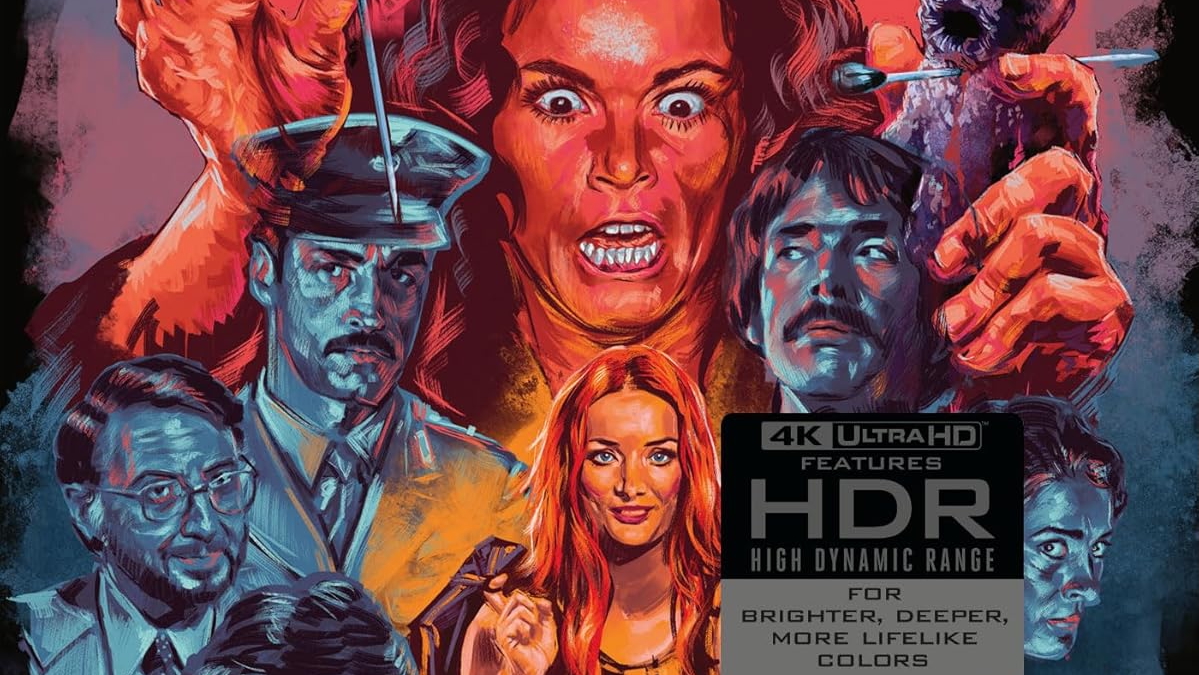
One Lucio Fulci best the searing Giallo Don’t Torture a Duckling comes to 4K UHD by Arrow Video.
The Film
Don’t Torture a Duckling is Fulci at his full Fulci-ness with ample amounts of gore, nudity, and red herrings enough to shake a stick at. The plotting and mystery at its core are similar to the one in Argento’s The Bird with the Crystal Plumage. One can only imagine that Fulci after watching Crystal Plumage began his thoughts on how he could steal Argento’s plot and “make it better”. In a lot of ways… he did.
The film doesn’t just pay homage to Crystal Plumage, it does homage Italian style; ripping off wholesale. Those unfamiliar with Duckling but familiar with Crystal Plumage will find the story of a journalist and a beautiful woman teaming up to find a killer a bit of déjà vu. Though Fulci goes a step further, as he always does, instead of women the killer is targeting children. There’s a mean streak a mile wide on this one.
The cast is uniformly terrific with Tomas Milan and Barbara Bouchet doing excellent work. Bouchet is particularly great as a woman of a certain reputation who helps Bolkan’s reporter dig deeper into the truth of the story. Bouchet primarily known for her looks is great, giving her a role that allows her to do more than look pretty and scream (unlike The Red Queen Kills Seven Times). The role of Martelli is prime Tomas Milan’s work. Milan is all style and swagger here playing Martelli like he was in a poliziotteschi with that tough guy attitude that’s so fantastic in those films like Shoot First Die Later (which coincidentally is my favorite film title of all time god bless Fernando Di Leo).
Please be warned. There are moments of outright cruelty and sadism but with Fulci’s best work; it is for a point. Fulci shows how a small town reacts to a killer infesting their town. He doesn’t shy away from making them as unsavory as the killer themselves. The most disturbing scene isn’t one of a lifeless child (be warned there are a few in the film) but of the way that the town dispenses justice against someone who may be the killer. It’s stark, brutal and unrelenting. There’s a commentary on herd mentality that’s still fresh and acutely observed more than 50 years later.
The Transfer
The all-new 4K restoration from the original 2-perf Techniscope camera negative by Arrow Films is a masterful version of the film. The Dolby Vision and HDR10+ encoding give the transfer a lush layer of color, contrast, black levels, and all-around detail that even the 2017 Arrow Blu-Ray could never produce. The biggest difference in the transfers is the way the 4K UHD and its active grain structure feel as though you are watching the film on the big screen. Something the Blu-ray in its SDR just doesn’t mimic or come close to. It cannot be restated enough that Arrow’s upgrade to 4K UHD here is nothing short of a spectacular example of what can be done with restoration and this format in general.
The Extras
They include the following;
The audio commentary by Troy Howarth, author of So Deadly, So Perverse: 50 Years of Italian Giallo Films begins with a quote from Lucio Fulci and how he began to make dreamlike logic horror films they began to be successful. Some of the details include how this is Fulci’s favorite of his films; the production location shoot in various remote locations in Italy – some locations used by Passion of the Christ; the rarity of this Giallo being set in Italy – most are set elsewhere; a great discussion of the various dubs in the film – and the care that was taken in the Italian version which wasn’t the norms; the witchcraft that’s portrayed in this film and how it is not an evil act; the controversy over the first scene with Barbara Bouchet; the work and career of star Tomas Milian; the work of editor Ornella Micheli with Fulci and eventually working with Joe D’Amato; the work and career of actress Barbara Bouchet; a discussion of the personal and career of Lucio Fulci; a larger discussion of who the murder is and his motives and how it relates to the themes of the film; a larger discussion of the various English language actors that dubbed in the film; a larger discussion through out of the various actors that appear in the film; and much more. Howarth delivers an insightful commentary track for one of the more challenging Fulci films.
Giallo a la Campagna (27:44) – is an archival video discussion with Mikel J. Koven, author of La Dolce Morte: Vernacular Cinema and the Italian Giallo Film opens with how the giallo cycle that Fulci’s Don’t Torture a Duckling falls in is after Argento’s The Bird with the Crystal Plumage. Some of the details discussed by Koven is the Italian film culture that these films specifically played in – much more of a social gathering; how filmmakers would do things to spike everyone’s attention – how Don’t Torture a Duckling would do that; how modernity affects the giallo and also Italian culture as a whole; the stark contrast between this film and Fulci’s last film Woman in Lizard Skin; the element of witchcraft that play various roles in Giallo films and Giallo adjacent films; the roles priests plays in this film and other Giallo as well; and much more.
Hell is Already in Us (20:30) – is an archival video essay by critic Kat Ellinger looking at the claims of misogyny both here and throughout Lucio Fulci’s work. Using various films like The New York Ripper, The Black Cat, Don’t Torture a Duckling, Perversion Story, A Woman in Lizard’s Skin, and more. Duckling is the primary text that she uses to discuss some of the pillars of Fulci’s work including religion, setting/location, the lack of modernity, sin, murder, and roles of women in society as a critique of male violence toward women. Ellinger uses quotes from Fulci, scenes from his various films, his personal life (many tragedies), and grief to make this point very clearly. The essay is adoritly written by Ellinger, beautifully edited, and produced by Michael Mackenzie.
Lucio Fulci Remembers (Part I: 20:13 / Part II: 13:12) – is a rare archival two-part 1988 audio interview by journalist Gaetano Mistretta with Lucio Fulci. The context of these tapes was that Mistretta wrote a letter filled with questions to Fulci for a magazine interview. In kind, Fulci responded with an audio record – where were later transcribed for Dark Star Magazine. The audio interview appears with an accompanying video of various locations and items that are relevant to the interview. It’s a clever way to approach visuals to the audio interview. The first part is a career overview talking about how he became a filmmaker (out of spite and a broken heart) to his Italian comedies – how they were still him but his true love is his “fantasy films” which were much closer to his soul; what he loved about making fantasy films; his influences – what he feels is his greatest influence; a discussion of the first Giallo he made Perversion Story; making Don’t Torture a Duckling and his goals in making a rural Giallo which was very different than other at the time; and much more. The second part is a discussion of contemporaries; his views on writing; and much more. In Italian with English Subtitles.
Who Killed Donald Duck (18:31) – is an archival interview with actress Barbara Bouchet where the actor begins discussing making 8 films in 1972 (the year that she made Don’t Torture a Duckling) and most were sex comedies, but this one was different and because it was different she accepted the role. The actor goes on to discuss the production; how it was working with Fulci; gossip from the production – including a few juicy tidbits about actors; working with the various actors; working on location in a smaller town; and much more. In Italian with English subtitles.
Those Days with Lucio (28:20) – is an archival interview with actress Florinda Bolkan. The actor begins with her memory of director Lucio Fulci as a trickster of sorts being nice but the niceties hiding his true “devil nature” (her words). Bolkan discusses how she was cast in A Woman in Lizard’s Skin (her prior work with Fulci); how great the role was from an actor’s perspective; the difficulties with working with Fulci on that picture and examples of how he would make things difficult for her – how she fought back and the respect he finally gave her; what drew her to the role in Don’t Torture a Duckling; the filming of her iconic scene in Duckling; and much more. In Italian with English subtitles.
The DP’s Eye (46:21) – is an archival interview with cinematographer Sergio D’Offizi. The cinematographer begins his interview with how he met the Fulci on a film called The Senator Likes Woman – joining the production of the tenuous production. D’Offizi goes on to discuss Fulci’s clear vision of what he wanted from him and how this helped him as other directors were indecisive; Fulci’s understanding of photography; a breakdown of how they approached and achieved each other various set pieces; working with Tomas Milian – both here and previously; his dislike of the zoom and the reasons why he hated it – as most cinematographers do (from his estimation); working on location in Southern Italy and some troubles they had with the youth; shooting the iconic death scene of the film; and much more. In Italian with English subtitles.
From the Cutting Table (25:38) – is an archival interview with editor Bruno Micheli. The editor begins with how he got his start because of his father’s work with Rossellini and Fellini – first working as a PA at Technicolor and eventually finding work as an editor out of watching his sister edit and learning from her. Micheli goes on to discuss how he and his sister began to work on Fulci’s films Two Escape from Sing Sing and 002 Operazione Luna; working with Fulci and the director’s confidence in his editors during the editing process; how he worked with his sister during the editing of the films; the editing of the iconic kill scene – how they built the edit, the music they chose, the sound mix, et. al.; and much more. In Italian with English subtitles.
Endless Torture (16:03) – is an archival interview with makeup artist Maurizio Trani. The makeup artist begins with his start in the industry because his father was also a makeup artist, and his entire family was in the film industry – and began as a PA working in all areas of film until twenty years later he got into makeup and how encompassing that was (including discussions of 1900 and Casanova) as compared to the compartmentalized American productions. Trani also discusses the hierarchy of Italian productions (using the Lugi Cozi’s Sinbad as an example); how he got hired on Don’t Torture a Duckling by lead makeup artist Franco di Girolamo; the work he specifically had to do on Duckling; and much more. In Italian with English subtitles.
Theatrical trailer (3:56) – in Italian with English Subtitles.
The Final Thought
Arrow Video’s 4K UHD upgrade to Lucio Fulci’s Giallo Masterpiece is everything a fan could want in picture sound and content. Highest recommendations!
Arrow Video’s 4K UHD Edition of Don’t Torture a Duckling is out March 25th
Share this:
Like this:
Discover more from The Movie Isle
Subscribe to get the latest posts sent to your email.