George Armitage’s Miami Blues is one of the best films of the 1990s. A pitch-black crime comedy adapted from the novel by Charles Willeford of the same name. It’s the kind of take-no-prisoners film that frees an actor like Alec Baldwin to do his very best work as Junior, a low-level criminal and pure psychopath working his way through Miami.
Just released from prison, Junior makes his way from California to the sunny land of opportunity of Miami, Florida. Junior’s first interaction with anyone in Miami is a Hare Krishna that he murders by breaking his thumb. Junior’s reign of terror and skullduggery begins as he cons a simple call girl (Jennifer Jason Leigh) into being his girl. It gets better, for Junior at least, when he assaults Detective Hoke Moseley (Fred Ward), taking his gun, badge and teeth. The assault emboldens Junior as he begins to impersonate a police officer as a way to extort criminals cleanly. Though eventually someone like Junior the violent temper matches with the wrong person or situation.
Alec Baldwin never found footing as a leading man the way Hollywood wanted him to. Miami Blues proves he was much more suited for darker supporting roles he grew into. Junior is the perfect distillation of what Baldwin excelled at, creating a character whose charm belied true seething violent rage. Junior can’t even be joyous in counting his winnings; he has to make it a situation where he pretends to rage against slights.
Though Baldwin isn’t the only performance that makes Miami Blues great. It’s actually the one-two knockout hits of Fred Ward and Jennifer Jason-Leigh. Ward is genius as the detective who bumbles his way through the string of violent cases Junior leaves behind. Mosley could be a joke, but he’s never that; the film treats him with the sort of grounded blue-collar respect the best neo-noirs have for their characters. As good as Ward and Baldwin are, Jennifer Jason-Leigh outdoes them both as the broken heart and soul of the film. As Susie, the not-so-bright call girl that Junior continually dupes into his web of lies, could be a one-note joke or some “hooker with the heart of gold” Pretty Woman replay. Jason-Leigh gives Susie so much quirk and spark that it feels like an altogether new type of character we are seeing on screen. Her work is so impressive one can see Ward and Baldwin both having genuine reactions to her work in real time.
Writer/director George Armitage brings the perfect tonal balance of humor and violence to Miami Blues as he did with his equally ingenious high school reunion action black comedy Grosse Pointe Blank. It’s that understanding that the more dryly things are played out, the funnier they are. Armitage directs the film like it’s a Lee Marvin film from 1972. It’s that deadpan sense of utility that makes everything that happens on screen even funnier. Hearing Junior respond to Mosley’s “stop police!” with his own “stop police!” is funny because both men mean the declarative statement.
Miami Blues is the kind of dark eccentric comedy that is rarely made anymore. One that puts character above all else and finds humor even in the most violent of situations.
The Transfer
The 4K restoration of the original negative, presented in HDR / Dolby Vision, is another beautiful winner from Radiance Films. The Dolby Vision keeps the original golden hue sunshine color palette of Miami that Armitage and cinematographer Tak Fujimoto used to great effect intact. In fact, the HDR manages to imbue the color with deeper saturation without overwhelming the image, but gives us truer color reproduction. The image is sharp without a scratch or blemish through the runtime. The care they’ve taken with this release continues to show why Radiance remains one of the best, if not the best boutique label in the home video market.
The Extras
They include the following;
Interviews with Alec Baldwin and Jennifer Jason Leigh
David Jenkins Interview
Maxim Jakubowski Interview
Gallery
Trailer
Alec Baldwin & Jennifer Jason Leigh (26:01) – in these archival interviews (both actors recorded separately) begin with how both got involved with the project. Baldwin discusses how he wanted to work with Leigh because of her reputation as a great actor; how his research about newly released prisoners informed his decision on his performance; her favorite scene from the film; what he loves about Demme’s films (even the ones produced by the director like this one); working with Fred Ward; working with director George Armitage; and more. Leigh discusses how Phoebe Cates recommended her for the role; how she shot Last Exit to Brooklyn and Miami Blues back-to-back and both changed her career; her love of the role and what made it special; the way she approached working with Fred Ward and the character she played; working with director George Armitage; and more.
David Jenkins (11:58) – in this all-new interview, the critic gives a detailed look at Miami Blues and Jonathan Demme’s role in the production. Opening with Armitage and Demme’s friendship beginning with producer Roger Corman – how they actually first met; Armitage’s career with Corman in the 1970s; how the film – an adaptation of a novel – came together after Fred Ward sent it to Jonathan Demme while he was filming Married to the Mob; where the film gets its understanding of Miami and lived-in feeling; and much more.
Maxim Jakubowski (11:16) – in this archival interview, pulp crime expert Maxim Jakubowski looks at the character of Hoke Moseley in both Miami Blues and Charles Willeford’s novels, in which he is a recurrent character and is the Fred Ward character in the film adaptation. Beginning with Willeford’s early life, Jakubowski does an excellent job of charting the writer’s work in both fiction and non-fiction.
Gallery – The gallery consists of 19 behind-the-scenes and promotional images.
Trailer (2:11)
The Final Thought
Miami Blues is one of the gems of the late 1980s. Highest possible recommendations.

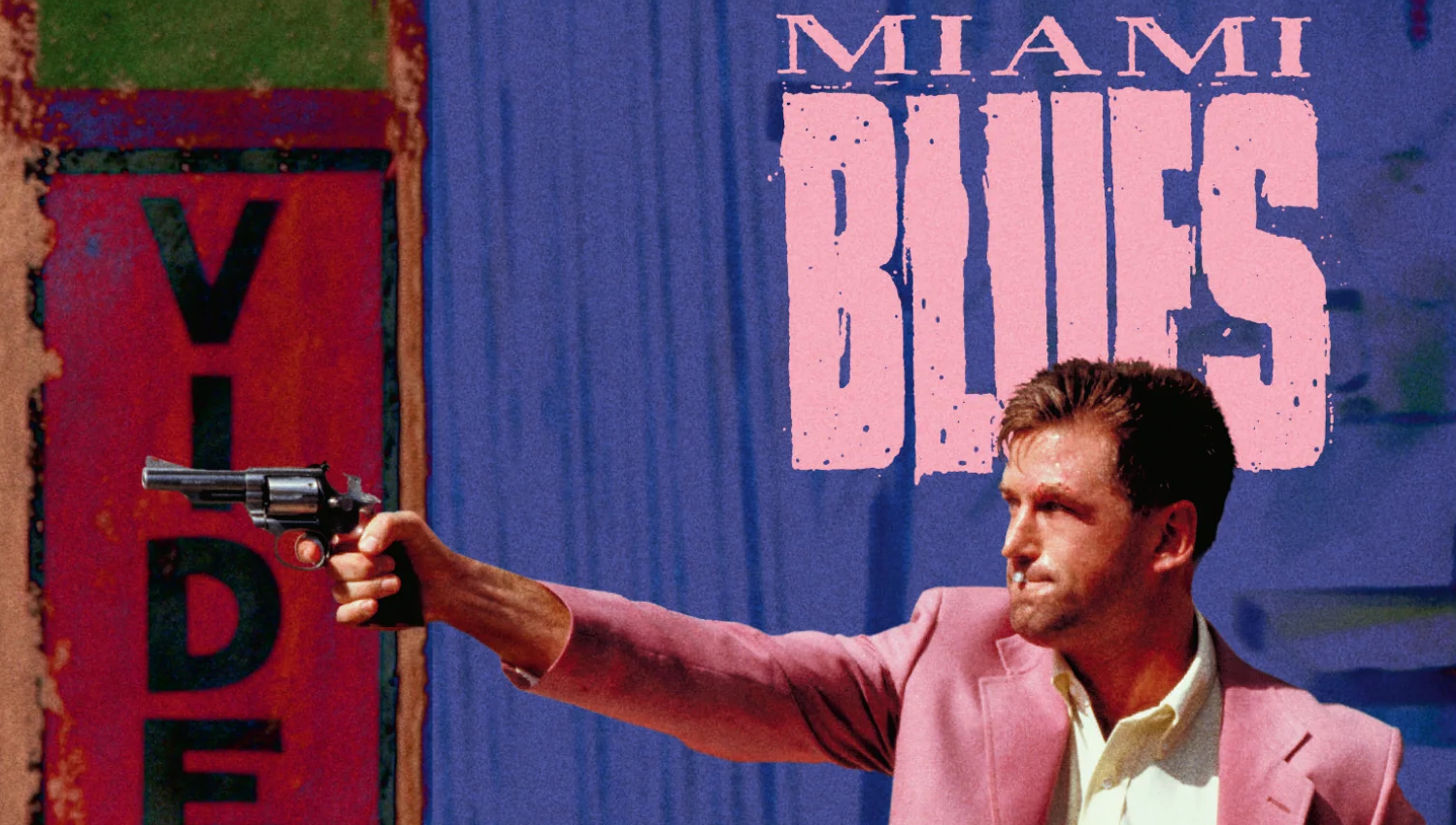
Alec Baldwin gives a career-best performance in Miami Blues new to 4K UHD from Radiance Films.
The Film
George Armitage’s Miami Blues is one of the best films of the 1990s. A pitch-black crime comedy adapted from the novel by Charles Willeford of the same name. It’s the kind of take-no-prisoners film that frees an actor like Alec Baldwin to do his very best work as Junior, a low-level criminal and pure psychopath working his way through Miami.
Just released from prison, Junior makes his way from California to the sunny land of opportunity of Miami, Florida. Junior’s first interaction with anyone in Miami is a Hare Krishna that he murders by breaking his thumb. Junior’s reign of terror and skullduggery begins as he cons a simple call girl (Jennifer Jason Leigh) into being his girl. It gets better, for Junior at least, when he assaults Detective Hoke Moseley (Fred Ward), taking his gun, badge and teeth. The assault emboldens Junior as he begins to impersonate a police officer as a way to extort criminals cleanly. Though eventually someone like Junior the violent temper matches with the wrong person or situation.
Alec Baldwin never found footing as a leading man the way Hollywood wanted him to. Miami Blues proves he was much more suited for darker supporting roles he grew into. Junior is the perfect distillation of what Baldwin excelled at, creating a character whose charm belied true seething violent rage. Junior can’t even be joyous in counting his winnings; he has to make it a situation where he pretends to rage against slights.
Though Baldwin isn’t the only performance that makes Miami Blues great. It’s actually the one-two knockout hits of Fred Ward and Jennifer Jason-Leigh. Ward is genius as the detective who bumbles his way through the string of violent cases Junior leaves behind. Mosley could be a joke, but he’s never that; the film treats him with the sort of grounded blue-collar respect the best neo-noirs have for their characters. As good as Ward and Baldwin are, Jennifer Jason-Leigh outdoes them both as the broken heart and soul of the film. As Susie, the not-so-bright call girl that Junior continually dupes into his web of lies, could be a one-note joke or some “hooker with the heart of gold” Pretty Woman replay. Jason-Leigh gives Susie so much quirk and spark that it feels like an altogether new type of character we are seeing on screen. Her work is so impressive one can see Ward and Baldwin both having genuine reactions to her work in real time.
Writer/director George Armitage brings the perfect tonal balance of humor and violence to Miami Blues as he did with his equally ingenious high school reunion action black comedy Grosse Pointe Blank. It’s that understanding that the more dryly things are played out, the funnier they are. Armitage directs the film like it’s a Lee Marvin film from 1972. It’s that deadpan sense of utility that makes everything that happens on screen even funnier. Hearing Junior respond to Mosley’s “stop police!” with his own “stop police!” is funny because both men mean the declarative statement.
Miami Blues is the kind of dark eccentric comedy that is rarely made anymore. One that puts character above all else and finds humor even in the most violent of situations.
The Transfer
The 4K restoration of the original negative, presented in HDR / Dolby Vision, is another beautiful winner from Radiance Films. The Dolby Vision keeps the original golden hue sunshine color palette of Miami that Armitage and cinematographer Tak Fujimoto used to great effect intact. In fact, the HDR manages to imbue the color with deeper saturation without overwhelming the image, but gives us truer color reproduction. The image is sharp without a scratch or blemish through the runtime. The care they’ve taken with this release continues to show why Radiance remains one of the best, if not the best boutique label in the home video market.
The Extras
They include the following;
Alec Baldwin & Jennifer Jason Leigh (26:01) – in these archival interviews (both actors recorded separately) begin with how both got involved with the project. Baldwin discusses how he wanted to work with Leigh because of her reputation as a great actor; how his research about newly released prisoners informed his decision on his performance; her favorite scene from the film; what he loves about Demme’s films (even the ones produced by the director like this one); working with Fred Ward; working with director George Armitage; and more. Leigh discusses how Phoebe Cates recommended her for the role; how she shot Last Exit to Brooklyn and Miami Blues back-to-back and both changed her career; her love of the role and what made it special; the way she approached working with Fred Ward and the character she played; working with director George Armitage; and more.
David Jenkins (11:58) – in this all-new interview, the critic gives a detailed look at Miami Blues and Jonathan Demme’s role in the production. Opening with Armitage and Demme’s friendship beginning with producer Roger Corman – how they actually first met; Armitage’s career with Corman in the 1970s; how the film – an adaptation of a novel – came together after Fred Ward sent it to Jonathan Demme while he was filming Married to the Mob; where the film gets its understanding of Miami and lived-in feeling; and much more.
Maxim Jakubowski (11:16) – in this archival interview, pulp crime expert Maxim Jakubowski looks at the character of Hoke Moseley in both Miami Blues and Charles Willeford’s novels, in which he is a recurrent character and is the Fred Ward character in the film adaptation. Beginning with Willeford’s early life, Jakubowski does an excellent job of charting the writer’s work in both fiction and non-fiction.
Gallery – The gallery consists of 19 behind-the-scenes and promotional images.
Trailer (2:11)
The Final Thought
Miami Blues is one of the gems of the late 1980s. Highest possible recommendations.
Radiance Films’ Blu-ray edition of Miami Blues is out now.
Share this:
Like this:
Discover more from The Movie Isle
Subscribe to get the latest posts sent to your email.