What was a dark comedy in 1993 has now become super text in 2026. The angry middle-aged white man has been a trope since as far back as one can remember. It became an art form and critique in Sydney Lumet’s Network at its high point. Falling Down is the perfect overwrought pot-boiler thriller from the 1990s that may have aged too well.
Bill Foster aka D-FENS (Michael Douglas) is sitting in LA traffic in the sweltering heat of summer when he snaps. “I’m going home,” D-FENS announces to LA. Thus begins his Odysseus-style hellish journey of violence and frustration to his wife (Barbra Hershey) and daughter. It should be no surprise to find this man is one disturbed individual who is provoked both at the inconsequential (the price of a Coke) to the warranted (a white supremacist) and every sort of piece of city life that Los Angeles has to throw at him. That includes an about-to-retire police detective (Robert Duvall).
Joel Schumacher’s filmography before the two Batman films he made was filled with projects like Falling Down, edgy genre pictures that pushed and pulled in the right kind of way. The kind of films that studios would never touch now. The director always found the right style and commercial sheen to make movies like this spark. Schumacher, working with cinematographer Andrzej Bartkowiak, created the sweltering heat of a Los Angeles day that few films do. Schumacher and editor Paul Hirsch play into the darkly comedic sensibilities of Ebbe Roe Smith’s script that wouldn’t have worked in anyone else’s hands.
The other part of the brilliance of the film is in its casting of Michael Douglas and Robert Duvall as unstoppable forces headed to a collision. Douglas excelled at these broken, flawed characters at the apex of his career. He always found the empathy in these terrible white men that made you understand how they ticked. Duvall was incapable of a bad performance, and here as the retiring cop, you feel the weight and humanity of his character. It’s not a grizzled vet of action, but Duvall chooses to play him as the eccentric lifer that doesn’t want to retire but has to. The rest of the cast are uniformly excellent, with stand-out work by Rachel Ticotin, Barbara Hershey, Tuesday Weld. Michael Paul Chan, and Vondie Curtis-Hall. Though it’s Frederic Forrest that’s as brilliant as Douglas and Duvall as the opposite side of D-FENS’s coin.
Unfortunately, one would hope to say that Falling Down managed to be an aberration, some sort of darkly comedic one-off, but like the aforementioned Network, it’s become more prescient than anyone could imagine. If there is a message to any of the film, it’s that men should go seek help, but would rather do anything but.
The Transfers
The all-new 4K restoration by Arrow Films, approved by cinematographer Andrzej Bartkowiak, presented in Dolby Vision (HDR10 compatible), is another flawless transfer for the boutique label. The 35mm widescreen shot film looks glorious on the format in the way that films shot on 35mm back in the 1990s can. The way that disc gets everything right from the grain structure, to the color reproduction, to the contrast level, perfectly emulates the visual presentation that was exhibited when this reviewer saw the film opening weekend back in February 1993. Arrow continues to stun with their partnership with Warner Bros releasing some of the very best titles, giving them upgraded 4K UHD releases.
The Extras
They include the following;
Archival audio commentary by director Joel Schumacher, editor Paul Hirsch, screenwriter Ebbe Roe Smith, LA Times writer Shawn Hubler, and actors Michael Douglas, Michael Paul Chan, Vondie Curtis-Hall, and Frederic Forrest
Man on the Edge: Screenwriter Ebbe Roe Smith Unravels Falling Down
At War with the World: Composer James Newton Howard on Falling Down
Going Home: Falling Down’s Los Angeles, Then and Now
Deconstructing D-Fens, an archival interview with Michael Douglas
Original trailer
Image gallery
This archival audio commentary by director Joel Schumacher, editor Paul Hirsch, screenwriter Ebbe Roe Smith, LA Times writer Shawn Hubler, and actors Michael Douglas (who they pulled from a 1993 interview), Michael Paul Chan, Vondie Curtis-Hall, and Frederic Forrest begins with Schumacher beginning with a discussion of the opening and Douglas’ character leaving his car. The cast and crew were all recorded separately but seem to be scene-specific or at least are prompted to discuss specific scenes at certain points in their interviews. Some of the details include what inspired the writer and the screenplay’s development; each of the actors (Chan, Curtis-Hall, Forrest) discuss their casting, the production, Schumacher’s directorial style, etc.; Schumacher’s discussion of various actors, including star Douglas, and their various approaches and performances; the production itself and the risky nature of the material that informed on the lower budget and shorter schedule (for the time); the portrayal of violence, racial tensions, social inequalities, and the more sensational aspects of the film; how Schumacher was hired as he’s was not the studio’s choice; the film’s story’s specific to Los Angeles as opposed to other cities; some of the historical, political, and socio-economical events that this film emerged from; the film made in the wake of the LA Riots and the film was on location shooting at the time that the Rodney King verdict occurred; the controversy the film garnered even back in the 1990s; and much more.
Man on the Edge: Screenwriter Ebbe Roe Smith Unravels Falling Down (18:23) – is an all-new interview with screenwriter Ebbe Roe Smith. Smith begins with his transition from Actor to Screenwriter and the inspiration for the film. The screenwriter goes on to discuss the original vision of the screenplay he wrote; the development and rewrites; his cameo appearance in the film; being on set for the entire production and his experiences during that time; and more.
At War with the World: Composer James Newton Howard on Falling Down (9:04) – is an all-new interview with composer James Newton Howard. Newton Howard opens with how he began his collaboration with director Joel Schumacher that began with Flatliners. The composer goes on to discuss Schumacher choosing another composer for this film before issues arose and he was hired with only three weeks to compose and score the film; the militaristic nature of the score; the way that Howard created some of the scorescape (sounds as composition); the various themes and compositions of the score; and more.
Going Home: Falling Down’s Los Angeles, Then and Now (12:49) – is an all-new location featurette revisiting the real-life Los Angeles sites used in Falling Down. Hosted by Gillian Wallace Horvat (who also wrote and produced the piece), this is more than just a look at the locations but rather a historical/socio-economic and political dive into the boroughs of Los Angeles that Michael Douglas’ character traverses in the film. This is a great look at the city regardless if you’re an Angeleno or someone merely interested in topography (including a map that tracks not only the journey but also where the locations are).
Deconstructing D-Fens: A Conversation with Michael Douglas (10:12) – is an archival interview with Michael Douglas. Douglas opens with how the project came to him and, even at the time, how controversial it was and his insistence on making it his next project. The star goes on to discuss the context in which the character came to be; his approach to the character; charting the character and is frustrations and how he portrays that; the political strife that the film was made in; and more.
Trailers – Can be accessed through a submenu
Trailer 1 (2:32)
Trailer 2 (2:34)
Image gallery – features (a whopping) 162 production stills, behind-the-scenes photos, poster art and more. The gallery can be navigated by using your next and back chapter stop buttons on your remote.
The Final Thought
Arrow continues its curation of some of the best cult titles of the 1990s to 4K UHD, filled with special features. Highest Possible Recommendation!!

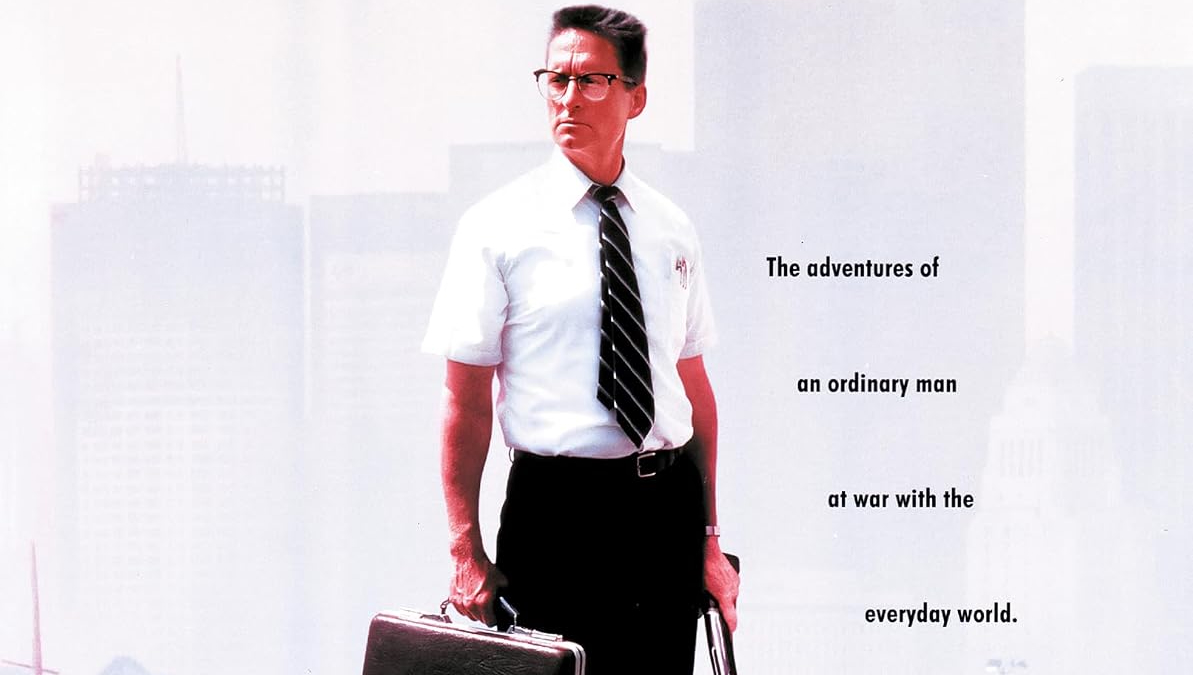
Michael Douglas takes on Los Angeles in the 90s cult film Falling Down. New on 4K UHD from Arrow Video.
The Film
What was a dark comedy in 1993 has now become super text in 2026. The angry middle-aged white man has been a trope since as far back as one can remember. It became an art form and critique in Sydney Lumet’s Network at its high point. Falling Down is the perfect overwrought pot-boiler thriller from the 1990s that may have aged too well.
Bill Foster aka D-FENS (Michael Douglas) is sitting in LA traffic in the sweltering heat of summer when he snaps. “I’m going home,” D-FENS announces to LA. Thus begins his Odysseus-style hellish journey of violence and frustration to his wife (Barbra Hershey) and daughter. It should be no surprise to find this man is one disturbed individual who is provoked both at the inconsequential (the price of a Coke) to the warranted (a white supremacist) and every sort of piece of city life that Los Angeles has to throw at him. That includes an about-to-retire police detective (Robert Duvall).
Joel Schumacher’s filmography before the two Batman films he made was filled with projects like Falling Down, edgy genre pictures that pushed and pulled in the right kind of way. The kind of films that studios would never touch now. The director always found the right style and commercial sheen to make movies like this spark. Schumacher, working with cinematographer Andrzej Bartkowiak, created the sweltering heat of a Los Angeles day that few films do. Schumacher and editor Paul Hirsch play into the darkly comedic sensibilities of Ebbe Roe Smith’s script that wouldn’t have worked in anyone else’s hands.
The other part of the brilliance of the film is in its casting of Michael Douglas and Robert Duvall as unstoppable forces headed to a collision. Douglas excelled at these broken, flawed characters at the apex of his career. He always found the empathy in these terrible white men that made you understand how they ticked. Duvall was incapable of a bad performance, and here as the retiring cop, you feel the weight and humanity of his character. It’s not a grizzled vet of action, but Duvall chooses to play him as the eccentric lifer that doesn’t want to retire but has to. The rest of the cast are uniformly excellent, with stand-out work by Rachel Ticotin, Barbara Hershey, Tuesday Weld. Michael Paul Chan, and Vondie Curtis-Hall. Though it’s Frederic Forrest that’s as brilliant as Douglas and Duvall as the opposite side of D-FENS’s coin.
Unfortunately, one would hope to say that Falling Down managed to be an aberration, some sort of darkly comedic one-off, but like the aforementioned Network, it’s become more prescient than anyone could imagine. If there is a message to any of the film, it’s that men should go seek help, but would rather do anything but.
The Transfers
The all-new 4K restoration by Arrow Films, approved by cinematographer Andrzej Bartkowiak, presented in Dolby Vision (HDR10 compatible), is another flawless transfer for the boutique label. The 35mm widescreen shot film looks glorious on the format in the way that films shot on 35mm back in the 1990s can. The way that disc gets everything right from the grain structure, to the color reproduction, to the contrast level, perfectly emulates the visual presentation that was exhibited when this reviewer saw the film opening weekend back in February 1993. Arrow continues to stun with their partnership with Warner Bros releasing some of the very best titles, giving them upgraded 4K UHD releases.
The Extras
They include the following;
This archival audio commentary by director Joel Schumacher, editor Paul Hirsch, screenwriter Ebbe Roe Smith, LA Times writer Shawn Hubler, and actors Michael Douglas (who they pulled from a 1993 interview), Michael Paul Chan, Vondie Curtis-Hall, and Frederic Forrest begins with Schumacher beginning with a discussion of the opening and Douglas’ character leaving his car. The cast and crew were all recorded separately but seem to be scene-specific or at least are prompted to discuss specific scenes at certain points in their interviews. Some of the details include what inspired the writer and the screenplay’s development; each of the actors (Chan, Curtis-Hall, Forrest) discuss their casting, the production, Schumacher’s directorial style, etc.; Schumacher’s discussion of various actors, including star Douglas, and their various approaches and performances; the production itself and the risky nature of the material that informed on the lower budget and shorter schedule (for the time); the portrayal of violence, racial tensions, social inequalities, and the more sensational aspects of the film; how Schumacher was hired as he’s was not the studio’s choice; the film’s story’s specific to Los Angeles as opposed to other cities; some of the historical, political, and socio-economical events that this film emerged from; the film made in the wake of the LA Riots and the film was on location shooting at the time that the Rodney King verdict occurred; the controversy the film garnered even back in the 1990s; and much more.
Man on the Edge: Screenwriter Ebbe Roe Smith Unravels Falling Down (18:23) – is an all-new interview with screenwriter Ebbe Roe Smith. Smith begins with his transition from Actor to Screenwriter and the inspiration for the film. The screenwriter goes on to discuss the original vision of the screenplay he wrote; the development and rewrites; his cameo appearance in the film; being on set for the entire production and his experiences during that time; and more.
At War with the World: Composer James Newton Howard on Falling Down (9:04) – is an all-new interview with composer James Newton Howard. Newton Howard opens with how he began his collaboration with director Joel Schumacher that began with Flatliners. The composer goes on to discuss Schumacher choosing another composer for this film before issues arose and he was hired with only three weeks to compose and score the film; the militaristic nature of the score; the way that Howard created some of the scorescape (sounds as composition); the various themes and compositions of the score; and more.
Going Home: Falling Down’s Los Angeles, Then and Now (12:49) – is an all-new location featurette revisiting the real-life Los Angeles sites used in Falling Down. Hosted by Gillian Wallace Horvat (who also wrote and produced the piece), this is more than just a look at the locations but rather a historical/socio-economic and political dive into the boroughs of Los Angeles that Michael Douglas’ character traverses in the film. This is a great look at the city regardless if you’re an Angeleno or someone merely interested in topography (including a map that tracks not only the journey but also where the locations are).
Deconstructing D-Fens: A Conversation with Michael Douglas (10:12) – is an archival interview with Michael Douglas. Douglas opens with how the project came to him and, even at the time, how controversial it was and his insistence on making it his next project. The star goes on to discuss the context in which the character came to be; his approach to the character; charting the character and is frustrations and how he portrays that; the political strife that the film was made in; and more.
Trailers – Can be accessed through a submenu
Image gallery – features (a whopping) 162 production stills, behind-the-scenes photos, poster art and more. The gallery can be navigated by using your next and back chapter stop buttons on your remote.
The Final Thought
Arrow continues its curation of some of the best cult titles of the 1990s to 4K UHD, filled with special features. Highest Possible Recommendation!!
Arrow Video’s 4K UHD Edition of Falling Down is out now.
Share this:
Like this:
Discover more from The Movie Isle
Subscribe to get the latest posts sent to your email.