
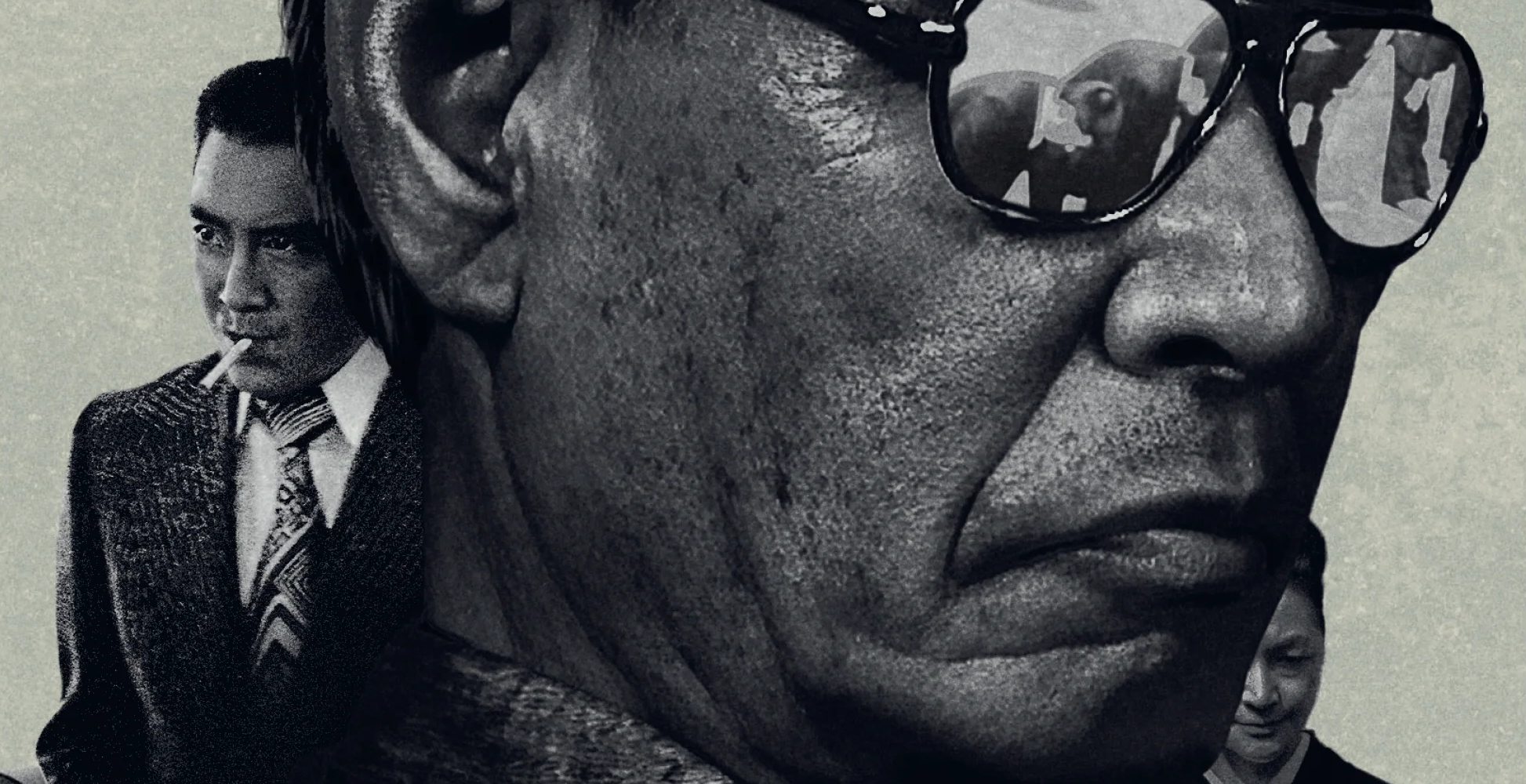
Director Sadao Nakajima’s trilogy of complex and intricately plotted yakuza films makes its Blu-ray debut thanks to Radiance Films in the Japanese Godfather Trilogy Box Set.
The Films
The Japanese Godfather
The influence of The Godfather cannot be overstated. That just doesn’t include European and American Cinema, but also Asian Cinema as well. Though based on a Japanese novel, Sadao Nakajima’s Japanese Godfather (aka Japan’s Don) is heavily influenced by Coppola’s adaptation of The Godfather. Though the film and the ensuing trilogy are not a one-to-one copy, but more of an inspiration. Screenwriter Koji Takada has created a labyrinthine story of corruption, corporate greed, criminality, family, politics, and moral bankruptcy in the face of Yakuza families in an ever changing came of 4-D chess that leaves no clear winner and many, if not all, suffering the loss of more than just their lives.
The first, and eventually three film cycle charts the rise of the Nakajima crime family and their “don” or leader, Sakura (Shin Saburi), to keep them as the most powerful Yakuza family in all of Japan. Cast with multiple characters (most of whom die at the hands of their own greed or struggle for power) that push their family’s agenda. Though not just the Yakuza are at play on this battlefield. Sakura’s a Richard III-type figure even beyond Michael Corleone, manipulating his family members from the outset. There is nothing Sakura and the other heads of family and level employees will do to ensure their stay in power or their quest for ascension.
From the opening moments of The Japanese Godfather, the violence is not just physical but emotional and spiritual. All of it is messy and played out on the streets of Japan, not just exclusive to Tokyo. The action is thrilling and the kind that would later inspire directors like Quentin Tarantino and Beat Takashi. The acts of violence are never choreographed perfection like John Woo, but rather clumsy and messy, with people often missing their targets or hitting their targets with a hail of bullets.
Half of the brilliance of The Japanese Godfather is its pitch-black sense of rotten moral guise that drives the narrative and action to its cold and calculating end. The other half is the complex plot machinations between the family heads, but Sakura gets the better of them, even if it means corrupting the core of his family.
Japanese Godfather Ambition
Not a sequel per se, as much as it’s a continuation of the power struggles within the various Yakuza organizations and the Nakajima group’s struggle to maintain power in a new era of Yakuza and Corporate integration. Picking up right where The Japanese Godfather left off, with Sakura’s (Saburi) organization still intact after his Physician son-in-law (Etsushi Takahashi) ensured Tatsumi (Koji Tsuruta), his second in command, could not disband the gang. This has set Nakajima up with a windfall of power, but also contending with not just other organizations but also politicians, bankers, and corporate executives.
One would not think that an intricate tale of corporate takeovers of the Japanese shipping and the fluctuation of the country’s stock market in order to seize control of companies would be so thrilling, but director Nakajima and screenwriter Takada have created a Molotov cocktail of a yarn. One that shifts its focus from its original lead, Tsuruta’s Tatsumi, to Saburi’s Sakura and a rotating cast of characters, many of whom meet an unsavory end. Sakura’s rise to prominence in the second film benefits the narrative in all respects.
Takada gives the actor a role befitting a morally corrupt leader. This is all the richer of a text for showing us the rot not just within the organization but within Sakura’s family. The way that Saburi plays it as a man whose body is turning on him with every corrupt turn is a brilliant bit of acting and storytelling that plays over not just this film but in the third as well. That sense of corruption within the social structures does not just go into the family, but all aspects, including the Yakuza itself. No longer is there a code of conduct.
When a character cuts off his finger to show his remorse for corruption, it’s laughed at as though he wasted his finger for nothing. Nothing is more fitting than this analogy for the thesis of this film, which shows the uselessness of any code of conduct. It is a futile act that will be laughed at and eventually used against you.
Japanese Godfather Conclusion
The finale continues the corporate integration of the Yakuza or its attempts to ensure they are installed into the highest corridors of power. The darkest of the trilogy, which shows the cost that everyone must pay to ascend.
Shifting away from the Japanese shipping interests to real-estate dealings in Southeast Asia and the high-stakes ownership of a Casino Resort is the final battleground for Sakura and the other Yakuza organizations. Sakura and the Nakajima crime organization make one more push for total supremacy and consolidation of all of the other families. Sakura finally meets his match in the form of Oishi (Toshiro Mifune), a character introduced in Japanese Godfather Ambition, now taking the stage next to Saburi’s Sakura. Oishi is as ruthless as he is smart, outwitting Sakura at every point in this battle that will determine who runs Japan.
The darkest of the three, there is no one left unscathed by the end of the film. There is a sense of foreboding and nihilism for even the younger characters in the film. No one is going to escape unbruised or unscathed. As Sakura and Oishi begin their all-out proxy war with one another, we see key characters not just lose their lives, but many lose their souls and what’s most precious to them before dying. Many of the innocent bystanders and female characters of the films. What was implied in the other two films is made explicit here, as many of the girlfriends, wives, and daughters are the pawns and sacrificial lambs in the war for power.
Japanese Godfather Conclusion is by far the most damning and critical of the three films. It’s a searing film that cuts to the bone. It’s every bit the worthy conclusion for this truly epic tale of criminality and how the quest for absolute power corrupts absolutely.
The Transfers
The High-Definition digital transfers of each film for the first time on Blu-ray are another standout release for Radiance. The care they’ve taken with these releases spread over three discs (one for each film to allow for a healthy bit-rate image) speaks to how they’ve quickly become a standout boutique label of a specific type of release. Each of the films is flawless without any blemishes or artifacts. The saturated look of these Toei Yakuza films (which is a trademark of Toei Studios’ 35mm widescreen films of the era), shot by cinematographer Toshio Masud, is lovely in its color reproduction and contrast levels. Radiance continues to provide collectors with truly wonderful transfers that rival anything that other labels produce.
The Extras
They include the following;
- Archival interview with Sadao Nakajima
- Kazuyoshi Kumakiri on The Japanese Godfather Trilogy
- Koji Takada on The Japanese Godfather Trilogy
- Trailers
Disc 1:
Sadao Nakajima’s Movie Chats (33:12) – in this archival interview with Sadao Nakajima (which appears to be from a longer series of interviews) the director opens with a discussion of star Koji Tsuruta and his first film with him called Classmates which is about the training of Kamikaze pilots in WW2 and how Koji Tsuruta himself was in the 14th Class Naval Academy (which was known for Kamikaze pilots and how that informed the role. Nakajima goes on to discuss with great detail his collaboration with Tsuruta on multiple films and the incident on their next film, a very politically charged film about terrorism in Japan that caused a rift in their relationship and wasn’t until Japanese Godfather that it was healed; how working with Shin Saburi helped Tsuruta and Nakajima’s creative bond on the film; and much more. In Japanese with English Subtitles.
Japanese Godfather Trailers (5:26) – Japanese with English Subtitles
Disc 2:
Kazuyoshi Kumakiri on The Japanese Godfather Trilogy (16:09) – in this all-new interview/appreciation, director Kazuyoshi Kumakiri opens with how he came to work under/mentored by the trilogy director Sadao Nakajima, who was his film professor. Some of the details include how Nakajima would roll into class with an entourage; what he learned from Nakajima’s classes; what he learned that Nakajima liked about his scripts and shorts – and the director’s open-mindedness when others were not; what he felt about Nakajima films at the time; a larger discussion of their relationship both profession and personal including advice he gleaned from the many conversations; what makes this trilogy – especially at the time of making the film – so unique; what he loves about the films – including the all-star cast which you could never pull together now; and much more. In Japanese with English Subtitles.
Japanese Godfather Ambition Trailers (6:30) – Japanese with English Subtitles
Disc 3:
Koji Takada on The Japanese Godfather Trilogy (28:54) – in this all-new interview with the screenwriter of the Japanese Godfather trilogy, Koji Takada begins with his cameo appearance in the final film and how the trilogy of films allowed him to stretch and grow as a writer. The interview moderated by film scholar Taichi Kasuga details how Takada came to work on the project and how Coppola’s The Godfather influenced the project; the differences between Yakuza films and Mafia films; how within the genre there were differences talking about Battles without Honor or Humanity as an example; the research done to bring the newer aesthetic that the trilogy brought to the genre; the all-star cast they were able to cast in the film that was beyond the normal Toei stars (like trilogy lead Shin Saburi, and Toshiro Mifune) along with Toei stars (like Sonny Chiba in a very different supporting role); some of the real life incidents that inspired the films; the way that they thoughtfully cast against type and genre; the difficulties that the script complexities caused director Nakajima as a storyteller; and much more. In Japanese with English Subtitles.
Japanese Godfather Conclusion Trailers (6:03) – Japanese with English Subtitles
The Final Thought
The Japanese Godfather trilogy is one of the best yakuza stories put to film. Radiance has given it the box set it deserves. Highest Possible Recommendations!!
Radiance Films’ Blu-ray Edition of The Japanese Godfather Trilogy is out now.
Discover more from The Movie Isle
Subscribe to get the latest posts sent to your email.
Pingback: Blu-ray Review: Radiance Films’ Aesthetics of a Bullet (Limited Edition) – The Movie Isle