When I approach viewing any horror remake, I consider this: why remake it? After Gus Van Sant’s “Psycho” thing, I’ve had to ask myself this question, and especially half a decade later, when they decided to remake arguably one of the seminal horror films of the 1970s. The Tobe Hooper original is a classic that still terrifies today. Even more so in this era of cleanly shot, beautifully cleaned up, perfect for Netflix horror films?
Back in 2003, the question was as prevalent as it is today. The answer two decades ago was the same; it remains today. In the hopes of turning on a new generation to the original. Even if one out of every ten was convinced to watch the original after this remake. Of those, one out of ten loved the original. That is a legion of new fans to carry the film on that would not have seen or known about it.
All that being said… I love how divisive this remake is. I love this remake for all the reasons it is not the original. I find it’s a seal of approval that Roger Ebert actively loathed this film. Transgressive horror is never going to be critically acclaimed. Or at least it shouldn’t be. There should be something dangerous about it. This Marcus Nispel remake even now has the sort of danger to it that shocks that it was a major studio release. Yes, it was New Line, but it was at a time when New Line was fresh off of Lord of the Rings acclaim and money. There is something wholly punk rock about the studio investing in their roots and going back to trashy B-movie genre cinema. Their investment paid off handsomely.
By letting Nispel, screenwriter Scott Kosar, and producers Michael Bay and Tobe Hooper have free rein, they created something wholly different from the 70s classic. A film that’s as actively repugnant as it is beautiful. A film that shocks as much as it’s gleefully gory, the way that the original was only implied to be. Kosar’s adaptation only brings a few things to the table, but it’s adroit about what it does, giving Nispel the latitude to go as hard as he wants. Nispel, working with original cinematographer Daniel Pearl, may be the crowning achievement of this film. The film, from beginning to end, is visually stunning in a way that the original was grim and grimy. Beyond that, the film has a visual geography that few horror films have, and when the bloodletting happens, you know exactly where, why, and how it is occurring.
Not enough credit is given to the performers of the film, specifically the trio of R. Lee Ermey, Jessica Biel, and Andrew Bryniarski. Ermey is an utter nightmare as the sheriff from hell, having the most wicked good times anyone ever has on screen, torturing these kids. Bryniarski, as Leatherface, gives an almost sympathetic touch to the hulking mass of a man-child, giving him a life and backstory through a few key moments. Though it’s Biel whose final girl is asked to do a lot of screaming and pushing herself into that heightened state of mania for the role gives us that human face (no pun intended) to latch onto. When she finally lashes out, it’s a moment of release because of Biel’s controlled performance (though many would not see it as such).
Ultimately, Texas Chainsaw Massacre (2003) is the perfect example of a great remake of a classic. It reminds you of the best parts of what it is reimagining, making one want to either revisit or view said original for the first time. Now, excuse me. I have a date with a certain 1974 horror classic…
The Transfer
Arrow Video continues to do amazing work in the 4K UHD realm. This 4K UHD presentation in Dolby Vision (HDR10 compatible) is an excellent example of the kind of work that’s being done in the format currently. The image looks as good as the 35mm release prints on opening day. The transfer is sharp with beautiful, luminous blacks and contrast levels. The Dolby Vision encoding allows for details within those blacks that haven’t been present in other home video iterations. 2003’s Texas Chainsaw Massacre has always been a gorgeous-looking film, but never more than here. Bravo to Arrow Video and their continued amazing work upgrading titles to 4K.
The Extras
They include the following;
Brand new audio commentary with Dread Central co-founder Steve “Uncle Creepy” Barton and co-host of The Spooky Picture Show podcast Chris MacGibbon
Archival audio commentary with director Marcus Nispel, producer Michael Bay, executive producers Brad Fuller and Andrew Form, and New Line Cinema founder Robert Shaye
Archival audio commentary with Marcus Nispel, director of photography Daniel Pearl, production designer Greg Blair, art director Scott Gallager, sound supervisor Trevor Jolly, and composer Steve Jablonsky
Archival audio commentary with Marcus Nispel, Michael Bay, writer Scott Kosar, Brad Fuller, Andrew Form, and actors Jessica Biel, Erica Leerhsen, Eric Balfour, Jonathan Tucker, Mike Vogel, and Andrew Bryniarski
Reimagining a Classic with Marcus Nispel
Shadows of Yesteryear with Daniel C Peral
The Lost Leatherface
Masks and Massacres
Chainsaw Symphony
Chainsaw Redux: Making A Massacre, a making-of documentary
Ed Gein: The Ghoul of Plainfield
Severed Parts, a look at the cutting room floor and some of the scenes excised from the final edit
Deleted scenes including an alternate opening and ending
Screen tests for Jessica Biel, Eric Balfour and Erica Leerhsen
Behind-the-scenes featurette
Cast and crew interviews
Theatrical trailers and TV spots
Concept art galleries
The first of four commentary tracks is an all-new commentary with Dread Central co-founder Steve “Uncle Creepy” Barton and co-host of The Spooky Picture Show podcast Chris MacGibbon begins with a discussion of the iconic teaser trailer and thoughts around the time about remaking this classic. Some of the details include their first viewings of the film; the work of cinematographer Daniel Pearl; how this reboot/remake is more akin of a sequel than an actual remake because of how the film is not a beat-for-beat remake; the work of the various directors taking on TCM films and actors/stuntmen that play Leatherface – how they line up with other franchises and what separates them; a larger discussion of the remakes of horror films of the 00s – where Texas Chainsaw Massacre lines up; a discussion of the original TCM series – and their feelings of the various entries and how wildly different they are; the work of Lee R. Ermy in this and the sequel; a discussion of the Brett Wagner and Andrew Bryniarski as Leatherface in this film; the real life location that was used for the house in the film and how the family that currently owns it does not like visitors; a larger discussion of the gore FX work throughout; a larger discussion of where horror films were at the time; a larger discussion of the various actors that appear in the film; and much more.
The second of four tracks is an Archival audio commentary with director Marcus Nispel, producer Michael Bay, executive producers Brad Fuller and Andrew Form, and New Line Cinema founder Robert Shaye. This track is labelled as The Production and focuses on the various aspects of the making of the film from the lead creatives. The track is edited together from various interviews and is non-screen specific. The track goes into detail on every aspect from each participant’s perspective on how Texas Chainsaw Massacre came to be the first film that Platinum Dunes (Michael Bay’s horror-centric production company) came to purchase, develop, and produce the film.
The third of four tracks is an Archival audio commentary with Marcus Nispel, director of photography Daniel Pearl, production designer Greg Blair, art director Scott Gallager, sound supervisor Trevor Jolly, and composer Steve Jablonsky. This track is labelled as Technical Aspects and focuses on the various technical details of the making of the film from those who brought the visuals to life. The track is another that is edited together from various interviews and is non-screen specific. The track goes on to focus on the work that was required during the pre-production, production, and post-production to bring this lower budget (by everyone’s admission) to life and look well beyond the $9 million below-the-line budget.
The final of four tracks is an Archival audio commentary with Marcus Nispel, Michael Bay, writer Scott Kosar, Brad Fuller, Andrew Form, and actors Jessica Biel, Erica Leerhsen, Eric Balfour, Jonathan Tucker, Mike Vogel, and Andrew Bryniarski. This track is labelled as The Story and focuses on the above-the-line talent and creatives parts in the making of the film. The track is another track that is edited together from various interviews and is non-screen specific. The track goes on to focus on the work the actors, writers, directors, and producers did during pre-production and production on this difficult (by all admissions) shoot.
New Interviews – accessed through a submenu.
Reimagining a Classic with Marcus Nispel (16:25) – is an all-new interview with director Marcus Nispel, which opens with his love of the original and the films of the 1970s. The director goes on to discuss how he became involved, coming out of Music videos, the approach he and Daniel Pearl took, and much more.
Shadows of Yesteryear with Daniel C Pearl (16:54) – is an all-new interview with cinematographer Daniel Pearl opens with his relationship with director Marcus Nispel prior to making the remake. Pearl goes on to discuss the struggles he and Nispel had with getting him hired to remake the original, in which he shot, how he was eventually hired to remake the film, the visual style he took, the different approach to the remake, and much more.
The Lost Leatherface (15:17) – is an all-new interview with actor Brett Wagner opens with why he’s called the Lost Leatherface and a discussion of the franchise and the various actors that played Leatherface. Wagner goes on to discuss the unique audition process, the preparation work he did, the makeup/mask and costume design, the terrible first day of production, how eventually Andrew Bryniarski took over, and much more.
Masks and Massacres (18:09) – is an all-new interview with makeup effects artist Scott Stoddard begins with his theories on effects work and makes sure that much is left to the imagination. Stoddard goes on to discuss his history with the original film, how he was hired on for the film, the research that he did and collaborated with director Nispel for the film, the design and approach to the mask and where they took inspirations from, and much more.
Chainsaw Symphony (19:01) – is an all-new interview with composer Steve Jablonsky opens with how Movie Composing was not in his initial plans. Jablonsky goes onto discuss going to school for musical composition, getting hired by Hans Zimmer, working with Harry Gregson-Wagner that lead to Zimmer hiring him to collaborate on Pearl Harbor, how working with Zimmer led to Texas Chainsaw Massacre, the approach to the score to the film – the melding of score and sound design, and much more.
Archival Extras – the following extras are from the original DVD release of the film and are accessible through their own submenu. All of these featurettes are in Standard Definition (480p/i).
Chainsaw Redux: Making A Massacre (76:09) – is the archival feature-length making-of documentary. They literally do not make special feature content like this anymore. Made during the Lord of the Rings – New Line era of truly great extra features. The documentary covers every aspect of the making of this remake. From pre-production, production, post-production, make-up FX, history, and background origins of the story… everything is covered with a level of detail you just don’t get anymore with polished behind-the-scenes footage. They even go as far as to give social context of the original film, the controversy around remaking the film, and much more. Featuring comments by director Marcus Nispel, producer Michael Bay, stars Jessica Biel, Erica Leerhsen, New Line CEO Robert Shaye, Cinematographer Daniel Pearl, critic Joe Bob Briggs, and more!
Ed Gein: The Ghoul of Plainfield (24:17) – another archival documentary that takes a deep dive into the serial killer who inspired not only Leatherface but so many other fictional serial killers. The documentary effectively sets up the era, the area, and the relationships to give context to which Gein’s murders occurred. Featuring not just photos but footage from the era, along with interviews by various experts in psychology and criminology.
Severed Parts (16:42) – is an archival featurette that has director Marcus Nispel discussing what was deleted from the final film, including the alternate opening and closing of the film, and the reasons why they were cut.
Screen tests – each accessed through a submenu.
Jessica Biel (3:24)
Eric Balfour (3:06)
Erica Leerhsen (0:47)
Cast and crew interviews – each can be accessed through a submenu. These do feature a play all. The interviews are your basic EPK-style interview, where the subject discusses their character and sells the film through the story and bigger points.
Jessica Biel (3:17)
Eric Balfour (2:02)
Jonathan Tucker (1:45)
Erica Leerhsen (1:28)
Mike Vogel (2:19)
R. Lee Ermey (2:06)
Marcus Nispel (2:45)
Brad Fuller and Andrew Form (2:11)
Behind-the-scenes featurette (9:22) – an archival featurette that is more b-roll footage from the production than an actual making of.
Theatrical trailers – accessed through a submenu
Michael Bay Teaser Trailer (1:31) – this iconic teaser trailer, directed by Bay, many consider turned the remake into a must-see event. Simple, effective and evocative of the Tobe Hopper original as it literally shows nothing.
Theatrical Trailer (2:21)
TV spots (4:16) – 8 TV spots of various lengths and attitudes.
Concept art galleries – accessed through a submenu
Production Concept Art Gallery – consisting of 10 pieces of concept art of the family’s basement. The gallery can be navigated by using your Next and Back Chapter Stop Buttons.
Leatherface Concept Art Gallery – consisting of 13 pieces of concept art and photos of maquettes of Leatherface. The gallery can be navigated by using your Next and Back Chapter Stop Buttons.
Deleted Scenes – Accessed through a submenu. Bravo to Arrow Video for having not just a featurette on the cut scenes but including the Cut/Delete footage in its own new section and restored in UHD (not just HD). Each can be played on their own, or there is a PLAY ALL option.
Alternate Opening -Asylum (1:26)
Alternate Suicide (1:02)
Erin’s News (1:17)
More Erin and Kemper (1:33)
Jedidah’s Drawings (1:25)
Alternate Morgan Death (0:32)
Alternate Ending -Asylum (2:20)
Image Gallery – gallery consisting of 74 different production stills and behind-the-scenes photos. The gallery can be navigated by using your Next and Back Chapter Stop Buttons.
The Final Thought
Arrow Video had gone all out on this amazing 4K UHD upgrade, including every archival special feature and including new ones as well. Highest Possible Recommendations!

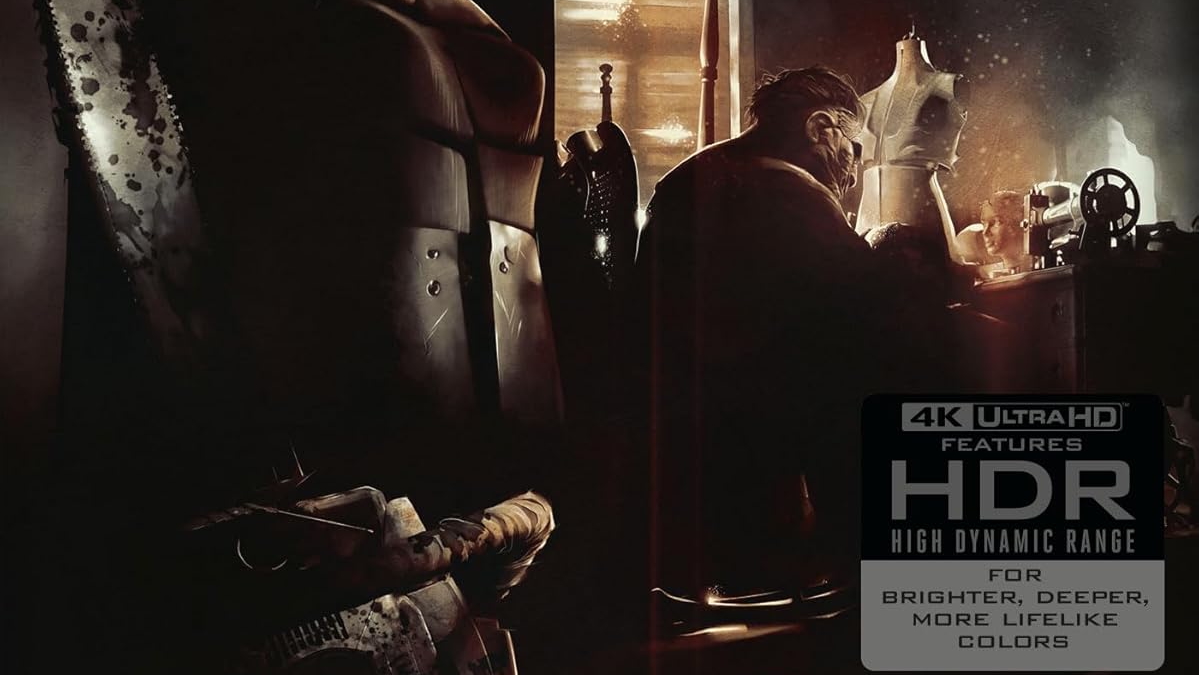
Marcus Nispel’s 2003 remake of Texas Chainsaw Massacre comes to 4K UHD thanks to Arrow Video.
The Film
When I approach viewing any horror remake, I consider this: why remake it? After Gus Van Sant’s “Psycho” thing, I’ve had to ask myself this question, and especially half a decade later, when they decided to remake arguably one of the seminal horror films of the 1970s. The Tobe Hooper original is a classic that still terrifies today. Even more so in this era of cleanly shot, beautifully cleaned up, perfect for Netflix horror films?
Back in 2003, the question was as prevalent as it is today. The answer two decades ago was the same; it remains today. In the hopes of turning on a new generation to the original. Even if one out of every ten was convinced to watch the original after this remake. Of those, one out of ten loved the original. That is a legion of new fans to carry the film on that would not have seen or known about it.
All that being said… I love how divisive this remake is. I love this remake for all the reasons it is not the original. I find it’s a seal of approval that Roger Ebert actively loathed this film. Transgressive horror is never going to be critically acclaimed. Or at least it shouldn’t be. There should be something dangerous about it. This Marcus Nispel remake even now has the sort of danger to it that shocks that it was a major studio release. Yes, it was New Line, but it was at a time when New Line was fresh off of Lord of the Rings acclaim and money. There is something wholly punk rock about the studio investing in their roots and going back to trashy B-movie genre cinema. Their investment paid off handsomely.
By letting Nispel, screenwriter Scott Kosar, and producers Michael Bay and Tobe Hooper have free rein, they created something wholly different from the 70s classic. A film that’s as actively repugnant as it is beautiful. A film that shocks as much as it’s gleefully gory, the way that the original was only implied to be. Kosar’s adaptation only brings a few things to the table, but it’s adroit about what it does, giving Nispel the latitude to go as hard as he wants. Nispel, working with original cinematographer Daniel Pearl, may be the crowning achievement of this film. The film, from beginning to end, is visually stunning in a way that the original was grim and grimy. Beyond that, the film has a visual geography that few horror films have, and when the bloodletting happens, you know exactly where, why, and how it is occurring.
Not enough credit is given to the performers of the film, specifically the trio of R. Lee Ermey, Jessica Biel, and Andrew Bryniarski. Ermey is an utter nightmare as the sheriff from hell, having the most wicked good times anyone ever has on screen, torturing these kids. Bryniarski, as Leatherface, gives an almost sympathetic touch to the hulking mass of a man-child, giving him a life and backstory through a few key moments. Though it’s Biel whose final girl is asked to do a lot of screaming and pushing herself into that heightened state of mania for the role gives us that human face (no pun intended) to latch onto. When she finally lashes out, it’s a moment of release because of Biel’s controlled performance (though many would not see it as such).
Ultimately, Texas Chainsaw Massacre (2003) is the perfect example of a great remake of a classic. It reminds you of the best parts of what it is reimagining, making one want to either revisit or view said original for the first time. Now, excuse me. I have a date with a certain 1974 horror classic…
The Transfer
Arrow Video continues to do amazing work in the 4K UHD realm. This 4K UHD presentation in Dolby Vision (HDR10 compatible) is an excellent example of the kind of work that’s being done in the format currently. The image looks as good as the 35mm release prints on opening day. The transfer is sharp with beautiful, luminous blacks and contrast levels. The Dolby Vision encoding allows for details within those blacks that haven’t been present in other home video iterations. 2003’s Texas Chainsaw Massacre has always been a gorgeous-looking film, but never more than here. Bravo to Arrow Video and their continued amazing work upgrading titles to 4K.
The Extras
They include the following;
The first of four commentary tracks is an all-new commentary with Dread Central co-founder Steve “Uncle Creepy” Barton and co-host of The Spooky Picture Show podcast Chris MacGibbon begins with a discussion of the iconic teaser trailer and thoughts around the time about remaking this classic. Some of the details include their first viewings of the film; the work of cinematographer Daniel Pearl; how this reboot/remake is more akin of a sequel than an actual remake because of how the film is not a beat-for-beat remake; the work of the various directors taking on TCM films and actors/stuntmen that play Leatherface – how they line up with other franchises and what separates them; a larger discussion of the remakes of horror films of the 00s – where Texas Chainsaw Massacre lines up; a discussion of the original TCM series – and their feelings of the various entries and how wildly different they are; the work of Lee R. Ermy in this and the sequel; a discussion of the Brett Wagner and Andrew Bryniarski as Leatherface in this film; the real life location that was used for the house in the film and how the family that currently owns it does not like visitors; a larger discussion of the gore FX work throughout; a larger discussion of where horror films were at the time; a larger discussion of the various actors that appear in the film; and much more.
The second of four tracks is an Archival audio commentary with director Marcus Nispel, producer Michael Bay, executive producers Brad Fuller and Andrew Form, and New Line Cinema founder Robert Shaye. This track is labelled as The Production and focuses on the various aspects of the making of the film from the lead creatives. The track is edited together from various interviews and is non-screen specific. The track goes into detail on every aspect from each participant’s perspective on how Texas Chainsaw Massacre came to be the first film that Platinum Dunes (Michael Bay’s horror-centric production company) came to purchase, develop, and produce the film.
The third of four tracks is an Archival audio commentary with Marcus Nispel, director of photography Daniel Pearl, production designer Greg Blair, art director Scott Gallager, sound supervisor Trevor Jolly, and composer Steve Jablonsky. This track is labelled as Technical Aspects and focuses on the various technical details of the making of the film from those who brought the visuals to life. The track is another that is edited together from various interviews and is non-screen specific. The track goes on to focus on the work that was required during the pre-production, production, and post-production to bring this lower budget (by everyone’s admission) to life and look well beyond the $9 million below-the-line budget.
The final of four tracks is an Archival audio commentary with Marcus Nispel, Michael Bay, writer Scott Kosar, Brad Fuller, Andrew Form, and actors Jessica Biel, Erica Leerhsen, Eric Balfour, Jonathan Tucker, Mike Vogel, and Andrew Bryniarski. This track is labelled as The Story and focuses on the above-the-line talent and creatives parts in the making of the film. The track is another track that is edited together from various interviews and is non-screen specific. The track goes on to focus on the work the actors, writers, directors, and producers did during pre-production and production on this difficult (by all admissions) shoot.
New Interviews – accessed through a submenu.
Archival Extras – the following extras are from the original DVD release of the film and are accessible through their own submenu. All of these featurettes are in Standard Definition (480p/i).
Deleted Scenes – Accessed through a submenu. Bravo to Arrow Video for having not just a featurette on the cut scenes but including the Cut/Delete footage in its own new section and restored in UHD (not just HD). Each can be played on their own, or there is a PLAY ALL option.
Image Gallery – gallery consisting of 74 different production stills and behind-the-scenes photos. The gallery can be navigated by using your Next and Back Chapter Stop Buttons.
The Final Thought
Arrow Video had gone all out on this amazing 4K UHD upgrade, including every archival special feature and including new ones as well. Highest Possible Recommendations!
Arrow Video’s 4K UHD Edition of The Texas Chainsaw Massacre is out now
Share this:
Like this:
Discover more from The Movie Isle
Subscribe to get the latest posts sent to your email.