
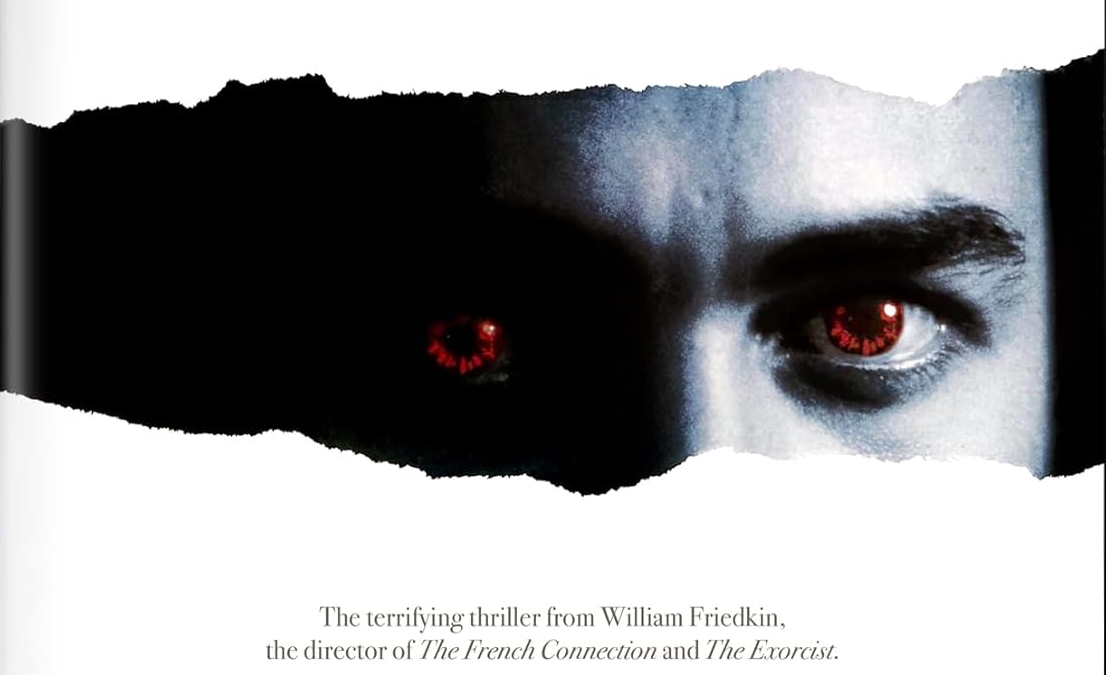
William Friedkin’s rarely seen Rampage comes to 4K UHD in both its theatrical and original cut forms from Kino Lorber.
The Film
There are very few films that director William Friedkin ever made that were average or standard issue. The director loved to use genre frameworks to investigate human nature and humans’ capacity for cruelty and violence. Rampage uses the trappings of a serial killer/police procedural to look at not just the darker side of humanity but how society counters that.
The police capture Charles Reece (Alex McArthur) after a string of brutal murders, rather quickly, though not before taking half a dozen lives. Now, the state has to put Reece on trial, and it is up to prosecutor Anthony Fraser (Michael Biehn), a devout catholic and anti-death penalty, to get a conviction and guarantee Reece is sentenced to death and not given an insanity plea. As Fraser’s morals are put to the test, the defense mounts its case that Reece is unfit for trial. Who is right and who is wrong? Is there a right and is there a wrong in these dark acts done by someone who may not be fit to stand trial?
Friedkin’s film is not concerned with the lurid details or some sort of vigilante justice. The film, as constructed and written by the director, is one of questions rather than actions. There is a clinical, almost documentary way that Friedkin allows everything to unfold. The murders, the pursuit, the trail, everything is given a clinical detachment. It is meant to provoke a reaction, but not the one that many would have.
Rampage is a conundrum that doesn’t give easy answers or a simple thesis. Rather, a balanced look at two sides of an argument, no one is right, no one is wrong. By placing a prosecutor who has his moral compass put to the test, we are forced to reckon with our own views. Friedkin has always been a provocateur, and Rampage has him at the very top of that particular game. The hunt for the killer only takes twenty minutes of the film; even then, it is intercut with the case work being done, hunting down Reece.
Even at its end, there isn’t any sort of satisfaction to the resolution or even really a resolution. Question upon question, one is forced to ask about our justice system, the nature of humanity, the nature of society, and our part in violence. Rampage is a film that will disturb you and one that will stay with you long after the credits have rolled.
Reviewed is the far superior Original Cut.
The Transfer
The all-new HDR/Dolby Vision Masters – From a 4K Scan of the 35mm Original Camera Negative (Original Version) and 35mm Interpositive (Recut Version) are excellent transfers and an example of the subtle work that Kino Lorber is currently doing. Of course, the Original Version that was scanned from the OCN is the better of the two transfers. The OCN transfer is flawless without any issues or defects. The transfer is sharp and beautifully rendered to mimic Robert Yeoman’s 35mm photography. The Recut Version from the Interpositive is still an excellent transfer from the sourced material, though there is a light wear and tear on this version, but that is a minor critique.
The Extras
They include the following;
DISC 1 (4KUHD):
- NEW Audio Commentaries by Film Historians Howard S. Berger and Nathaniel Thompson (Both Cuts)
DISC 2 (BLU-RAY):
- NEW Audio Commentaries by Film Historians Howard S. Berger and Nathaniel Thompson (Both Cuts)
- Where’s the Blood: NEW Interview with Actor Alex McArthur
- Psychotic Vampire: NEW Interview with True Crime Writer Harold Schechter
- Theatrical Trailer (Newly Restored)
The all-new Audio Commentaries by Film Historians Howard S. Berger and Nathaniel Thompson, the track appears on both cuts of the film. The duo opens with Thompson beginning with the fact that this is the 1987 cut and how the film did not get a release in the US (though there was a Japanese Laserdisc), in this cut, and how it was bootlegged from that source, and how many saw this original cut. The duo opens very differently on the 1992 cut, as the film opens on a different note, as it was entirely recut by Friedkin, and they go into this, including a new additional scene that was deleted in the original cut. The details include a larger discussion of the way the original cut differs from the theatrical cut release; a larger discussion of Friedkin’s subtle film in this cut; a discussion of the score by Ennio Morricone; where Friedkin was during his career and where many of the 1970s directors were during this time, as it relates to the industry; director Richard Fleisher’s influence and mentorship of Friedkin; the connections to various films in Friedkin’s other films including The Exorcist; how many of Friedkin’s films late in his career have now being reassessed when they were critically lambasted when initially released; a larger discussion of how many filmmakers have taken the original theatrical versions out of circulation; a larger discussion of the various films that Friedkin altered and changed throughout his career and how Rampage is the first of his films he did so; a larger discussion of the themes, directorial style, shot selection, edits, performance, et. al.; a larger discussion of the various actors that appear in the film; a larger discussion of the various crew that worked on the film; and much more. Berger and Thompson provide two very fascinating commentary tracks. There is recorded overlap on the tracks, but the duo has gone the extra mile and recorded differences between the Theatrical and Original Cuts, and both tracks are definitely worth listening to, especially when it comes to the differences in the ending and additional material that was either added or taken away from both of the films.
Where’s the Blood: Interview with Actor Alex McArthur (16:06) – in this all-new interview with Actor Alex McArthur began with how he was inspired to move to California and eventually moved to New York to study acting, and how working at Studio 54 introduced him to Liz Taylor. McArthur goes on to discuss how Madonna’s Papa Don’t Preachmusic video got him the role in Rampage; the work and collaboration with William Friedkin was like on this role; the information came out of the research that came out of the time; the closeness to the real-life serial killer Richard Chase; anecdotes from the production that was filmed in and around Stockton, California; working with Friedkin on set – the way he treated some of the cast; the tow different cuts and his knowledge of the two different endings; and much more.
Psychotic Vampire: Interview with True Crime Writer Harold Schechter (19:14) – in this all-new interview with Writer Schechter opens with Friedkin’s inspiration that came out of Richard Chase’s killings for Rampage. Schechter goes on to explain how he became interested in True Crimes and our fascination with these violent beings; how, since the beginning of the printing press, we have been printing True Crime stories; the details of the Chase files and the history behind the case; how Friedkin’s film downplayed many of the details of Chase’s crimes; and much more.
Rounding out the special features are the trailers for Rampage [Newly Restored] (1:04); To Live and Die in L.A. (2:08); Rules of Engagement (2:21); The Hunted (2:22); Bug (1:22)
The Final Thought
Kino Lorber has done a magnificent job of providing us with an ultimate edition for a rarely seen William Friedkin film, giving us context about this fascinating film. Highest possible recommendations!!
Kino Lorber 4K UHD Edition of Rampage is out now
Discover more from The Movie Isle
Subscribe to get the latest posts sent to your email.
Pingback: 4K UHD Review: Kino Lorber’s Dust Devil (Special Edition) – The Movie Isle
Pingback: 4K UHD Review: Kino Lorber’s K2 (Special Edition) – The Movie Isle