Harvey Keitel and an all-star cast star in two films for Wayne Wang and Paul Auster, Smoke and Blue in the Face, the new beautiful Blu-ray double feature from Kino Lorber.
The Films
Smoke is the rarest of films. One that studios or streamers would not dare make. A look at people, a city, and life as life happens on its terms. People talk and interact as they do in day-to-day life. Even back in 1995, the Wayne Wang-directed, Paul Auster-scripted film was special and has only grown in esteem in its quiet and moving humanity.
Auggie (Harvey Keitel) runs a smoke shop in the heart of Brooklyn. Paul Benjamin (William Hurt) is one of his many patrons who come in and out of the store daily to share a smoke or a moment of reprieve from his stalled writing. Enter Rashid (Harold Perrineau) into Paul’s life, a young man in need of help. That help from the cagey Paul opens the world of these three souls and many others for the better and worse, but mostly better. As much as Auggie and Paul enrich Rashid, it’s more the opposite as Rashid gives these two men a richer life for being in their’s.
The film began life as a Christmas short story in the New York Times, written by Auster has turned into a film like the short story of unexpected humanity and life. The above description only skims the surface of the riches that Wang and Auster have in store for an audience willing to take their tour of Brooklyn. Like the New York Borough, the film takes place in the film is an unexpected treasure of humanity.
As much as Harvey Keitel and William Hurt put on a masterclass of acting, it is Harold Perrineau as Rashid that’s the heart and soul of the film. Perrineau is electric as the smart and talented Rashid, who truly had a bad run of luck. The actor is both heartbreaking and defiantly strong-willed as the character whose life is changed by not just these two men who help him, but also others in the film. To discuss the arc of Rashid would be to run the heart and crux of the film. There is a moment between Keitel, Hurt, Perrineau, and another titan of acting that’s a masterclass in silence that this reviewer considers one of the best scenes of the last fifty years.
There isn’t a gut-punch moment in Smoke that elevates it to one of the best of the ‘90s indie cinema movement. Rather, Smoke snakes into your soul with its act of kindness and human nature with the right amount of acidic comedic grace. Be it stealing an already stolen camera or showing a man his long-departed wife in pictures, Smoke and its characters are as uniquely New York and Brooklyn as anything put on screen. That in it of itself is deserving of reappraisal and reconsideration by cineastes.
Blue in the Face is the wiseass goodtime cousin to the serious but often funny Smoke. If Smoke is a slow Sunday morning, reading the New York Times with a cup of coffee and the one you love. Blue in the Face is the night out on the town with that same someone, drinking and dancing the night away. Directors Wayne Wang and Paul Auster’s companion piece to Smoke is every bit the freewheeling, improvisational comedy you want it to be.
Auggie (Keitel reprising his role from Smoke) has just been told by owner Vinnie (Victor Argo) that he’s selling the smoke shop. Over the next week, Auggie and those in and around the smoke shop contend with micro dramas, comedy, singing telegrams (by Madonna, no less), tragedy, adultery, Belgian waffles, Jackie Robinson, and pollsters. It all ends happily, though, with a dance off with RuPaul no less… only in Brooklyn in the summer.
Again, the film, as constructed by Wang and Auster, is deserving of being discovered on its own merits. This film is as loose as they come. There isn’t a story other than the throughline of the smoke shop being sold. Blue in the Face is a love letter to Brooklyn and the conversations and confrontations one has in the borough. The love of Jackie Robinson and the pain and heart of the Brooklyn Dodgers. The hustle of a young entrepreneur. The anger of a housewife wanting attention. The chance meeting of two high school friends. Is all done with the sort of exciting possibilities of film that made ‘90s indie cinema so compelling.
Blue in the Face is the kind of comedic delight that, from moment to moment, is so expected that it feels like the Brooklyn so many of us have remembered but no longer exists. In Wang and Auster’s hands, it feels as though it’s that dream of a time that may never have existed, but only in our hearts. Though that may be true, we have this film as a document of not just a place and time, but an era of cinema where something as magical as Blue in the Face could be produced and released in thousands of theaters around the world.
The Transfers
The all-new HD Masters by Paramount Pictures – From 4K Film and 2K Film Restorations by ZAP Zoetrope Aubry Productions – San Francisco are flawless representations of these 35mm shot films. Both films look excellent on Blu-ray. There really isn’t a way to distinguish between the two films as they were filmed at the same time by cinematographer Adam Holender. The work here is beautiful, the transfers retaining the filmic look of both films. Though there is some video footage in Blue in the Face that still manages to maintain consistent image quality. Having seen both of these films in theaters when initially released and on Laserdisc, and eventually on DVD, this is the best the films have looked since the theater. The image managed to retain much of the grain structure and the gritty but warm feel of both films. Kino Lorber continues their curation of truly wonderful restorations on home video.
The Extras
They include the following;
Smoke – Behind-the-Scenes Featurette
Smoke – Berlin Film Festival Press Conference (1995)
Interview with Director Wayne Wang, moderated by Kate MacKay, Associate Film Curator at Berkeley Art Museum and Pacific Film Archive
Interviews with Writer Paul Auster (Excerpts from Running Away to the Circus: Paul Auster on Film)
Blue in the Face – Archival Conversation with Lou Reed
Smoke – Behind-the-Scenes Featurette (20:51) – this archival behind-the-scenes featurette shows the origins of the film with the NY Times short piece of fiction by Paul Auster, turning that piece into the film Smoke. This featurette is fairly in-depth piece that goes into the origins, development, casting, and production of this special film using interviews, b-roll footage, and scenes from the film. If you loved the film, this featurette shouldn’t be missed, as it’s an excellent featurette with some great anecdotes from the making of this film. Featuring interviews with director Wayne Wang, writer Paul Auster, actors William Hurt, Harvey Keitel, Stockard Channing, Forrest Whitaker, Ashley Judd, Harold Perrineau, and cinematographer Adam Holender.
Smoke – Berlin Film Festival Press Conference (44:23) – this archival press conference from 1995 during the premiere of both Smoke and Blue in the Face, which were shown as a double feature. This is actually a great source of information about the production of the film, including how the film Blue in the Face came about. Though it should be noted that this press conference is very similar to current era Q&As, with a fair amount of terrible questions and some strangely adversarial, pushy statements, along with the relevant questions about the film. Luckily, those involved keep their cool in answering these questions. Featuring actor Harvey Keitel, writer Paul Auster, director Wayne Wang, actor William Hurt, producer Peter Newman, and producer Hisami Kuroiwa.
Smoke Interview with Director Wayne Wang, moderated by Kate MacKay, Associate Film Curator at Berkeley Art Museum and Pacific Film Archive (22:32) – in this all-new interview begins with MacKay asking if Wang smokes or was a smoker during the making of the film. The director goes on to discuss how he became interested in the Paul Auster NY Times Christmas story; his first interactions with Auster; the first screenplays that were produced that were over 300 pages; how the success of Joy Luck Club led to his being able to make Smoke; the reasons why he chose Smoke after Joy Luck Club; how they were able to cast Harvey Keitel; the honest story behind how they were able to get William Hurt who was notoriously difficult to work with; how the two actors worked so differently; Brooklyn and the cigar store as characters – which leads to a discussion of the work of production designer Kalina Ivanov, the real life smoke shop that Auster was obsessed with; how the storyline of the photographs played a major story point in the film; and much more.
Blue in the Face Interview with Director Wayne Wang, moderated by Kate MacKay, Associate Film Curator at Berkeley Art Museum and Pacific Film Archive (18:05) – in this all-new interview begins with MacKay about how Blue in the Face came about. The director goes on to explain being ahead of schedule during the Smoke shoot and doing something smaller, “wilder” (his word), doing it without a script (to which Auster wrote an outline). They go on to discuss the ”loose story” that the film is framed by; the various themes and threads that make up Brooklyn, and what they wanted to focus on; their specific and unique use of music as it relates to Brooklyn; the statistics that feature in the film and if they were factual; how they went about getting the Hi-8 documentary footage and Harvey Wang’s contribution; the stylistic differences between the two films – and how they approached the editing of Blue in the Face; the work of Michael J Fox and how he came to appear in the film; the cameo by Rupal and how that came about; and much more.
Blue in the Face: Archival Conversation with Lou Reed (18:12) – this is more than just an interview with the musical legend. This featurette is the actual interview footage (which was shot on 35mm) with Lou Reed that features prominently in Blue in the Face. Reed discusses all manner of topics including leaving NYC for good; people he has interesting conversations with; living in the Lower Eastside; the various boroughs of NYC; his love of walking around NYC; what he loves in his movies when going to see films in the theater including his thoughts on advertising in theaters; his thoughts on smoking and quitting cigarettes; and much more. More than filler, this is a wonderfully verbose, spirited conversation with the rock star.
Interview with Writer Paul Auster [Excerpts from Running Away to the Circus: Paul Auster on Film] (23:08) – in this all-new interview, which is an excerpt from a documentary, begins with the origins of the story that would eventually become Smoke, which was published in the NY Times at Christmas. The writer goes on to discuss how they eventually got financing for the film, and the unique situation they had to make the film; the unique improvisational nature of Blue in the Face, and how the film came to be out of the improvisations during the rehearsals of Smoke; how the three day production of Blue in the Face came to be; how he became co-director of Blue in the Face; how they got three additional days to fill out the film – the additional cast that came in including Michael J Fox, Rupal, Madonna; where the obsession of Belgian waffles came about; and much more.
The Final Thought
Two of the very best independent films of the ‘90s, and Kino Lorber has done them right by giving them this beautiful double feature Blu-ray Edition. Highest Possible Recommendations!!!

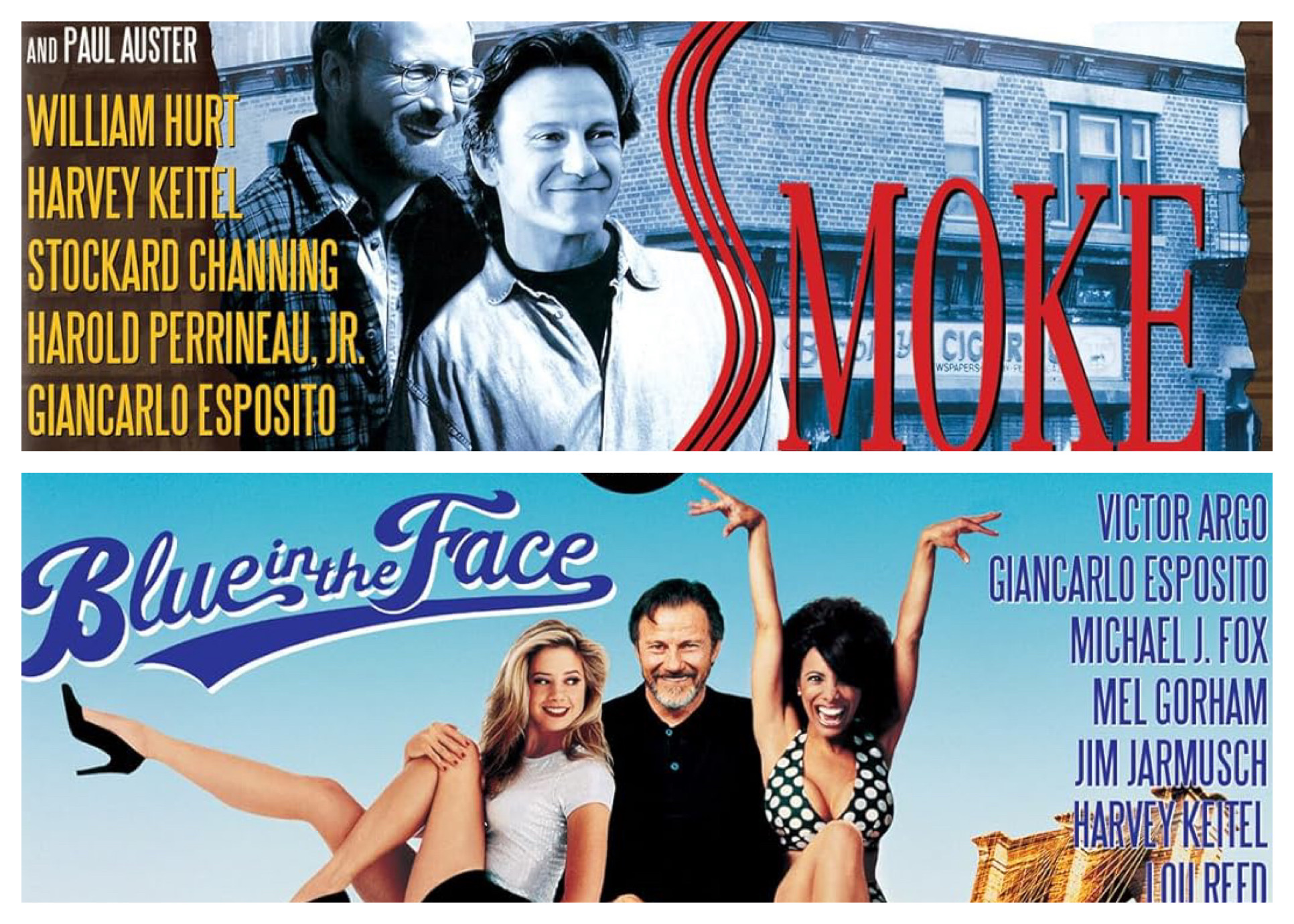
Harvey Keitel and an all-star cast star in two films for Wayne Wang and Paul Auster, Smoke and Blue in the Face, the new beautiful Blu-ray double feature from Kino Lorber.
The Films
Smoke is the rarest of films. One that studios or streamers would not dare make. A look at people, a city, and life as life happens on its terms. People talk and interact as they do in day-to-day life. Even back in 1995, the Wayne Wang-directed, Paul Auster-scripted film was special and has only grown in esteem in its quiet and moving humanity.
Auggie (Harvey Keitel) runs a smoke shop in the heart of Brooklyn. Paul Benjamin (William Hurt) is one of his many patrons who come in and out of the store daily to share a smoke or a moment of reprieve from his stalled writing. Enter Rashid (Harold Perrineau) into Paul’s life, a young man in need of help. That help from the cagey Paul opens the world of these three souls and many others for the better and worse, but mostly better. As much as Auggie and Paul enrich Rashid, it’s more the opposite as Rashid gives these two men a richer life for being in their’s.
The film began life as a Christmas short story in the New York Times, written by Auster has turned into a film like the short story of unexpected humanity and life. The above description only skims the surface of the riches that Wang and Auster have in store for an audience willing to take their tour of Brooklyn. Like the New York Borough, the film takes place in the film is an unexpected treasure of humanity.
As much as Harvey Keitel and William Hurt put on a masterclass of acting, it is Harold Perrineau as Rashid that’s the heart and soul of the film. Perrineau is electric as the smart and talented Rashid, who truly had a bad run of luck. The actor is both heartbreaking and defiantly strong-willed as the character whose life is changed by not just these two men who help him, but also others in the film. To discuss the arc of Rashid would be to run the heart and crux of the film. There is a moment between Keitel, Hurt, Perrineau, and another titan of acting that’s a masterclass in silence that this reviewer considers one of the best scenes of the last fifty years.
There isn’t a gut-punch moment in Smoke that elevates it to one of the best of the ‘90s indie cinema movement. Rather, Smoke snakes into your soul with its act of kindness and human nature with the right amount of acidic comedic grace. Be it stealing an already stolen camera or showing a man his long-departed wife in pictures, Smoke and its characters are as uniquely New York and Brooklyn as anything put on screen. That in it of itself is deserving of reappraisal and reconsideration by cineastes.
Blue in the Face is the wiseass goodtime cousin to the serious but often funny Smoke. If Smoke is a slow Sunday morning, reading the New York Times with a cup of coffee and the one you love. Blue in the Face is the night out on the town with that same someone, drinking and dancing the night away. Directors Wayne Wang and Paul Auster’s companion piece to Smoke is every bit the freewheeling, improvisational comedy you want it to be.
Auggie (Keitel reprising his role from Smoke) has just been told by owner Vinnie (Victor Argo) that he’s selling the smoke shop. Over the next week, Auggie and those in and around the smoke shop contend with micro dramas, comedy, singing telegrams (by Madonna, no less), tragedy, adultery, Belgian waffles, Jackie Robinson, and pollsters. It all ends happily, though, with a dance off with RuPaul no less… only in Brooklyn in the summer.
Again, the film, as constructed by Wang and Auster, is deserving of being discovered on its own merits. This film is as loose as they come. There isn’t a story other than the throughline of the smoke shop being sold. Blue in the Face is a love letter to Brooklyn and the conversations and confrontations one has in the borough. The love of Jackie Robinson and the pain and heart of the Brooklyn Dodgers. The hustle of a young entrepreneur. The anger of a housewife wanting attention. The chance meeting of two high school friends. Is all done with the sort of exciting possibilities of film that made ‘90s indie cinema so compelling.
Blue in the Face is the kind of comedic delight that, from moment to moment, is so expected that it feels like the Brooklyn so many of us have remembered but no longer exists. In Wang and Auster’s hands, it feels as though it’s that dream of a time that may never have existed, but only in our hearts. Though that may be true, we have this film as a document of not just a place and time, but an era of cinema where something as magical as Blue in the Face could be produced and released in thousands of theaters around the world.
The Transfers
The all-new HD Masters by Paramount Pictures – From 4K Film and 2K Film Restorations by ZAP Zoetrope Aubry Productions – San Francisco are flawless representations of these 35mm shot films. Both films look excellent on Blu-ray. There really isn’t a way to distinguish between the two films as they were filmed at the same time by cinematographer Adam Holender. The work here is beautiful, the transfers retaining the filmic look of both films. Though there is some video footage in Blue in the Face that still manages to maintain consistent image quality. Having seen both of these films in theaters when initially released and on Laserdisc, and eventually on DVD, this is the best the films have looked since the theater. The image managed to retain much of the grain structure and the gritty but warm feel of both films. Kino Lorber continues their curation of truly wonderful restorations on home video.
The Extras
They include the following;
Smoke – Behind-the-Scenes Featurette (20:51) – this archival behind-the-scenes featurette shows the origins of the film with the NY Times short piece of fiction by Paul Auster, turning that piece into the film Smoke. This featurette is fairly in-depth piece that goes into the origins, development, casting, and production of this special film using interviews, b-roll footage, and scenes from the film. If you loved the film, this featurette shouldn’t be missed, as it’s an excellent featurette with some great anecdotes from the making of this film. Featuring interviews with director Wayne Wang, writer Paul Auster, actors William Hurt, Harvey Keitel, Stockard Channing, Forrest Whitaker, Ashley Judd, Harold Perrineau, and cinematographer Adam Holender.
Smoke – Berlin Film Festival Press Conference (44:23) – this archival press conference from 1995 during the premiere of both Smoke and Blue in the Face, which were shown as a double feature. This is actually a great source of information about the production of the film, including how the film Blue in the Face came about. Though it should be noted that this press conference is very similar to current era Q&As, with a fair amount of terrible questions and some strangely adversarial, pushy statements, along with the relevant questions about the film. Luckily, those involved keep their cool in answering these questions. Featuring actor Harvey Keitel, writer Paul Auster, director Wayne Wang, actor William Hurt, producer Peter Newman, and producer Hisami Kuroiwa.
Smoke Interview with Director Wayne Wang, moderated by Kate MacKay, Associate Film Curator at Berkeley Art Museum and Pacific Film Archive (22:32) – in this all-new interview begins with MacKay asking if Wang smokes or was a smoker during the making of the film. The director goes on to discuss how he became interested in the Paul Auster NY Times Christmas story; his first interactions with Auster; the first screenplays that were produced that were over 300 pages; how the success of Joy Luck Club led to his being able to make Smoke; the reasons why he chose Smoke after Joy Luck Club; how they were able to cast Harvey Keitel; the honest story behind how they were able to get William Hurt who was notoriously difficult to work with; how the two actors worked so differently; Brooklyn and the cigar store as characters – which leads to a discussion of the work of production designer Kalina Ivanov, the real life smoke shop that Auster was obsessed with; how the storyline of the photographs played a major story point in the film; and much more.
Blue in the Face Interview with Director Wayne Wang, moderated by Kate MacKay, Associate Film Curator at Berkeley Art Museum and Pacific Film Archive (18:05) – in this all-new interview begins with MacKay about how Blue in the Face came about. The director goes on to explain being ahead of schedule during the Smoke shoot and doing something smaller, “wilder” (his word), doing it without a script (to which Auster wrote an outline). They go on to discuss the ”loose story” that the film is framed by; the various themes and threads that make up Brooklyn, and what they wanted to focus on; their specific and unique use of music as it relates to Brooklyn; the statistics that feature in the film and if they were factual; how they went about getting the Hi-8 documentary footage and Harvey Wang’s contribution; the stylistic differences between the two films – and how they approached the editing of Blue in the Face; the work of Michael J Fox and how he came to appear in the film; the cameo by Rupal and how that came about; and much more.
Blue in the Face: Archival Conversation with Lou Reed (18:12) – this is more than just an interview with the musical legend. This featurette is the actual interview footage (which was shot on 35mm) with Lou Reed that features prominently in Blue in the Face. Reed discusses all manner of topics including leaving NYC for good; people he has interesting conversations with; living in the Lower Eastside; the various boroughs of NYC; his love of walking around NYC; what he loves in his movies when going to see films in the theater including his thoughts on advertising in theaters; his thoughts on smoking and quitting cigarettes; and much more. More than filler, this is a wonderfully verbose, spirited conversation with the rock star.
Interview with Writer Paul Auster [Excerpts from Running Away to the Circus: Paul Auster on Film] (23:08) – in this all-new interview, which is an excerpt from a documentary, begins with the origins of the story that would eventually become Smoke, which was published in the NY Times at Christmas. The writer goes on to discuss how they eventually got financing for the film, and the unique situation they had to make the film; the unique improvisational nature of Blue in the Face, and how the film came to be out of the improvisations during the rehearsals of Smoke; how the three day production of Blue in the Face came to be; how he became co-director of Blue in the Face; how they got three additional days to fill out the film – the additional cast that came in including Michael J Fox, Rupal, Madonna; where the obsession of Belgian waffles came about; and much more.
The Final Thought
Two of the very best independent films of the ‘90s, and Kino Lorber has done them right by giving them this beautiful double feature Blu-ray Edition. Highest Possible Recommendations!!!
Kino Lorber’s Blu-ray Edition of Smoke / Blue in the Face Double Feature is out now
Share this:
Like this:
Discover more from The Movie Isle
Subscribe to get the latest posts sent to your email.