It does have to be stated before anything that this was made well before cultural norms deemed it unacceptable to have someone portray someone who isn’t his/her race.
The Castle of Fu Manchu is the final Christopher Lee film as the Pulp Super Villain. Many consider this the worst of the five-film series and accuse this of killing the franchise. The unfair assessment of a series that is as serious as Batman ’66. Much like Batman ’66, the Jess Franco film dives deep into the colorful underground laboratories with plentiful jars and beakers filled with boiling, colorful liquids.
Fu Manchu (Lee) and his daughter Lin Tang (Tsai Chin) have a new plan for world destruction. This time, it is freezing the world into a new ice age. His plan and new super weapon depend on two things: heroin and the work of Dr. Curt Kessler (Günther Stoll). Thus begins Fu Manchu’s taking over the heroin trade in Morocco and kidnapping Dr. Kessler and his doctor to keep the weak-hearted Kessler alive. Can Fu Manchu’s nemesis, Neyland Smith (Richard Greene), foil the villain’s plan for world destruction?
It isn’t a bad movie as many claim it to be. Even within the work of Jess Franco, you can find many other “films” that are crimes against cinema. The film does really feel like it’s a Saturday morning version of a series that was more adult-flavored pulp of the mid-to-late 1960s. That shift in tone and style, along with the terrible opening sequence, makes for a jaunty but not terrible experience. If one gets over these hills you are treated to a delightfully colorful (in terms of visuals) pulp adventure that may be defanged of the sexuality and violence but is just as wildly quirky and strange.
The biggest crime is the lack of Christopher Lee, who is the best part of the film, other than the visuals. Lee as Fu Manchu is what you would want in a pulpy super villain. The actor is all stature and imposing physicality. Even in the goofiest of scenes, Lee is nothing short of magnetic. The same can be said of Tsai Chin, who is also shortchanged in screentime as Fu Manchu’s daughter and instrument of his actions. Though you cannot be mad at a film that fills its time with Lee and Chin with moments like their hooded goons running around the streets of modern-day Spain (filling in Morocco) with horse carriage with dead bodies.
The Castle of Fu Manchu isn’t a perfect film, but it’s not the “worst film of all time,” maybe somewhere in between, making it all the more fascinating visually unique film.
The Transfer
The all-new 4K restoration from the original camera negative in Dolby Vision HDR is another excellent example of the work done by Blue Underground. The image is a healthy, sharp affair throughout. There isn’t a scratch or blemish present throughout the runtime. The transfer is gorgeously luminous, showcasing the beautiful photography, which in previous iterations was muddy to say the least. The image has a patina of active grain throughout, giving the transfer a look of a beautifully archived 35mm print. The Dolby Vision allows for retaining all the beautiful black and contrast levels without a hint of artifacting or crushing of the blacks, making the 35mm shot film look beautifully representative of its origins.
The Extras
They include the following;
NEW! Audio Commentary with Film Historians Nathaniel Thompson and Troy Howarth
The Fall of Fu Manchu – Interviews with Director Jess Franco, Producer Harry Alan Towers, and Stars Christopher Lee & Tsai Chin
NEW! Castle of Carnage – Interview with Stephen Thrower, Author of “Murderous Passions: The Delirious Cinema of Jesus Franco”
International Trailer
NEWLY EXPANDED! Poster & Still Gallery
NEW! RiffTrax Edition – THE CASTLE OF FU MANCHU Riffed by Mike Nelson, Bill Corbett & Kevin Murphy (75 Mins.)
The all-new Audio Commentary with Film Historians Nathaniel Thompson and Troy Howarth begins with their bonafides before diving into the fifth and final Fu Manchu that Harry Alan Towers made. Some of the details include the inclusion of the A Night to Remember footage and The Brides of Fu Manchu to create this new opening; a discussion of the much maligned last entry and making a case for the film after the “choppy” opening sequence; their first viewing experiences of the film – a larger discussion of how once the film was restored showed the work and visual style of Franco which did not appear to be present on the terrible VHS versions; the production schedule and locations (which was done in Spain); the release of the film; the credit sequences and discrepancies in the English language versions as opposed to the other languages that reveal more accurate credits; Franco’s career and the critique that he “killed careers” and the unfair assessment that was laid on him; a larger discussion of Franco’s style and the use of Zoom (both in and out); the various possible coded imagery and characters that show up in the film; how the film was close to the production of Franco’s Justine this film was – and how many locations it shared; the lack of period detail – though the film never really states it is a period film; the work of cinematographer Manuel Merino; the MST3K episode, which leads to a larger conversation that the show did a disservice of the film (including this one) they were showing; the lack of issues putting this through the board of censors in the UK; the film being edited down in various countries but not for violence or sex/nudity; a discussion of where Franco was in his career and if he was involved with editing of the film; a larger discussion throughout of the various actors and crew that appeared and worked on; and much more.
The Fall of Fu Manchu (14:01) – archival interviews with Director Jess Franco, Producer Harry Alan Towers, and Stars Christopher Lee & Tsai Chin. The interviewees discuss the subject of how they came onto the projects, stories of Jess Franco and their time in Brazil and Spain, the caustic nature how they made these final Fu Manchu films, of making this particular film, the film itself, and its quality of The Castle of Fu Manchu, and how it ostensibly ended the Fu Manchu franchise and why. Also, the cultural impact and the historical context in which these films and this film was/were made.
Castle of Carnage (21:25) – the all-new interview with Stephen Thrower, Author of “Murderous Passions: The Delirious Cinema of Jesus Franco,” is a companion piece to his Sanguine-Stained Celluloid interview on The Blood of Fu Manchu. Thrower’s own admission that the film has been the recipient of scorn, but the film has more going for it than The Blood of Fu Manchu, including more Fu Manchu. The historian goes on to discuss the screenplay/development; the issues with the production; the collaboration between Towers and Franco; working with the level of stars that Towers’ production allowed Franco; Franco’s style, and what worked best for him during production and how that was at odds with this production; the notorious opening sequence; the work of Christopher Lee and Jess Franco post-The Castle of Fu Manchu; the locations used in Spain including one of the most iconic locations that doubled for a castle in Istanbul; and much more. This dissection of the final Franco-directed Fu Manchu film (and the final Fu Manchu film) is a wonderful dissection that Thrower is known for producing.
International Trailer (2:26)
Poster & Still Gallery – a verbose 130+ posters, Press materials/writeups, lobby cards, both color and black and white production stills, and home video art.
RiffTrax Edition – THE CASTLE OF FU MANCHU Riffed by Mike Nelson, Bill Corbett & Kevin Murphy (1:15:05) – is an all-new special feature. As I said in my review for The Blood of Fu Manchu for those that love RiffTrax, this is definitely your jam. I’ve never been sold on this or MST3K or RiffTrax (which is slightly different a format than MST3K) as a venture into film fandom. I don’t bemoan it for anyone who loves them. But my love comes from a less snarky area of fandom, so these do not work for me. I did watch, and yes, for those that love what Nelson and Co. and what they do, this is going to be your jam. This also like the one on Blood, wasn’t very memorable to me, but none of these really are (though I will say that for all my complaints about these that make fun of films, MST3K and their Time of the Apes episode may be one of the funnier things I’ve ever seen). I commend Blue Underground for including this, as I know many who will be purchasing these titles specifically for this, as their love of certain films comes from Nelson and Co. taking them on and lampooning them in this way.
The Final Thought
Blue Underground has given this title a truly marvelous upgrade in picture, adding new special features, making this a HIGH RECOMMENDATION for the cult loving film fan for this much-maligned film, giving it a second lease on life.

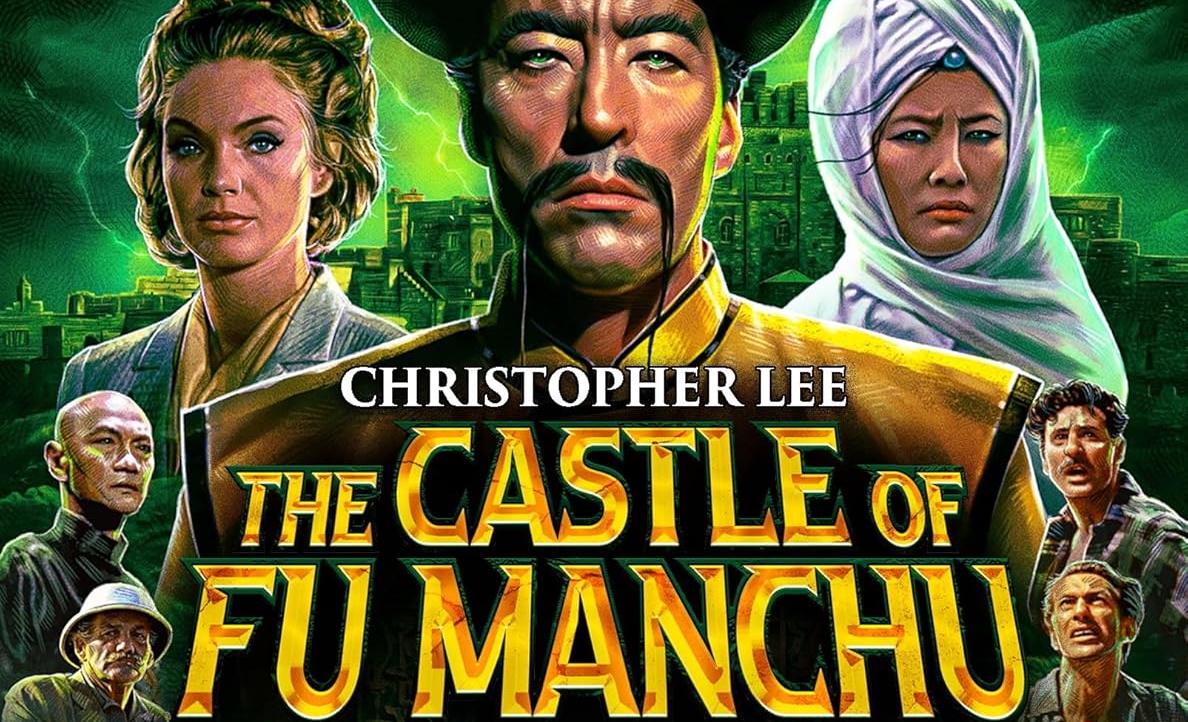
Christopher Lee stars in director Jess Franco’s continuation of their insane collaboration with The Castle of Fu Manchu. Newly minted in glorious 4K UHD thanks to Blue Underground.
The Film
It does have to be stated before anything that this was made well before cultural norms deemed it unacceptable to have someone portray someone who isn’t his/her race.
The Castle of Fu Manchu is the final Christopher Lee film as the Pulp Super Villain. Many consider this the worst of the five-film series and accuse this of killing the franchise. The unfair assessment of a series that is as serious as Batman ’66. Much like Batman ’66, the Jess Franco film dives deep into the colorful underground laboratories with plentiful jars and beakers filled with boiling, colorful liquids.
Fu Manchu (Lee) and his daughter Lin Tang (Tsai Chin) have a new plan for world destruction. This time, it is freezing the world into a new ice age. His plan and new super weapon depend on two things: heroin and the work of Dr. Curt Kessler (Günther Stoll). Thus begins Fu Manchu’s taking over the heroin trade in Morocco and kidnapping Dr. Kessler and his doctor to keep the weak-hearted Kessler alive. Can Fu Manchu’s nemesis, Neyland Smith (Richard Greene), foil the villain’s plan for world destruction?
It isn’t a bad movie as many claim it to be. Even within the work of Jess Franco, you can find many other “films” that are crimes against cinema. The film does really feel like it’s a Saturday morning version of a series that was more adult-flavored pulp of the mid-to-late 1960s. That shift in tone and style, along with the terrible opening sequence, makes for a jaunty but not terrible experience. If one gets over these hills you are treated to a delightfully colorful (in terms of visuals) pulp adventure that may be defanged of the sexuality and violence but is just as wildly quirky and strange.
The biggest crime is the lack of Christopher Lee, who is the best part of the film, other than the visuals. Lee as Fu Manchu is what you would want in a pulpy super villain. The actor is all stature and imposing physicality. Even in the goofiest of scenes, Lee is nothing short of magnetic. The same can be said of Tsai Chin, who is also shortchanged in screentime as Fu Manchu’s daughter and instrument of his actions. Though you cannot be mad at a film that fills its time with Lee and Chin with moments like their hooded goons running around the streets of modern-day Spain (filling in Morocco) with horse carriage with dead bodies.
The Castle of Fu Manchu isn’t a perfect film, but it’s not the “worst film of all time,” maybe somewhere in between, making it all the more fascinating visually unique film.
The Transfer
The all-new 4K restoration from the original camera negative in Dolby Vision HDR is another excellent example of the work done by Blue Underground. The image is a healthy, sharp affair throughout. There isn’t a scratch or blemish present throughout the runtime. The transfer is gorgeously luminous, showcasing the beautiful photography, which in previous iterations was muddy to say the least. The image has a patina of active grain throughout, giving the transfer a look of a beautifully archived 35mm print. The Dolby Vision allows for retaining all the beautiful black and contrast levels without a hint of artifacting or crushing of the blacks, making the 35mm shot film look beautifully representative of its origins.
The Extras
They include the following;
The all-new Audio Commentary with Film Historians Nathaniel Thompson and Troy Howarth begins with their bonafides before diving into the fifth and final Fu Manchu that Harry Alan Towers made. Some of the details include the inclusion of the A Night to Remember footage and The Brides of Fu Manchu to create this new opening; a discussion of the much maligned last entry and making a case for the film after the “choppy” opening sequence; their first viewing experiences of the film – a larger discussion of how once the film was restored showed the work and visual style of Franco which did not appear to be present on the terrible VHS versions; the production schedule and locations (which was done in Spain); the release of the film; the credit sequences and discrepancies in the English language versions as opposed to the other languages that reveal more accurate credits; Franco’s career and the critique that he “killed careers” and the unfair assessment that was laid on him; a larger discussion of Franco’s style and the use of Zoom (both in and out); the various possible coded imagery and characters that show up in the film; how the film was close to the production of Franco’s Justine this film was – and how many locations it shared; the lack of period detail – though the film never really states it is a period film; the work of cinematographer Manuel Merino; the MST3K episode, which leads to a larger conversation that the show did a disservice of the film (including this one) they were showing; the lack of issues putting this through the board of censors in the UK; the film being edited down in various countries but not for violence or sex/nudity; a discussion of where Franco was in his career and if he was involved with editing of the film; a larger discussion throughout of the various actors and crew that appeared and worked on; and much more.
The Fall of Fu Manchu (14:01) – archival interviews with Director Jess Franco, Producer Harry Alan Towers, and Stars Christopher Lee & Tsai Chin. The interviewees discuss the subject of how they came onto the projects, stories of Jess Franco and their time in Brazil and Spain, the caustic nature how they made these final Fu Manchu films, of making this particular film, the film itself, and its quality of The Castle of Fu Manchu, and how it ostensibly ended the Fu Manchu franchise and why. Also, the cultural impact and the historical context in which these films and this film was/were made.
Castle of Carnage (21:25) – the all-new interview with Stephen Thrower, Author of “Murderous Passions: The Delirious Cinema of Jesus Franco,” is a companion piece to his Sanguine-Stained Celluloid interview on The Blood of Fu Manchu. Thrower’s own admission that the film has been the recipient of scorn, but the film has more going for it than The Blood of Fu Manchu, including more Fu Manchu. The historian goes on to discuss the screenplay/development; the issues with the production; the collaboration between Towers and Franco; working with the level of stars that Towers’ production allowed Franco; Franco’s style, and what worked best for him during production and how that was at odds with this production; the notorious opening sequence; the work of Christopher Lee and Jess Franco post-The Castle of Fu Manchu; the locations used in Spain including one of the most iconic locations that doubled for a castle in Istanbul; and much more. This dissection of the final Franco-directed Fu Manchu film (and the final Fu Manchu film) is a wonderful dissection that Thrower is known for producing.
International Trailer (2:26)
Poster & Still Gallery – a verbose 130+ posters, Press materials/writeups, lobby cards, both color and black and white production stills, and home video art.
RiffTrax Edition – THE CASTLE OF FU MANCHU Riffed by Mike Nelson, Bill Corbett & Kevin Murphy (1:15:05) – is an all-new special feature. As I said in my review for The Blood of Fu Manchu for those that love RiffTrax, this is definitely your jam. I’ve never been sold on this or MST3K or RiffTrax (which is slightly different a format than MST3K) as a venture into film fandom. I don’t bemoan it for anyone who loves them. But my love comes from a less snarky area of fandom, so these do not work for me. I did watch, and yes, for those that love what Nelson and Co. and what they do, this is going to be your jam. This also like the one on Blood, wasn’t very memorable to me, but none of these really are (though I will say that for all my complaints about these that make fun of films, MST3K and their Time of the Apes episode may be one of the funnier things I’ve ever seen). I commend Blue Underground for including this, as I know many who will be purchasing these titles specifically for this, as their love of certain films comes from Nelson and Co. taking them on and lampooning them in this way.
The Final Thought
Blue Underground has given this title a truly marvelous upgrade in picture, adding new special features, making this a HIGH RECOMMENDATION for the cult loving film fan for this much-maligned film, giving it a second lease on life.
Blue Underground’s 4K UHD Edition of The Castle of Fu Manchu is out now.
Share this:
Like this:
Discover more from The Movie Isle
Subscribe to get the latest posts sent to your email.