
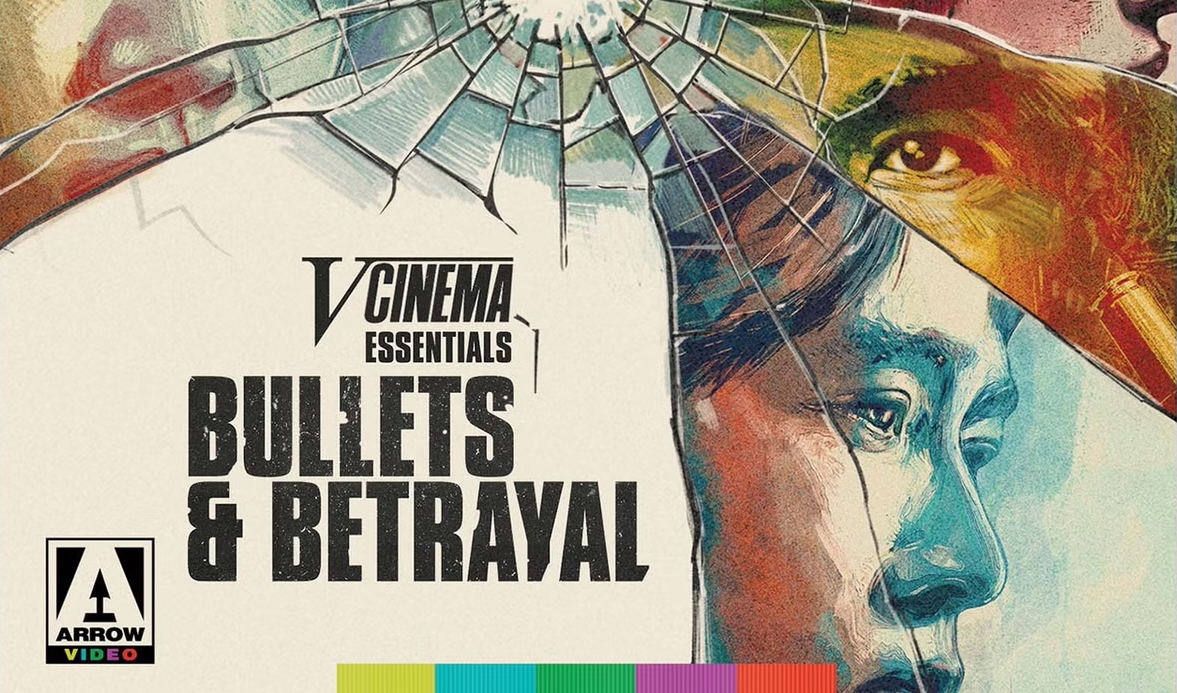
Arrow Video has packed 9 of Japanese V-Cinema (their equivalent of DTV) Action Cult Classics in one box set: V-Cinema Essentials: Bullets & Betrayal. The box set comes loaded with special features!


The Films
Crime Hunter: Bullets of Rage
A shot of adrenaline. This 58-minute piece of action potboiler feels as much Michael Mann as it is John Woo as filtered through the low budget world of Japanese Cop films. The set up is simple; a pair of cops get setup trying to take down a drug dealer. One survives Detective Joe Kawamura (Masanori Sera), one doesn’t. The one that survives goes on a manhunt for vengeance taking along with him a Nun (Minako Tanaka) with a score to settle and a bag of charity money to get back. Commence with the hail of bullets, buckets of blood, and copious amounts of tough guy speak. It all ends like all great 80s films do in a manufacturing plant (minus the Cobra sparks) but much more … existentially than US films of this ilk do.
They use Okinawa as Los Angeles, specifically Little Tokyo, almost brazenly as they knew that real Angelenos would never set eyes on this pic. The result is like shooting Tokyo in Toronto… just a wild piece of low budget daring and IDGAF attitude that adds to the ballsy charm of it all. The bad guy being named Bruce (Seiji Matano) seems to be a nod to Bruce Willis – who’s Die Hard was a worldwide sensation – and to hear Joe yell out his name repeatedly is a thing of joy.
Director Shundo Okawa creates a truly wonderful action picture here that’s low on exposition and character – which is a good thing – and high on action and drama. It moves with a pace that truly defines “breathless”. It may be low budget but it’s definitely hitting above its weight class and has this reviewer dying to see Crime Hunter 2 and 3.
Neo Chinpira: Zoom Goes the Bullet
I was not expecting something as contemplative as this drama-comedy-crime film was. It feels like nothing happens during this character study of a low-level yakuza driver (Show Aikawa) that gets tasks to be a hitman who can’t seem to pull the trigger. It is almost the anti-climatic version of this yakuza thriller. Going hard into the contemplative and fear of a youth who is asked to kill someone. Which becomes more and more fascinating but troubling as he begins a troubling relationship with a wild child of a young woman, Yumeko (Chikako Aoyama). How that relationship evolves with his hesitance and his inability to finish “the job” his Yakuza management has asked him to fulfill is the core of the film.
Director Banmei Takahashi creates more of a commentary on the fruitily of a violent lifestyle that youth want all the perks of and none of the responsibility. The way this plays out more of a reckless youth drama and doom youthful romance is one of the more interesting mashup this reviewer has ever seen. A special appearance by Joe Shishido elevates this piece into the Patheon of truly great Yakuza films – just one that’s more ponderous like Takeshi Kitano’s Sonatine than it is the action driven Yakuza films of Kinji Fukasaku.
Stranger
The crassest description of this is Female Taxi Driver Tokyo Edition. Though the film by writer/director Shunichi Nagasaki is much more than that. A feminist critique of Japanese society wrapped in a genre package Stranger works both a character drama and thriller. Stranger is a tense psychological thriller that works better than most thrillers of the day because of its writing, direction and themes of sexism and persecution that females faced in Japan in the 1980s and 1990s as they rose in the work force.
After Bank Employee Kiriko (Yuko Natori) is duped by her would-be lover and conman Kenichi (Naito Kenichi) into stealing hundreds of thousands of dollars, she is forced into the life of a cabbie. As a cabbie she’s subjected to not just the classism by the various fares she must take but she’s also subjected to constant sexual harassment by fellow cabbies – including the newest cabbie Kijima (Kentaro Shimizu). All of this made worse when she begins to be stalked by an unknown figure in a 4-Runner. These appearances begin to take an ever increasingly sinister and violent turn. With her employer not believing or in a state of apathy, Kiriko is forced to take drastic measures and trust Kentaro’s want to help her. Though if she is going to confront this stalker it will be on her own terms.
Stranger by the finale an excellent and thrilling car chase has set the standard for just how compelling and elevated V-Cinema can be. It does not have to always be bloodshed, bullets, sex and gangsters. It can be a character-based thriller with more on its mind than cheap violence. Writer/Director Nagasaki has concocted a truly great film that elevates itself from its direct-to-video origins. No matter the release format Stranger delivers.
Carlos
The way a low-level immigrant criminal starts a proxy war between two rival gangs is the kind of unique take on the Yakuza genre that V-Cinema offered. The film’s pitch-black outlook on humanity is even darker than the normal existential outlook offered by Yakuza action thrillers. Director Kazuhiro Kiuchi’s film is electric because of the tensions between the Yakuza and the immigrant class gangs, suffering no fools as both sides escalates this war to its blood-soaked bullet ridden conclusion.
Naoto Takensaka as Carlos is an agent of chaos and simmer anger. The performance is electrifying with Takensaka’s Carlos moves through the Yazuka underworld with righteous indignation as the racism, classism, and violence he faces at every turn. There’s an almost youthful DeNiro quality to the way that Takensaka sucks the air out of a scene. Even the best of the performers in the film don’t hold a candle to Takensaka. The biggest drawback of the film is that it when Carlos/Takensaka isn’t on screen the film falters and slows, losing a sense of urgency that his character imbues the film with.
Director Kiuchi’s film never strays from Carlos and his ever-worsening situation till its bleak bloody finale. One that even on a budget gives DePlama’s Scarface finale a run for its money. Carlos is not just a unique Yakuza film but one that‘s as brutal as it’s thrilling.
Burning Dog
Shu (Seiji Matano) is double crossed post heist. Having killed all but one of his crew that betrayed him, he must go to Okinawa to cool down. There in Okinawa is there anything but cool. Its scorching hot, even hotter now that his friend wants him in on a bank job. An “easy” job that just requires them to go into the middle of the US Army Base to pull off. Double crosses, triple crosses, and quadruple crosses surround Shu. Though a chance to get back at the guy who double crossed him in Tokyo is too ripe to pass up. All that and a $20 Millon US Dollar pay day. What could possibly go wrong? In a word, everything.
Writer/Director Yoichi Sai’s Burning Dog feels like a Japanese set Donald Westlake or Jim Thompson novel in its causal brutality, violence, and existential viewpoint. His use of Okinawa both in the typical (US Military Bases) and the atypical (the Japanese owned business we get a glimpse into) makes Burning Dog a compelling visual film. The film isn’t just a lazy seaside island but an exodus for Shu – a place he must contend with and escape from.
The centerpiece heist of the film is everything you want it to be – daring, thrilling, and a complete disaster. The final act of the film post-heist is where Sai’s writing and direction truly shines. Bleak in a way that feels matter-of-factly brutal as Shu begins to realize the end game and who has truly double crossed him. In the film’s final moments, the violence is not just shocking but as blunt as we’ve seen in the film. In that moment, Shu has won but at a cost of it all. As though Doc was by himself at the end of The Getaway – his only choice to go it alone to El Ray with his bag of cash.
Female Prisoner Scorpion: Death Threat
A reboot of the iconic genre series from the 1970s gets a 1990s coat of paint. Make no mistake this isn’t any softer than by any means. Co-Writer/Director Toshiharu Ikeda and screenwriter Fumio Konami have created a film that’s as hard, vile, and bloody as anything from the original series. Adding a quasi-political and social bent to fit the era adds to this bleak 90-minute action thriller. The way they tie this series to the original is pretty inventive for the time. Though a V-Cinema entry this is by no means a lesser entry into the series and contends with the very best of the long running series.
Two decades after the original a Gangster has gone respectable as now a hopeful Politician. The largest of his secrets lays dormant in the dungeon of a Japanese prison. Now that prison is being closing, he cannot risk it coming out that a prisoner has been kept in such conditions. He tasks his best female Assassin (Natsuki Okamoto) to go in and kill her. The Assassin gets more than she bargains for as there is more at play within the Prison walls beyond the Dungeon kept Prison.
Part Prison film. Part Revenge Escape film. All brutal Female Prison Scorpion. Director Ikeda’s film not only does the film series justice, in many ways it tops the best entries of the series by using the history and story build throughout the series. We are used to reboots or legacy-sequels now but in the early 90s this wasn’t the norm. It’s shocking that without a real template that this film does everything right.
Even if the prison and prison escape genres are not your thing – and for many it won’t. It will be hard to deny the blood-soaked finale at an amusement park isn’t peak action cinema.
The Hitman: Blood Smells Like Roses
This film starts off hard and doesn’t relent for its 86-minute run time. The lean thriller gives us the simple story of a man whose wife is murder during a Yakuza proxy war shootout and decides to take on the entire Yakuza because of it.
Writer/director Teruo Ishii has concocted a Molotov cocktail of a revenge film. Ice cold and burning hot clever play on Yojimbo with a steely lead in Hideki Saijo as the husband turned cold blooded killer Yuichiro Takanashi. The film is as lean as they come with the barest of plot points being doled out through the film’s runtime. Ishii does give some complications with the addition of a female entanglement Rumi (Nanase Natsumi) who at every turn seems to hinder Takanashi’s efforts.
The Hitman: Blood Smells Like Roses is a film that builds and builds to its John Woo style dizzy guns and explosions ending. Special note of the model work at that finale is as truly inspired as the bullets and bloodshed quarry set finale itself. Bonus points to the film and the end credit sequence with the J-rock song has to be seen and heard to be believed, that has nothing to do with the film.
Danger Point: The Road to Hell
$20 million has gone missing after a botched gun deal and the Yakuza want to know what happened to it. Enter Joji (Joe Shishido) and Ken (Show Aikawa) two hitman/enforcers trying to solve the mystery of who has the money. Armed with their wits, brutality and a suitcase filled with exotic guns. They stop at nothing to find not the truth but the money. Truth be damn, because everyone is lying to them.
Director Yasuharu Hasebe and screenwriters Ryuzo Nakanishi and Takashi Fujii have created a witty and stylish Crime Mystery wrapped up in a Buddy Action Film packaging. The brief screentime given to Shishido and Aikawa in Neo Chinpira only hinted as the full-on great partnership Danger Point: The Road to Hell would prove to be. They may be the two coolest dudes in 90s Japanese Cinema as they chip away at who has that $20 million dollars. Shishido and Aikawa play off each other so well that even when they’re just in a hotel room cleaning guns you’re thrilled. Director Hasebe and director of photography Tatsumi Takahashi film them like the stars they are – giants who dwarf over anyone that comes into their orbit.
Special note must be made of the Jazz-infused score by Makahiko Sato that’s just a damn 90s vibe in a way that you had to be there to understand how much of a vibe it is.
XX: Beautiful Hunter
So… this is. Well, I’m gonna warn you. This isn’t for everyone. XX: Beautiful Hunter makes Female Prisoner Scorpion: Death Threat look positively Disney by comparison. There is a level of … depravity as some would say that’s on display here that many will find distasteful. So, you’ve been warned. Proceed with caution.
You know you’re in for a wild ride when the opening moments feature a young girl being trained to be an assassin by some Rogue Japanese Catholic Sect of Nuns and Priests. Now, yes this isn’t anything that’s not been done by the MCU in Black Widow and The Thunderbolts* but here it’s… well it’s not done for the PG-13 set. In fact, this opening moment is about as sanitized as it gets as the film tells the tale of the aforementioned young girl, now an adult Shion (Makiko Kuno), as she defies her “programming” and refuses to kill a man Ito (Johnny Okura) who becomes her lover the worst of her criminal underworld come after her.
Make no mistake, director Masaru Konuma and screenwriter Hiroshi Takahashi have concotted a twisted psycho-sexual action thriller with the emphasis on psycho-sexual. Konuma’s past in the world of S&M softcore films at Nikkatsu plays heavily into this film. If XX: Beautiful Hunter isn’t in the midst of a brutal action scene it more than likely is in the throes of a sex sense or a scene of torture bondage. The film makes Skinamax late night films look reserved by comparison. Though XX: Beautiful Hunter has something on any Skinamax feature, its stylish, and amazingly produced.
The biggest problem is star Makiko Kuno and her lifeless performance. Some would say that this informs the character as she’s been essentially trained to be a killing machine. The problem is that once the character is shaken out of that, Kuno remains the same emotion-less character.
One does XX: Beautiful Hunter and director Konuma had been able to coax a different performance out of Kuno. Though many who love the extremities of cult films will find a new treasure in this wild and oftentimes inappropriate exploitation psycho-sexual action thriller.
The Transfers
In a word; amazing.
All eight films are brilliantly transferred to Blu-ray. This reviewer is unsure of what he was expecting from the visual look of these films, but it was not this. No one would think that these started as cheaply produced direct to video thrillers. Each of these films are masterfully transferred to Blu-ray. The care and time that Arrow and Toei have approached these restorations/transfers is astounding. The films – most shot on 16mm or 35mm – look beautiful. Thankfully Arrow has decided to present these titles in their original 1.33 Standard Academy framing. The grainy look of each of the films adds to the gritty aesthetic of the work. Though the grain is never distracting always adding to the razor-sharp transfers. There is not a scratch or blemish present on any of the films. Bottom line is that Arrow has gone above and beyond to give each of these films in the best possible presentation – beyond one can imagine. The transfers alone put this box set in the realm of Best Blu-ray Release of 2025.

The Extras
They include the following;
DISC 1 – CRIME HUNTER: BULLETS OF RAGE / NEO CHINPIRA: ZOOM GOES THE BULLET
- Newly filmed introductions to both films by Japanese film critic Masaki Tanioka
- Loose Cannon
- Zooming Out
- Crime Hunter and the Dawn of V-Cinema
- Original trailers for both films
DISC 2 – STRANGER / CARLOS
- Newly filmed introductions to both films by Japanese film critic Masaki Tanioka
- Stranger than Fiction
- From Manga to Movies
- An Extra Round in the Chamber
DISC 3 – BURNING DOG / FEMALE PRISONER SCORPION: DEATH THREAT
- Newly filmed introductions to both films by Japanese film critic Masaki Tanioka
- Fire and Ice, a brand new video essay on Burning Dog by critic and Japanese cinema expert Mark Schilling
- Toshiharu Ikeda’s Beautiful Monster of Vengeance, a brand new video essay on Female Prisoner Scorpion: Death Threat by film historian Samm Deighan
- Original trailers for both films
DISC 4 – THE HITMAN: BLOOD SMELLS LIKE ROSES / DANGER POINT: THE ROAD TO HELL
- Newly filmed introductions to both films by Japanese film critic Masaki Tanioka
- The Versatility of Teruo Ishii, a brand new video essay on The Hitman: Blood Smells Like Roses and its director Teruo Ishii by Japanese cinema expert Frankie Balboa
- The Road to V-Cinema, a brand new video essay on Danger Point: The Road to Hell by critic and Japanese cinema expert James Balmont
- Original trailer for The Hitman: Blood Smells Like Roses
DISC 5 – XX: BEAUTIFUL HUNTER
- Newly filmed introduction by Japanese film critic Masaki Tanioka
- The Sacred and the Profane, a newly filmed interview with screenwriter Hiroshi Takahashi
- They Brought Back the Sleaze, a brand new video essay on XX: Beautiful Hunter by critic and Japanese cinema expert Patrick Macias
- Original trailer
DISC 1 – CRIME HUNTER: BULLETS OF RAGE / NEO CHINPIRA: ZOOM GOES THE BULLET
Newly filmed introductions to both films by Japanese film critic Masaki Tanioka
- Crime Hunter: Bullets of Rage (4:47) – Masaki Tanioka discusses Toei’s first entry into V-Cinema and the background leading up to this with Toei’s history with crime thrillers, the director, and stars involved in the movie and the films that inspired Crime Hunter. In Japanese with English subtitles.
- Neo Chinpira: Zoom Goes the Bullet (4:25) – Masaki Tanioka discusses how this film created V-Cinema’s first star in actor Show Aikawa. The critic goes onto discuss the film’s style, its director Banmei Takahashi and his beginnings in Japan’s Pink Cinema, and the beginning of the rise of Nikkatsu action star of the 1960s Joe Shishido into V-Cinema. In Japanese with English subtitles.
Loose Cannon (18:24) – is an all-new interview with Crime Hunter: Bullets of Rage director Shundo Okawa opens with his decision out of film school to become a screenwriter before making a 16m short film based off of action scenes he loved. Okawa discusses how the short he made got him the job at Toei to do Crime Hunter; the era in which this first venture into direct to video was made; the people involved with this decision and how much research went into this decision; the issues during the production that he faced as an inexperienced – what he calls a student filmmaker – on this film; the film being designed as a sub-60 minute film; Beat Takeshi seeing the film and the inspirations he took from the film; some of the innovations from the film that he worked on to make Crime Hunter above what was Japanese Action films at the time; and much more. In Japanese with English subtitles.
Crime Hunter and the Dawn of V-Cinema (13:09) – is an all-new video essay on Crime Hunter: Bullets of Rage by Japanese cinema expert Tom Mes. Mes goes on to discuss the beginnings of Japanese rental video in the late 1970s into early 1980s; how the companies experimented with releases and eventually OVA (original video anime) being a huge success; the rise of the video rental markets – how this eclipsed Movie Theaters market; the economic boom in Japan and how that informed video; Toei’s creation of V-Cinema and how Fukasaku’s Battle without Honor and Humanity success on VHS was in large part of this; the release of Crime Hunter V-Cinema’s first film; a discussion of the film itself and how it was produced and made and why it was only 60 minutes long; the economic equations that helped Toei make huge success; a discussion of Neo Chinpira: Zoom Goes the Bullet and its success as well; the rise of other V-Production Labels; and much more. The visual essay is cleverly produced and edited with some great video clips, photo, and film footage.
Zooming Out (15:14) – is an all-new interview with Neo Chinpira: Zoom Goes the Bullet writer-director Banmei Takahashi. Takahashi begins with how Neo Chinpira as an attempt at a new style or genre of film. The director goes on to discuss the culture and conditions in which the film was made in – lack of budgets and lack of oversight; Toei approaching him and his producer to make a film under the V-Cinema banner; how they approached the development of the idea of making a yakuza film about uncool gangsters; some of the interesting research he did for the film – including casting and how Show Aikawa became someone they pointed him to; the collaboration with Aikawa – which started with clothing and hair style; how they developed the relationship/romance at the center of the film; how the lower budget (from prior films before getting into V-Cinema) informed the production and shooting locations; and much more. In Japanese with English subtitles.
Trailers for Crime Hunter: Bullets of Rage (1:54) and Neo Chinpira: Zoom Goes the Bullet (2:07) – both in Japanese with English Subtitles
DISC 2 – STRANGER / CARLOS
Newly filmed introductions to both films by Japanese film critic Masaki Tanioka
- Stranger (4:32) – Masaki Tanioka discusses this being writer-director Shunichi Nagasaki’s single V-Cinema film in his varied career. How Stranger is very much made in the B-Side of the Japanese cinema of the 60s and 70s but bucks the convention of the female led exploitation cinema of that era; the various actors that appear and the success and they had before and after this; actress Yuko Natori in the role; cultural touchstones of the film; and much more. In Japanese with English subtitles.
- Carlos (4:00) – Masaki Tanioka discusses this film’s rule breaking of not just film but cultural norms and taboos. Tanioka goes on to discuss race/racism, class, and culture in Carlos as it relates and works in the conventions of a very unique Yakuza thriller; the work of Director Kazuhiro Kiuchi – and how his work as a manga artist informed the visual style of the film; the critical reception of the film in the intervening years; and much more. In Japanese with English subtitles.
Stranger than Fiction (18:01) – is an all-new interview with Stranger writer-director Shunichi Nagasaki. The director begins with how the origins of working with actress Yuko Natori on this specific project begain on another film they collaborated and came to fruition with Toei asking him to direct a film. Nagasaki goes onto explain how he came to write the film himself; the development of the screenplay and unused ideas and why he ultimately chose the story he did; the research done for the project and what came out of that research; the inspiration that was taken unknowingly from Spielberg’s Duel; and much more. In Japanese with English subtitles.
From Manga to Movies (20:17) – is an all-new interview with Carlos writer-director Kazuhiro Kiuchi. The director begins with his love as a child of both manga and movies but ultimately choosing manga because of it being a more pragmatic goal. Kiuchi goes on to discuss how the rise of Toei’s DTV market made him initially want to invest and produce – as he began to work as a produce and the choice of director came up he became an option; the reasons why he became the director; how he came to develop the story which began as a Twainanese Gang film and how it eventually evolved into Carlos; why they cast Naoto Takenaka – and his work at the time only in comedy – and how doing the film as V-Cinema allowed the unconventional casting; how they got legendary cinematographer Seizo Sengen on the project; and much more. In Japanese with English subtitles.
An Extra Round in the Chamber (17:40) – is an all-new video essay on Carlos by critic and Japanese cinema expert Jonathan Clements. Clements begins with a dissection of Carlos’ plot before diving into the themes, visuals, and unique characters of this V-Cinema Classic. The essay goes on to discuss director Kiuchi’s success – including other examples of the kind of cross over success; the director’s manga Be-Bop High School – and its massive success as a film series and anime; the use of guns and gun play throughout the film – and cultural touchstones in Japan that guns take; the huge immigration of Brazilians in Japanese history; the racial and cultural boundaries that the film plays with; the star Naoto Takenaka – his rise as a star in Japan and where this film lands in his filmography; and much more.
DISC 3 – BURNING DOG / FEMALE PRISONER SCORPION: DEATH THREAT
Newly filmed introductions to both films by Japanese film critic Masaki Tanioka
- Burning Dog (4:05) – Masaki Tanioka discusses the films of director Yoichi Sai, his outsider status as he was a Korean living and working in Japan, his reputation for being physically abusive to his crew, and more. In Japanese with English subtitles.
- Female Prisoner Scorpion: Death Threat (3:33) – Masaki Tanioka discusses lead actress Natsuki Okamoto’s status as a model and personality who spoke her mind about issues at the time; the success and rebellion of screenwriter Fumi Konami and director Toshiharu Ikeda both here and other films within their other films; how Ikeda’s background informed the film that was produced; and more. In Japanese with English subtitles.
Fire and Ice (15:55) – is an all-new video essay on Burning Dog by critic and Japanese cinema expert Mark Schilling. Shilling discusses how Burning Dog is one of the best of director Yoichi Sai’s output but is little known outside of Japan and specifically known to fans V-Cinema. The visual essay goes on to discuss the origins and beginnings of V-Cinema – including Crime Hunter; the success V-Cinema and comparisons to the heyday of Toei genre output in the 1970s; a history of Sai’s career until he was hired for Burning Dog; Sai’s career post Burning Dog and its unexpected success; the true crime origins of Burning Dog’s story; a discussion of the careers of the various actors that were cast in the film; the film’s inspiration from other films and filmmakers; and much more.
Toshiharu Ikeda’s Beautiful Monster of Vengeance (12:08) – is an all-new video essay on Female Prisoner Scorpion: Death Threat by film historian Samm Deighan. Deighan discusses the personal and professional career of director Ikeda who worked in the Roman Porno Films and the themes of sadomasochism that are the primary focus of those soft-core sex films. The essay dissects what specifically how the Roman Porno and Pink Films were and how they could often subvert what one thinks of erotic films; the rise of V-Cinema and the Pink Films’ place in it; how does Female Prisoner Scorpion: Death Threat fit into this all and Ikeda’s filmography; a discussion of Female Prisoner Scorpion series and where Female Prisoner Scorpion: Death Threat takes from that series; the themes of Female Prisoner Scorpion: Death Threat and the larger touchstones within the genre; and more.
Original trailers for Burning Dog (0:17) and Female Prisoner Scorpion: Death Threat (2:09) – both in Japanese with English Subtitles.
DISC 4 – THE HITMAN: BLOOD SMELLS LIKE ROSES / DANGER POINT: THE ROAD TO HELL
Newly filmed introductions to both films by Japanese film critic Masaki Tanioka
- The Hitman: Blood Smell Like Roses (3:39) – Masaki Tanioka discusses the film directed by cult legend Teruo Ishii; the director making his first film in 12 year and how he 5 more V-Cinema films; the work of star and J-Pop legend Hideki Saijo; and much more. In Japanese with English subtitles. In Japanese with English subtitles.
- Danger Point: The Road to Hell (4:03) – Masaki Tanioka discusses director Yashuharu Hasebe along with director Banmei Takahashi made the best use of star Show Aikawa; the reteaming of Aikawa with acting legend Joe Shishido; what separated Hasebe and his Yakuza films from his contemporaries in V-Cinema; how Danger Point differs from Neo Chinpira – though both star Aikawa and Shishido; and much more. In Japanese with English subtitles. In Japanese with English subtitles.
The Versatility of Teruo Ishii (7:38) – is an all-new video essay on The Hitman: Blood Smells Like Roses and its director Teruo Ishii by Japanese cinema expert Frankie Balboa. Baloba discusses the varied and diverse the career of director Teruo Ishii – starting with a discussion of Abashiri Prison series connecting to Ishii V-Cinema’s classic The Hitman: Blood Smells Like Roses.
The Road to V-Cinema (14:42) – is an all-new video essay on Danger Point: The Road to Hell by critic and Japanese cinema expert James Balmont. Balmont discusses the how Japan’s V-Cinema though a fertile ground for new and exciting talent but oftentimes it’s a mixture of new and old talents. The video essay makes the case study for Danger Point: The Road to Hell starring legend Joe Shishido and new acting talent Show Aikawa directed veteran director Yashuharu Hasebe. Dissecting the careers Shishido, Hasebe, and Aikawa – including the history of the Japanese film industry – all leading to their collaboration in the fantastic Danger Point: The Road to Hell.
Original trailer for The Hitman: Blood Smells Like Roses (2:03) – in Japanese with English Subtitles.
DISC 5 – XX: BEAUTIFUL HUNTER
Newly filmed introduction by Japanese film critic Masaki Tanioka
- XX: Beautiful Hunter (4:03) – Masaki Tanioka discusses director Masaru Konuma and his beginnings with Nikkatsu Roman Porno films – making over 47 films in 17 years. Tanioka goes on to explain how Toei brough him on to their V-Cinema line expecting him to bring his crew but Konuma in an unexpected move did not and used the legends of Toei for his films. The critic goes on to discuss star Makiko Kuno’s less than impressive almost robotic like performance but how it works in favor for the film. In Japanese with English subtitles.
The Sacred and the Profane (17:39) – an all-new interview with screenwriter Hiroshi Takahashi. Takahashi discusses how he got his beginnings as a screenwriter because of V-Cinema producer “Man” Kurosawa eventually writing for the XX series. The screenwriter goes on to discuss his love of the first film because of the collaboration with director Masaru Konuma; a discussion of the source material the manga Shion; the influence that Konuma had on the next generation; their approach to the heighten aspects of the film and the films style – and Konuma’s insistence that the film be a “human drama”; Konuma’s rewriting his script on set and what that changed and examples; the differences in approach and style between him and Konuma; and much more. In Japanese with English subtitles.
They Brought Back the Sleaze (19:01) – an all-new video essay on XX: Beautiful Hunter by critic and Japanese cinema expert Patrick Macias. Macias discusses the origins of V-Cinema. Starting with the Toei B-Movie output to compete with Television in the 1970s which began to up the exploitation with Nikkatsu and their Roman Porno line of softcore S&M to which all but puttered out in the 1980s because of big budget event films. By the late 1980s the rise of V-Cinema using the model of the 1970s of action thrillers and low budget films. How the rise and success around the world the erotic thrillers and women with guns – to which V-Cinema took to make their own. How out of this came XX: Beautiful Hunter. A breakdown of the film both visually and the cast and crew that made the film – including discussion of the careers of director Konuma, star Makiko Kuno, co-stars Johnny Ohkura, Koji Shumizu, screenwriter Hiroshi Takahashi and others.
Original trailer (1:18) – in Japanese with English subtitles.
The Final Thought
Arrow Video has outdone themselves with their V-Cinema Box Set. From the Transfers to the special features to the film themselves put this Box Set in contention for Best Blu-ray Set of 2025. Highest Possible Recommendations!!!
Arrow Video’s Blu-Ray edition of V-CINEMA ESSENTIALS: BULLETS & BETRAYAL is out April 29th
Discover more from The Movie Isle
Subscribe to get the latest posts sent to your email.
Pingback: Big Bad Film Festival 2026: Crime and Punishment (Day Two) – The Movie Isle