Bob Clark’s clever Murder by Decree plays to the director’s strength as a filmmaker who was at his best in the horror genre. By melding Sherlock Holmes and Jack the Ripper the director created an entire subgenre that played with the Ripper intrigue (e.g., he was actually an agent of the Crown). Yes, Murder by Decree’s story and conspiracy has been done numerous times since it’s 1979 release but not with this cast.
Clark’s smartest move was the casting of Christopher Plummer and James Mason as Holmes and Watson respectively. Both are game to play the world’s greatest detective team. Plummer and Mason’s chemistry is off the chart great in that English dry wit sort of way. Plummer in particular relishes to play Holmes with the sort of sly theatricality that his best performances are imbued with. Watch as he ribs Mason’s Watson after a night in the clink. Mason is perfect as the reserved Watson. The actor has always been great at playing the preverbal stiff-upper-lip British types.
The film moves quickly in setting up the players and the murders with Holmes being brought in by chance to the White Chappel murders. Clark and screenwriter John Hopkins use of The Ripper Files a pulpy non-fictional account of Jack the Ripper by John Lloyd and Elwyn Jones as the basis for their film. They just take the basics of the story, going so far as to not even call the Ripper, “The Ripper” until the second half of the film. Which isn’t a bad thing. In fact, they play the right kind of fast and loose with the story to create their own play on the story, one that allows for the kind of action and scenes of humor that inject the film with a bump of energy.
Murder by Decree, and its stars, acquits itself quite well in the pantheon of Sherlock Holmes films. However, it’s in its final third where the film shines. Plummer’s Holmes facing off against none other than Sir John Gielgud in the corridors of power. It’s Clark’s understanding that giving Plummer a stage to perform will induce something special and it is special.
Yes, some will say that Plummer does go over the top but one can’t help but be caught up in Plummer as Holmes’s righteous indignation as he lays into Gielgud and Roy Lansford as Lord Salisbury and Sir Thomas Spivey (real-life figures). It’s these moments that Clark’s Sherlock Holmes tale elevates itself to something altogether different. Murder by Decree may have told a well-worn tale but never as adroitly as this one.
The Transfer
The all-new UHD SDR Master by StudioCanal is a beautiful upgrade and is the best the film has ever looked. Though some would complain about the lack of an HDR but the image in SDR has wonderful contrast and black levels. Adding an HDR layer to the image that is shot to mimic the London fog of the night and early mornings could have been troublesome. The transfer is still wonderfully verbose in its sharpness of the constant diffuse image. There is not a scratch or blemish on the image. An all-around excellent transfer that mimics the film’s 35mm origins to the tee.
The Extras
They include the following;
DISC 1 (4KUHD):
Audio Commentary by Director Bob Clark
Audio Commentary by Film Historians Howard S. Berger and Steve Mitchell
Theatrical Trailer
DISC 2 (BLU-RAY):
Audio Commentary by Director Bob Clark
Audio Commentary by Film Historians Howard S. Berger and Steve Mitchell
Theatrical Trailer
NOTE: All special features appear on both the 4K UHD and Blu-ray.
The first of two audio commentaries is by Director Bob Clark. Clark opens his track with the amazing model that opens the film. Some of the details include how he had to convince James Mason to star as Watson – and the two scenes he wanted to rewrite, which Clark gladly did; the approach they took to the murders and the style in which he knew he needed to employ and why he did so; the actual budget – and how difficult it was to produce a period piece; the importance of the style and how it informs time and place – especially a period piece; the casting what-if’s of Laurence Oliver and Peter O’Toole as Watson and Holmes – the reason why that didn’t work out; working with Christopher Plummer – including a humor anecdote about Plummer’s notorious on-set drinking; the issues with something as people see as simple like fog and matching studio and on-location; the research and development he and writer John Hopkins did on the script and story; the differences in British and Canadian crews and the differences; how this project went to Avco Embassy; a discussion of the scripts submittal to the Holmes Society for approval from the group; the balance he took in attempting to stretch out his budget and his sacrifices he made; a larger discussion throughout about the various cast that appear in the film; a larger discussion throughout about the facts and fiction that intermingle in the film; a larger discussion of the sets and work done by production designer Harry Pottle; and more.
The second of two audio commentaries by Film Historians Howard S. Berger and Steve Mitchell. The duo begins with their bonafides and their love of the opening miniature FX shot. Some of the details include a discussion of the budget and the impressiveness of the production – how Clark accomplished this; the number of sets built specifically for the production; how this Watson differs very much from the Basil Rathbone’s Sherlock Holmes iteration; a discussion with Clark about the way that Plummer and Mason handled the subtly of the relationship between Holmes and Watson; the scene that convinced James Mason to take the part of Watson; a discussion of the building of massive water way/harbor set that features prominently in the film; a discussion of the work and personal history of director Bob Clark – his important work in horror including his milestones like Black Christmas and going up to this film; a discussion of the appearance of Donald Sutherland – larger discussion of his work in period pictures; the social constructs and social themes that the film employs throughout; the work here and elsewhere of screenwriter John Hopkins; the appearance of Genevieve Bujold – a discussion of the asylum system during this era and how the film treats her character and the system; the short time frame that Clark had John Gielgud; a larger discussion of the various models and VFX shots employed throughout the film; a larger discussion of the visuals and color palette that Clark and cinematographer Reginald H. Morris employs throughout the film; a larger conversation of the mixture of fact and fiction with Holmes and Jack the Ripper case; a larger discussion of the various actors and crew members that contributed to the picture; and much more.
Rounding out the special features are trailers for Murder by Decree (3:33); They MightBe Giants (2:19); The Private Life of Sherlock Holmes (3:01); Murder on the Orient Express (2:38); And Soon the Darkness (2:45); The Silent Partner (1:55); Evil Under the Sun (3:13); The Great Train Robbery (2:52)
The Final Thought
Kino Lorber has given Murder by Decree a new life with its lovely 4K UHD disc. Highest Recommendations!!

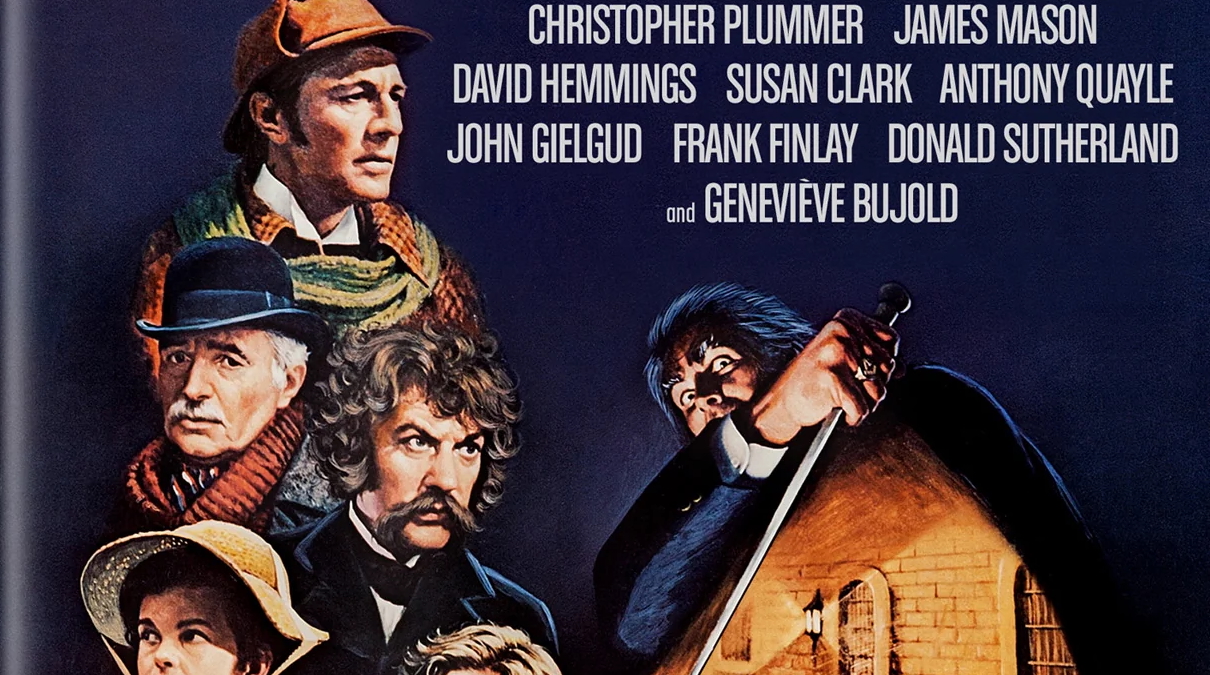
Director Bob Clark’s Sherlock Holmes horror mystery Murder by Decree comes to 4K UHD thanks to Kino Lorber.
The Film
Bob Clark’s clever Murder by Decree plays to the director’s strength as a filmmaker who was at his best in the horror genre. By melding Sherlock Holmes and Jack the Ripper the director created an entire subgenre that played with the Ripper intrigue (e.g., he was actually an agent of the Crown). Yes, Murder by Decree’s story and conspiracy has been done numerous times since it’s 1979 release but not with this cast.
Clark’s smartest move was the casting of Christopher Plummer and James Mason as Holmes and Watson respectively. Both are game to play the world’s greatest detective team. Plummer and Mason’s chemistry is off the chart great in that English dry wit sort of way. Plummer in particular relishes to play Holmes with the sort of sly theatricality that his best performances are imbued with. Watch as he ribs Mason’s Watson after a night in the clink. Mason is perfect as the reserved Watson. The actor has always been great at playing the preverbal stiff-upper-lip British types.
The film moves quickly in setting up the players and the murders with Holmes being brought in by chance to the White Chappel murders. Clark and screenwriter John Hopkins use of The Ripper Files a pulpy non-fictional account of Jack the Ripper by John Lloyd and Elwyn Jones as the basis for their film. They just take the basics of the story, going so far as to not even call the Ripper, “The Ripper” until the second half of the film. Which isn’t a bad thing. In fact, they play the right kind of fast and loose with the story to create their own play on the story, one that allows for the kind of action and scenes of humor that inject the film with a bump of energy.
Murder by Decree, and its stars, acquits itself quite well in the pantheon of Sherlock Holmes films. However, it’s in its final third where the film shines. Plummer’s Holmes facing off against none other than Sir John Gielgud in the corridors of power. It’s Clark’s understanding that giving Plummer a stage to perform will induce something special and it is special.
Yes, some will say that Plummer does go over the top but one can’t help but be caught up in Plummer as Holmes’s righteous indignation as he lays into Gielgud and Roy Lansford as Lord Salisbury and Sir Thomas Spivey (real-life figures). It’s these moments that Clark’s Sherlock Holmes tale elevates itself to something altogether different. Murder by Decree may have told a well-worn tale but never as adroitly as this one.
The Transfer
The all-new UHD SDR Master by StudioCanal is a beautiful upgrade and is the best the film has ever looked. Though some would complain about the lack of an HDR but the image in SDR has wonderful contrast and black levels. Adding an HDR layer to the image that is shot to mimic the London fog of the night and early mornings could have been troublesome. The transfer is still wonderfully verbose in its sharpness of the constant diffuse image. There is not a scratch or blemish on the image. An all-around excellent transfer that mimics the film’s 35mm origins to the tee.
The Extras
They include the following;
DISC 1 (4KUHD):
DISC 2 (BLU-RAY):
NOTE: All special features appear on both the 4K UHD and Blu-ray.
The first of two audio commentaries is by Director Bob Clark. Clark opens his track with the amazing model that opens the film. Some of the details include how he had to convince James Mason to star as Watson – and the two scenes he wanted to rewrite, which Clark gladly did; the approach they took to the murders and the style in which he knew he needed to employ and why he did so; the actual budget – and how difficult it was to produce a period piece; the importance of the style and how it informs time and place – especially a period piece; the casting what-if’s of Laurence Oliver and Peter O’Toole as Watson and Holmes – the reason why that didn’t work out; working with Christopher Plummer – including a humor anecdote about Plummer’s notorious on-set drinking; the issues with something as people see as simple like fog and matching studio and on-location; the research and development he and writer John Hopkins did on the script and story; the differences in British and Canadian crews and the differences; how this project went to Avco Embassy; a discussion of the scripts submittal to the Holmes Society for approval from the group; the balance he took in attempting to stretch out his budget and his sacrifices he made; a larger discussion throughout about the various cast that appear in the film; a larger discussion throughout about the facts and fiction that intermingle in the film; a larger discussion of the sets and work done by production designer Harry Pottle; and more.
The second of two audio commentaries by Film Historians Howard S. Berger and Steve Mitchell. The duo begins with their bonafides and their love of the opening miniature FX shot. Some of the details include a discussion of the budget and the impressiveness of the production – how Clark accomplished this; the number of sets built specifically for the production; how this Watson differs very much from the Basil Rathbone’s Sherlock Holmes iteration; a discussion with Clark about the way that Plummer and Mason handled the subtly of the relationship between Holmes and Watson; the scene that convinced James Mason to take the part of Watson; a discussion of the building of massive water way/harbor set that features prominently in the film; a discussion of the work and personal history of director Bob Clark – his important work in horror including his milestones like Black Christmas and going up to this film; a discussion of the appearance of Donald Sutherland – larger discussion of his work in period pictures; the social constructs and social themes that the film employs throughout; the work here and elsewhere of screenwriter John Hopkins; the appearance of Genevieve Bujold – a discussion of the asylum system during this era and how the film treats her character and the system; the short time frame that Clark had John Gielgud; a larger discussion of the various models and VFX shots employed throughout the film; a larger discussion of the visuals and color palette that Clark and cinematographer Reginald H. Morris employs throughout the film; a larger conversation of the mixture of fact and fiction with Holmes and Jack the Ripper case; a larger discussion of the various actors and crew members that contributed to the picture; and much more.
Rounding out the special features are trailers for Murder by Decree (3:33); They Might Be Giants (2:19); The Private Life of Sherlock Holmes (3:01); Murder on the Orient Express (2:38); And Soon the Darkness (2:45); The Silent Partner (1:55); Evil Under the Sun (3:13); The Great Train Robbery (2:52)
The Final Thought
Kino Lorber has given Murder by Decree a new life with its lovely 4K UHD disc. Highest Recommendations!!
Kino Lorber’s 4K UHD Edition of Murder by Decree is out now.
Share this:
Like this:
Discover more from The Movie Isle
Subscribe to get the latest posts sent to your email.