Quentin Tarantino’s masterpiece Inglorious Basterds comes to Arrow Video in a fully armed limited edition 4K UHD Set.
UPDATE: The Limited Editions sets have sold out, but the Regular Special Editions are available for pre-order and will be available on March 4th. Order 4K Here. Order Blu-ray here.
The Film
I think this might be my masterpiece.
Inglorious Basterds isn’t just a masterpiece. It’s a grand piece of cinema that gives the release that history could have never done for so many. A tightly constructed piece of alt-history that’s as angry, violent, and clear eyed as it is a magnificent piece of pulpy complex character romp.
It isn’t good enough for Tarantino to create one complex character but a trio of characters in Colonel Hans Landa, Lieutenant Aldo Raine, and Shosanna Dreyfus. All with their own agendas and all somehow as fate would have it ending up in the same small theater in Paris for the premiere of Nation’s Pride. The crown jewel of the Nazi German propaganda machine starring Fredrick Zoller – a sniper that killed 300 American Soldiers. So important is this film for the morale of the Nazi rank and file that Hitler himself is going to be in attendance.
Tarantino’s menagerie of stories within stories and one-off set pieces to create more than just a mere War film. Inglorious Basterds is a film about language and storytelling – how we use them not just as a weapon but how they can conceal and reveal and are the true weapons of war.
Take Landa and his ability to corner anyone and everyone into revealing what he wants to do by his use and mastery of language – not a gun. The opening twenty-minute scene illustrates this magnificently. Speaking English to hide his true intent from the Dreyfus family under the floorboards of the French house they are hiding under. The way he talks to the Milk Farmer convincing him to give them up even though the whole time Landa knew their locations is the true insipid nature of evil.
The Basterds as Aldo states is to inflict fear into the Nazi. Their violence is the pen they use to write the tales of horror to spread through the Reich. Watching the intercutting between the Bastards and Hilter as their story is recounted is effectively showing how Aldo’s plan of fear as a blunt instrument is perfectly executed. They are the counterpoint to Landa and his razor-sharp execution. It’s this bluntness and inability to understand the culture that almost ends the Basterd’s plans in the tense and marvelously plotted Tavern scene.
Even Shosanna uses language, the language of film, for her end game to exact her revenge not just on Landa but the entire Third Reich. Not just killing these fascists but ruining their moment of glory. It’s a beautifully designed moment, perfectly edited by Shosanna (and Tarantino Editor the late great Sally Menke), as her face appears at the moment of Zoller’s triumph in Nation’s Pride cutting everything the film is intended to do down. Her words they are forced to hear are as cutting as her retribution by fire vengeance. Her laughter echoes as they burn alive.
Though the biggest release comes in the form of Tarantino’s most delicious of inventions. The Basterds specifically Donny “The Bear Jew” Donowitz executing the single most heinous venal man in history. It’s no mistake that Donowitz is rumored to be a Golem and the full circle moment that Donowitz is not rumored but truly is a Golem is maybe the best piece of writing that Tarantino has ever done.
Inglorious Basterds ends with the rhetorical question that began this review. It is rhetorical because the film is Tarantino’s Masterpiece — Full Stop.
End. Of. Discussion.
The Transfer
The 4K Ultra HD presentation in HDR10 looks to be sourced from the same Universal 4K transfer. This is an excellent transfer with wonderful color reproduction, contrast level, and a patina of grain that gives it the look of a freshly struck film print. Upon comparison between the older Universal Disc and the new Arrow Video finds the bit rate and just about everything on the Arrow Disc up ticked in quality. The disc is just an all-around more pleasing experience (which again the Universal Disc is no slouch). Arrow has definitely given more than enough reasons to purchase their Edition and one of them is this transfer.
The Extras
They include the following;
DISC 1 – FEATURE (4K ULTRA HD BLU-RAY)
Brand new audio commentary by film critic and author Tim Lucas
DISC 2 – EXTRAS (BLU-RAY)
What Would Sally Do?
Blood Fiction
Doomstruck
Making it Right
Film History on Fire
Filmmaking in Occupied France
Extended and alternate scenes
Nation’s Pride
The Making of Nation’s Pride
Roundtable Discussion, an archival interview with Quentin Tarantino, Brad Pitt and Elvis Mitchell
The Original Inglorious Bastards
A Conversation with Rod Taylor
Rod Taylor on Victoria Bitter
Quentin Tarantino’s Camera Angel
Hi Sallys
Film Poster Gallery Tour with Elvis Mitchell
Trailers
DISC 1 – FEATURE (4K ULTRA HD BLU-RAY)
The all-new audio commentary by film critic and author Tim Lucas opens with his bonafides before diving into the opening musical cue that came from the John Wayne-directed Western The Alamo and how it was pulled from Quentin Tarantino’s own personal vinyl. Some of the details include the novelistic framework that Tarantino uses; the production details including filming locations and studios; a discussion of how Tarantino builds his film – and a larger discussion of the way that cineastes view this some very limited view – and why he does build his films and this film specifically; the ties to Sherlock Holmes to the film and larger discussion of German and English language adaptations both pre-War and post-War; a great discussion of the real actor Hugo Stiglitz – which the character in the film based on in the film; the pointed references to certain films that Shoshana’s theatre and shows Tarantino’s continued multilayered intelligent and thoughtful homages in his film; a discussion of the very infamous ending and crossing the alt history line which is something it does from the outset but the bold move of the end is only when the audience saw it – and a discussion of our “post factual” era that rose after this film but not because of it; a discussion of Lilian Harvey – her history and work both as an actress and an underground freedom fighter in Germany; a discussion of Tarantino’s development of the screenplay which began as early as 1997 – which leads to the very interesting conversation about the structure of the plot and how the characters interact or more importantly do not interact; a discussion of the centerpiece piece of the film – the tavern in Nadine – and all aspects of the 30-minute sequence including the pop cultural touchstones, the game they play, cultural differences, the accents, the acting, the directing, et.al. is covered; a discussion of the origins of the film – including the original film The Inglorious Bastards (directed by Enzo G. Casteralli); a larger discussion throughout the film of how language is the primary theme of the film; a larger discussion of the various actors that appear in the film; a larger discussion of the various musical cues that Tarantino uses from other films and including not just the film it came from but the composer and the track’s history; a larger discussion of the various visual and cinematic homages that Tarantino employs and their purpose – including how these reference go across various other Tarantino’s films; and much more. Lucas’ track rises to the occasion of Tarantino’s masterpiece providing a truly masterfully commentary track that deep dives into the film beyond just normal factoids. The track is essentially viewing.
DISC 2 – EXTRAS (BLU-RAY)
What Would Sally Do? (11:08) – in an all-new interview with editor Fred Raskin, he opens with his childhood and going to film school – switching over to editing after it was apparent that he wasn’t going to direct. Some of the details of rising through the ranks as an editor; how he eventually became Sally Menke’s assistant editor – working on two of Billy Bob Thorton’s directorial efforts; working on his first Tarantino film – Kill Bill; working on Inglorious Basterds with Sally and Tarantino – and how he came to the film and his first impressions; some of the differences between the Cannes Cut and the Theatrical Cut; the tragic passing of Sally and what he took from their collaboration; and more.
Doomstruck (11:24) – is an all-new interview with actor Omar Doom begins with his childhood, his parents raising him in the arts, and his attraction to music to his current project Straight Razor. Some of the details include his inspiration for his music from Giallo and horror films; how he met Quentin and began his process of becoming an actor; his audition for Death Proof; a great story about “checking the gate” – and Tarantino’s love of filmmaking; Tarantino playing music from the loudspeakers when they film – and why; how he was cast in Inglorious Basterds; working on the film – and the cast and how they bonded offset; how Tarantino got the actors in line and why they were doing the film; scalping school – and what that was and what was the “featured scalper”; and watching and working with Tarantino on set; and much more.
Blood Fiction (22:14) – is an all-new interview with special make-up effects supervisor Greg Nicotero opens with a discussion of his collaboration with Tarantino over the years (in fact; Nicotero has worked with Tarantino since Reservoir Dogs). Some of the details include how they worked with Tarantino with Makeup FXs on Inglorious Basterds; a larger discussion of the various FX work and how they were accomplished – including the scalping, the Landa carving, and other set pieces; his cameo in the film and cutting is iconic long hair; a great story about Brad Pitt and never seeing Fulci’s Zombi; the prosthetics to create the various historical figures and how complex it was to accomplish;
Making it Right (22:04) – is an all-new visual essay by film critic Walter Chaw, author of A Walter Hill Film. The visual essay written by Chaw, produced by Neil Snowdown and Edited by Jack Whiting mimics the film in chapters where Chaw dissects the film and Tarantino’s post-Basterds work as well. Chaw closes in on the “kindness” of Tarantino, giving back some humanity through exorcised injustices through violence and re-writing of history. The rest of the essay is in support of this thesis and shows through the real protagonist of the film, the purposeful retitling of the title of the film its remaking, the basis of Bridget Von Hammersmark, and much more.
Film History on Fire (19:49) – is an all-new visual essay by film scholar Pamela Hutchinson, author of BFI Film Classics Pandora’s Box. The visual essay written by Hutchinson and produced by Neil Snowdown and Edited by Jonathan Zaurin proposes the thesis that film both literal and metaphorical fights against fascism. Hutchinson does a masterful job of showing the physical dangers of Nitrate film; the propaganda films of fascist Germany; Tarantino’s mixing, matching, and playing loose and sometimes changing history – and how he does this within the film; the various German stars of the era both mentioned and unmentioned in the film and how they relate to the film’s themes and plots; GW Pabst – a figure in German cinema and his historical imprint and how it relates to this film; and much more.
Filmmaking in Occupied France (15:42) – is an all-new interview with film scholar Christine Leteux, author of Continental Films: French Cinema Under German Control. The visual essay written by Leteux, produced by Neil Snowdown and Edited by Jonathan Zaurin specifically discusses the French cinema under the German Occupation of WW2. Beginning with the collapse of the French film industry in the 1930s and their beginning to do co-productions in Germany with German film studios eventually leading to the invasion of France and how Germany took control of the French film industry and how they began to make films during the occupation – and the films they produced.
Archive Extras – a submenu gives access to the archival extras from the various previous releases of Inglorious Basterds. They include:
Roundtable Discussion (30:47) – is an archival interview with Quentin Tarantino, and Brad Pitt hosted by Elvis Mitchell. The discussion ranges from the quick production – both challenges and inspiration it brought; character work – both from Pitt’s perspective and Tarantino’s; the casting of Pitt and how it transpired; and much more.
Nation’s Pride (6:13) – the film within a film that was directed by Eli Roth at Tarantino’s request.
The Making of Nation’s Pride (4:02) – an archival featurette that proposes that if Germany of the era had making-of.
The Original Inglorious Bastards (7:41) – an archival featurette looking at the cameos from the cast and crew of the original The Inglorious Bastards featuring actor Eli Roth. Featuring director Enzo G Castellari, and actor Bo Sveinsson.
A Conversation with Rod Taylor (6:45) – an archival featurette/interview with Rod Taylor discussing Quentin Tarantino casting him and his return to the big screen as Winston Churchill for Quentin Tarantino.
Rod Taylor on Victoria Bitter (3:21) – an archival featurette/interview discussion about Victoria Bitter, an Australian Beer – and a great anecdote about Quentin Tarantino during the production.
Quentin Tarantino’s Camera Angel (2:44) – an archival featurette about the flip clapper and the b-roll of her unique way of calling out the shot number.
Hi Sallys (2:11) – an archival featurette that just shows various cast and crew saying “hi Sally” directly into the camera.
Extended and alternate scenes – three extended and alternate scenes that are within a submenu. Each played on their own.
Lunch with Goebbels (7:12) – almost a single camera angle take of the scene with added dialog that essentially wasn’t needed.
La Louisiane Card Game (2:09) – not the entire scene but the moment that opens the entire tavern scene with the game that the Germans are playing.
Nation’s Pride Begins (2:06) – a different opening for the premiere inside the theater for Nation’s Pride.
Film Poster Gallery Tour with Elvis Mitchell (11:02) – an archival featurette looking at the various fake and real posters that populate the film with an accompanying commentary by Elvis Mitchell on the backstories behind each.
Trailers – a sub-menu of the various trailers of Inglorious Basterds. Trailer 1 (1:47); Trailer 2 (2:25); Trailer 3 (2:10); Trailer 4 (1:19)
The Final Thought
Inglorious Basterds is Tarantino’s Masterpiece. Arrow Video has treated this 4K UHD release as such. It is early in 2025 but the set is already in contention at being one of the best of the year. Highest Possible Recommendations!!!

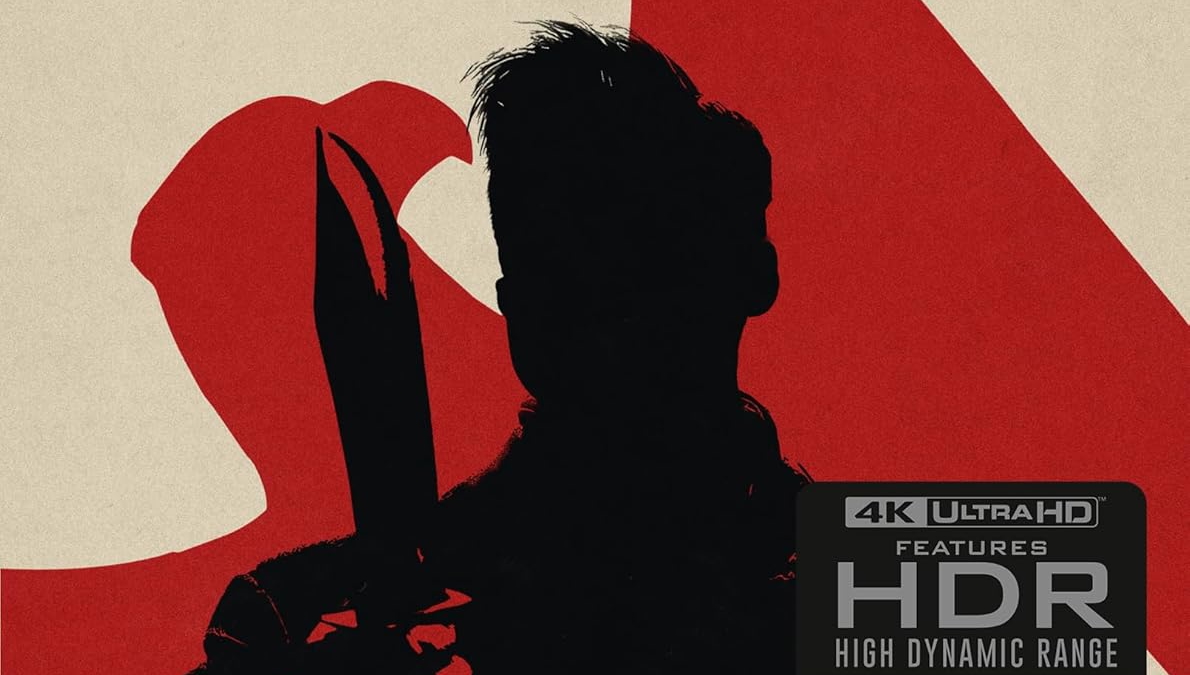
Quentin Tarantino’s masterpiece Inglorious Basterds comes to Arrow Video in a fully armed limited edition 4K UHD Set.
UPDATE: The Limited Editions sets have sold out, but the Regular Special Editions are available for pre-order and will be available on March 4th. Order 4K Here. Order Blu-ray here.
The Film
I think this might be my masterpiece.
Inglorious Basterds isn’t just a masterpiece. It’s a grand piece of cinema that gives the release that history could have never done for so many. A tightly constructed piece of alt-history that’s as angry, violent, and clear eyed as it is a magnificent piece of pulpy complex character romp.
It isn’t good enough for Tarantino to create one complex character but a trio of characters in Colonel Hans Landa, Lieutenant Aldo Raine, and Shosanna Dreyfus. All with their own agendas and all somehow as fate would have it ending up in the same small theater in Paris for the premiere of Nation’s Pride. The crown jewel of the Nazi German propaganda machine starring Fredrick Zoller – a sniper that killed 300 American Soldiers. So important is this film for the morale of the Nazi rank and file that Hitler himself is going to be in attendance.
Tarantino’s menagerie of stories within stories and one-off set pieces to create more than just a mere War film. Inglorious Basterds is a film about language and storytelling – how we use them not just as a weapon but how they can conceal and reveal and are the true weapons of war.
Take Landa and his ability to corner anyone and everyone into revealing what he wants to do by his use and mastery of language – not a gun. The opening twenty-minute scene illustrates this magnificently. Speaking English to hide his true intent from the Dreyfus family under the floorboards of the French house they are hiding under. The way he talks to the Milk Farmer convincing him to give them up even though the whole time Landa knew their locations is the true insipid nature of evil.
The Basterds as Aldo states is to inflict fear into the Nazi. Their violence is the pen they use to write the tales of horror to spread through the Reich. Watching the intercutting between the Bastards and Hilter as their story is recounted is effectively showing how Aldo’s plan of fear as a blunt instrument is perfectly executed. They are the counterpoint to Landa and his razor-sharp execution. It’s this bluntness and inability to understand the culture that almost ends the Basterd’s plans in the tense and marvelously plotted Tavern scene.
Even Shosanna uses language, the language of film, for her end game to exact her revenge not just on Landa but the entire Third Reich. Not just killing these fascists but ruining their moment of glory. It’s a beautifully designed moment, perfectly edited by Shosanna (and Tarantino Editor the late great Sally Menke), as her face appears at the moment of Zoller’s triumph in Nation’s Pride cutting everything the film is intended to do down. Her words they are forced to hear are as cutting as her retribution by fire vengeance. Her laughter echoes as they burn alive.
Though the biggest release comes in the form of Tarantino’s most delicious of inventions. The Basterds specifically Donny “The Bear Jew” Donowitz executing the single most heinous venal man in history. It’s no mistake that Donowitz is rumored to be a Golem and the full circle moment that Donowitz is not rumored but truly is a Golem is maybe the best piece of writing that Tarantino has ever done.
Inglorious Basterds ends with the rhetorical question that began this review. It is rhetorical because the film is Tarantino’s Masterpiece — Full Stop.
End. Of. Discussion.
The Transfer
The 4K Ultra HD presentation in HDR10 looks to be sourced from the same Universal 4K transfer. This is an excellent transfer with wonderful color reproduction, contrast level, and a patina of grain that gives it the look of a freshly struck film print. Upon comparison between the older Universal Disc and the new Arrow Video finds the bit rate and just about everything on the Arrow Disc up ticked in quality. The disc is just an all-around more pleasing experience (which again the Universal Disc is no slouch). Arrow has definitely given more than enough reasons to purchase their Edition and one of them is this transfer.
The Extras
They include the following;
DISC 1 – FEATURE (4K ULTRA HD BLU-RAY)
DISC 2 – EXTRAS (BLU-RAY)
DISC 1 – FEATURE (4K ULTRA HD BLU-RAY)
The all-new audio commentary by film critic and author Tim Lucas opens with his bonafides before diving into the opening musical cue that came from the John Wayne-directed Western The Alamo and how it was pulled from Quentin Tarantino’s own personal vinyl. Some of the details include the novelistic framework that Tarantino uses; the production details including filming locations and studios; a discussion of how Tarantino builds his film – and a larger discussion of the way that cineastes view this some very limited view – and why he does build his films and this film specifically; the ties to Sherlock Holmes to the film and larger discussion of German and English language adaptations both pre-War and post-War; a great discussion of the real actor Hugo Stiglitz – which the character in the film based on in the film; the pointed references to certain films that Shoshana’s theatre and shows Tarantino’s continued multilayered intelligent and thoughtful homages in his film; a discussion of the very infamous ending and crossing the alt history line which is something it does from the outset but the bold move of the end is only when the audience saw it – and a discussion of our “post factual” era that rose after this film but not because of it; a discussion of Lilian Harvey – her history and work both as an actress and an underground freedom fighter in Germany; a discussion of Tarantino’s development of the screenplay which began as early as 1997 – which leads to the very interesting conversation about the structure of the plot and how the characters interact or more importantly do not interact; a discussion of the centerpiece piece of the film – the tavern in Nadine – and all aspects of the 30-minute sequence including the pop cultural touchstones, the game they play, cultural differences, the accents, the acting, the directing, et.al. is covered; a discussion of the origins of the film – including the original film The Inglorious Bastards (directed by Enzo G. Casteralli); a larger discussion throughout the film of how language is the primary theme of the film; a larger discussion of the various actors that appear in the film; a larger discussion of the various musical cues that Tarantino uses from other films and including not just the film it came from but the composer and the track’s history; a larger discussion of the various visual and cinematic homages that Tarantino employs and their purpose – including how these reference go across various other Tarantino’s films; and much more. Lucas’ track rises to the occasion of Tarantino’s masterpiece providing a truly masterfully commentary track that deep dives into the film beyond just normal factoids. The track is essentially viewing.
DISC 2 – EXTRAS (BLU-RAY)
What Would Sally Do? (11:08) – in an all-new interview with editor Fred Raskin, he opens with his childhood and going to film school – switching over to editing after it was apparent that he wasn’t going to direct. Some of the details of rising through the ranks as an editor; how he eventually became Sally Menke’s assistant editor – working on two of Billy Bob Thorton’s directorial efforts; working on his first Tarantino film – Kill Bill; working on Inglorious Basterds with Sally and Tarantino – and how he came to the film and his first impressions; some of the differences between the Cannes Cut and the Theatrical Cut; the tragic passing of Sally and what he took from their collaboration; and more.
Doomstruck (11:24) – is an all-new interview with actor Omar Doom begins with his childhood, his parents raising him in the arts, and his attraction to music to his current project Straight Razor. Some of the details include his inspiration for his music from Giallo and horror films; how he met Quentin and began his process of becoming an actor; his audition for Death Proof; a great story about “checking the gate” – and Tarantino’s love of filmmaking; Tarantino playing music from the loudspeakers when they film – and why; how he was cast in Inglorious Basterds; working on the film – and the cast and how they bonded offset; how Tarantino got the actors in line and why they were doing the film; scalping school – and what that was and what was the “featured scalper”; and watching and working with Tarantino on set; and much more.
Blood Fiction (22:14) – is an all-new interview with special make-up effects supervisor Greg Nicotero opens with a discussion of his collaboration with Tarantino over the years (in fact; Nicotero has worked with Tarantino since Reservoir Dogs). Some of the details include how they worked with Tarantino with Makeup FXs on Inglorious Basterds; a larger discussion of the various FX work and how they were accomplished – including the scalping, the Landa carving, and other set pieces; his cameo in the film and cutting is iconic long hair; a great story about Brad Pitt and never seeing Fulci’s Zombi; the prosthetics to create the various historical figures and how complex it was to accomplish;
Making it Right (22:04) – is an all-new visual essay by film critic Walter Chaw, author of A Walter Hill Film. The visual essay written by Chaw, produced by Neil Snowdown and Edited by Jack Whiting mimics the film in chapters where Chaw dissects the film and Tarantino’s post-Basterds work as well. Chaw closes in on the “kindness” of Tarantino, giving back some humanity through exorcised injustices through violence and re-writing of history. The rest of the essay is in support of this thesis and shows through the real protagonist of the film, the purposeful retitling of the title of the film its remaking, the basis of Bridget Von Hammersmark, and much more.
Film History on Fire (19:49) – is an all-new visual essay by film scholar Pamela Hutchinson, author of BFI Film Classics Pandora’s Box. The visual essay written by Hutchinson and produced by Neil Snowdown and Edited by Jonathan Zaurin proposes the thesis that film both literal and metaphorical fights against fascism. Hutchinson does a masterful job of showing the physical dangers of Nitrate film; the propaganda films of fascist Germany; Tarantino’s mixing, matching, and playing loose and sometimes changing history – and how he does this within the film; the various German stars of the era both mentioned and unmentioned in the film and how they relate to the film’s themes and plots; GW Pabst – a figure in German cinema and his historical imprint and how it relates to this film; and much more.
Filmmaking in Occupied France (15:42) – is an all-new interview with film scholar Christine Leteux, author of Continental Films: French Cinema Under German Control. The visual essay written by Leteux, produced by Neil Snowdown and Edited by Jonathan Zaurin specifically discusses the French cinema under the German Occupation of WW2. Beginning with the collapse of the French film industry in the 1930s and their beginning to do co-productions in Germany with German film studios eventually leading to the invasion of France and how Germany took control of the French film industry and how they began to make films during the occupation – and the films they produced.
Archive Extras – a submenu gives access to the archival extras from the various previous releases of Inglorious Basterds. They include:
Trailers – a sub-menu of the various trailers of Inglorious Basterds. Trailer 1 (1:47); Trailer 2 (2:25); Trailer 3 (2:10); Trailer 4 (1:19)
The Final Thought
Inglorious Basterds is Tarantino’s Masterpiece. Arrow Video has treated this 4K UHD release as such. It is early in 2025 but the set is already in contention at being one of the best of the year. Highest Possible Recommendations!!!
Arrow Video’s 4K UHD Edition of Inglorious Basterds is out now.
Share this:
Like this:
Discover more from The Movie Isle
Subscribe to get the latest posts sent to your email.