I watched Miracle Mile for the first time as the 2025 LA Fires raged. It was the second night. I had gotten evacuation orders. We left and after a few hours, we were allowed to come back having gotten that portion of the fire (which they called the Kenneth Fire) under control. Unable to sleep I gave this film a spin. I give context because this film has been indelibly seared into my brain. Miracle Mile is the kind of end-of-world ticking time bomb that is a perfect distillation of the anxiety and calamity one would find themselves in if they only had 60 minutes until their world would turn to ash.
Harry (Anthony Edwards) and Julie (Mare Winningham) meet cute at the La Brea Tar Pits. It’s love at first sight. They spend the day together – connecting in a way that only Harry and Julie could connect. At the end of the day, Harry leaves Julie at her job at Johnie’s (a local diner), but not before he promises her to be back at the end of her shift. Harry misses his moment by oversleeping. He rushes to Johnie’s but it’s too late. She’s gone home. He tries to call her and gets her machine. Hangs up. The phone instantly rings – thinking it’s Julie picks it up. It isn’t Julie. The voice on the other end of the line tells him that an arsenal of Russian nukes are on its way to the United States. Going back into Johnie’s he tries to figure out if the news he’s been given is true. Slowly but surely, Harry begins to realize this may be true and with sixty minutes left he has one thought … get to Julie.
Writer/Director Steve De Jarnatt has created a stone-cold classic. A film of uncompromised darkness and beauty as it inches slowly to the end of the world. The script so precise at every moment finds the humanity, the darkness, and the humor of those final sixty minutes. The way the film escalates the problems and eventually the mania and violence as the world is let in on the news is the kind of sobering depiction of what one would feel the end would be like. Though never too far away pockets of pure humanity and love aches through the screen.
The ensemble cast is wonderful in the way they keep the heightened tone so consistent. It’s rare to find a film that has zero issues with its cast. Miracle Mile is one of those films. From Anthony Edwards to Mare Winningham to Denise Crosby to Mykelti Williamson to Eddie Bunker to Kurt Fuller to Alan Rosenberg to O-Lan Jones to Brian Thompson – all do wonderful lively unexpected work.
Miracle Mile is a minor miracle. A romance at the end of days that feels uncompromisingly beautiful from its opening moments to its final frame.
The Transfer
Brand New HD Master – From a 16-bit 4K Scan of the 35mm Original Camera Negative (Supervised and Approved by Writer/Director Steve De Jarnatt & Cinematographer Theo van de Sande) is a perfect update to the initial Blu-ray release from Kino Lorber. The image is sharp with a beautiful filmic look that retains the grain structure of van de Sande’s luminous nighttime photography of Los Angeles. There isn’t a single scratch or blemish on the image. No digital issues like artificing or DNR. It’s safe to assume that this is the best Miracle Mile has ever looked on the big or small screen.
The Extras
They include the following;
DISC 1:
NEW Audio Commentary by Los Angeles Literary Mavens Janet Fitch and Matthew Spector (L.A. as a Character in Miracle Mile)
Audio Commentary with Writer/Director Steve De Jarnatt and Film Critic Walter Chaw
Audio Commentary with Steve De Jarnatt, Cinematographer Theo van de Sande and Production Designer Chris Horner
Theatrical Trailers
DISC 2:
Tarzana (1978 35mm Short Film Noir by Steve De Jarnatt)
Eat the Sun (16mm Award-Winning Short by Jim Cox and Co-Written and Co-Directed by Steve De Jarnatt)
Grace for Grace: Audio Readings of Two Award-Winning Stories by Steve De Jarnatt
Johnie’s Supporting Cast Reunion: 2015 Featurette
Johnie’s Supporting Cast Reunion – Part 2: More Great Stuff
Harry and Julie: 2015 Interview with Stars Anthony Edwards and Mare Winningham
Scoring Miracle Mile: New Interview with Paul Hasunger
Excavations From the Editing Room Tar Pits
Diamond in the Rough – Refining the Diner Scene
Miracle Mile Storyboard by Paul Chadwick
The Extra Extras: Several Small Pieces and Short Films
A Tribute to the Crew, Cast, and Staff – Photo Montage
Alternate Diamond Ending
DISC 1:
In the all-new Audio Commentary by Los Angeles Literary Mavens Janet Fitch and Matthew Spector begin with their purpose as they dissect LA as a character in LA. Some of the details include the accuracy of the various locations which is never the case in most films; why Miracle Mile the location is called Miracle Mile – and is history; a discussion of the score by Tangerine Dream; Park Le Brea Apartments – that features prominently in the film; a great discussion of all-night diners that used to be a staple of Los Angeles – and the few that are currently still around; a great discussion about freeways and what their called in LA – and in the film; a larger discussion of the various locations that appear in the film and their history, factoids about the location and how the film used it; and much more. Fitch and Spector provide a unique and informative commentary track.
The second audio commentary is an archival one with Writer/Director Steve De Jarnatt and Film Critic Walter Chaw begins with the oblique opening and why De Jarnatt opened the film this way. Some of the details include credit misspelling and why they could not change it; Peter Berg cameo – which De Jarnatt said that the role got him his SAG card; working with comic book artist Paul Chadwick on the storyboards for the film; when the switch over to “real time” in the narrative; the development of the script and its more cynical and darker tone and ending – because of how the film was written in the 1970s, how much has changed since making the film with endings not allowed to be as dark as this; how they got the Cosmos the TV series and almost got Carl Sagan as a cameo; nightmares and the dreamscapes of De Jarnatt’s childhood and adulthood of nuclear war and how the script was his way to work through this; work of Mykelti Williamson and the original conception of his character; the appearance of Eddie Bunker in the film; the importance of the budget and schedule and the importance of staying on budget and on schedule – and some personal anecdotes of how stressful it was; the alternate ending and discussion of the post-production process; a larger discussion of Miracle Mile and it being a character in the film; a larger discussion of the unreliable nature of media which has become a bigger theme in our current era; a larger discussion of the various cast and crew; and much more. De Jarnatt and Chaw provide a fascinating look back at this very special film.
The third and final audio commentary is another archival track with Steve De Jarnatt, Cinematographer Theo van de Sande, and Production Designer Chris Horner. The trio begins with introductions before discussing the Carl Sagan would-be cameo. Some of the other details include the collaboration between van de Sande and Horner working cleverly at the Page Museum and how the visuals were accomplished; the hard work to ensure lighting was accurate throughout the various locations; the astoundingly low budget for visual effects; the film stock they used during the production; some of the reshoots and the difficulty in doing reshoots months later; artist Paul Chadwick’s storyboards heavy influence for the visual type of the film; the various tricks they use to accomplish the car process shots; a larger discussion of how they accomplished many of the trickier shots in the film; and much more. The final commentary track is a great technical conversation between the three visual primary architects of the film.
Theatrical Trailers for Cherry 2000 (2:25); Miracle Mile (2:16);
DISC 2:
Tarzana (1978 35mm Short Film Noir by Steve De Jarnatt) – This black and white hardboiled detective mystery is fantastic. The style and De Jarnatt’s ability to mimic the style and visuals of the 1950s detective fiction specifically Robert Aldrich’s Kiss Me Deadly is masterful in a way that it makes sense he got heat off of this short. The way he deftly satirizes the genre with his tale of a tale so twisty that it gives The Big Sleep a run for its money blurs the line between satire and true homage – which is this reviewer’s sweet spot. Starring Michael C. Gwynne, Eddie Constantine, Timothy Carey, Edie Adams, Pete Candoli, Reni Santoni, Charles Knapp, Kate Murtagh, Ann Dusenberry and Carel Struycken.
Eat the Sun (16mm Award-Winning Short by Jim Cox and Co-Written and Co-Directed by Steve De Jarnatt) – this short from 1975 feels the strong pull of both George Lucas’ THX-1138 short and feature film. Though it takes on the concept of TV, alternate dimensions and religion are very different than Lucas’ classics. A melding of faux-documentary and narrative the film charts the rise of a new religion and a guru within its ranks – is a cheeky look at the melding of technology and spirituality well before things like Altered States or Brain Scan.
Grace for Grace: Audio Readings of Two Award-Winning Stories by Steve De Jarnatt (115:05) – Yes, there are two stories, but you get three with one being performed twice. This is a gold mine and not just audiobooks but radio plays with accompanying scores by Ben Landsverk & Rachel Taylor Brown, and Stephen Day. The introduction gives everyone much-needed context to “what happened to Steve De Jarnatt” after these two cult classics.
Introduction
Her Great Blue – Read by Lily Cooper
Rubiaux Rising – Read by Duane Whitaker
Rubiaux Rising – Read by Steve De Jarnatt
This two-hour collection is a fascinating look and taste into De Jarnatt’s second-half career as a novelist. I will say that both stories intrigued me enough to investigate his written work. If you are as well the featurette lists a discount code to purchase from his website.
Johnie’s Supporting Cast Reunion: Part 1 (14:25) – meeting at Johnie’s diner, either virtually or in person, this is a great featurette with the cast that inhabits the world of Miracle Mile. Hosted by director Steven De Jarnatt this is a wild, loose, and very fun look back at the making of the film with a cast that has a lot of affection for the film and their director. Discussing rehearsing, the performances, the character work, filming at night, anecdotes from the set, and more. Featuring cinematographer Theo van de Sande, actors Denise Crosby, Diane Delano, Alan Rosenberg, Oland Jones, Danny Delaponce, Howard Swain, Jeanette Goldstein, Kelly Jo Minter, Kurt Fuller, and Brian Thompson.
Johnie’s Supporting Cast Reunion – Part 2 (24:59) – this is a continuation of the interviews from the first featurette. This is odd bits and ends of the cast coming together before the interview that begins this featurette. They do discuss some of the missing cast who were not there being filmed separately (Edwards and Winningham) and those who have passed. Other talking points include the fact Miracle Mile was one of the first “best-unproduced scripts” listed in the trades, the phone booth scene where Edwards had no one on the other end of the phone, and a lot more anecdotes from the production. Featuring cinematographer Theo van de Sande, actors Denise Crosby, Diane Delano, Alan Rosenberg, Oland Jones, Danny Delaponce, Howard Swain, Jeanette Goldstein, Kelly Jo Minter, Kurt Fuller, and Brian Thompson.
Harry and Julie: 2015 Interview with Stars Anthony Edwards and Mare Winningham (12:24) – a great interview with both Edwards and Winningham opens with how they were almost cast as the romantic leads in The Sure Thing. Some of the details include how Edwards suggested Winningham for the road; their love of the script and how dark it was; working with director Steven De Jarnatt; the film’s rise as a cult classic; and more. The chemistry is palpable in this interview and it should be noted that they ended up marrying in 2021 after knowing each other as kids.
Scoring Miracle Mile: Interview with Paul Hasunger (16:38) – in this all-new interview with Paul Hasunger begins with how Tangerine Dream began scoring Fassbender films before going to Hollywood Studio to work with Friedkin’s Sorcerer and ends with Miracle Mile. Hasunger discusses how the score came together under some duress and outside of their normal studio in Germany but in Austria; how Chris and Edgar worked as composers – dividing the work, and also when Chris left what Paul was responsible for; an interesting note about the Sorcerer score and how it came to be; they’re not being at the final mix of Miracle Mile – and how that affected the score and their intention; a great discussion of being offered Conan; how they came onto Miracle Mile; and much more.
Excavations From the Editing Room Tar Pits (11:20) – another great featurette, focusing on the editing and missing bits through the entirety of the film. By showing us VHS rips of the various Deleted Scenes, Outtakes, and Bloopers from that scene we get an idea of how the entire narrative was shaped and how much of the dialog was not necessary to create a feeling. These deleted scenes and outtakes definitely have a goofier, lighter tone that just wouldn’t have worked for the film they eventually made. There are some truly great bloopers and unscripted moments throughout. Also, look out for more Peter Berg and a nastier/bloodier ending for Mykelti Williamson and his sister’s characters.
Diamond in the Rough – Refining the Diner Scene (14:11) – a great featurette that uses various pieces like Script Text, Paul Chadwick’s Storyboards, Stills from the production, Clips from the film, and most importantly VHS Rehearsal Footage to show how the climatic diner scene where Harry has just been told about the end of the world was shaped from written word to finished product.
Miracle Mile Storyboard by Paul Chadwick (35:58) – similar to Cherry 2000’s featurettes about the amazing storyboards by Comic Book artist Paul Chadwick. This is accompanied by the great score by Tangerine Dream, this featurette charts all the storyboards in sequence basically giving you a pre-viz version of the film. A very interesting look at how the visual style adhered to and sometimes changed from Chadwick’s work.
The Extra Extras: Several Small Pieces and Short Films (27:26) – a fascinating featurette taking us through the early career of De Jarnatt. Beginning with a bit of TV ephemera from Occidental College program Steve De Jarnatt appeared as a “character”. It’s an interesting look back at something we rarely get a look at: a director’s early efforts. Included in the show is a short film that De Jarnatt created specifically for his character’s appearance. There is also a discussion of another appearance of the character at least a decade later on of all things The Ringo Starr Television special that aired in the late 70s. Another short film that’s shown at 10x speed that De Jarnatt all but absolves himself of. A discussion of the truly great Tarzan and storyboards of the film and outtakes from the film. As they go through various pieces of video and text explain the twists and turns De Jarnatt’s career took to get to his two feature films Cherry 2000 and Miracle Mile. All done in a very cheeky and witty style.
A Tribute to the Crew, Cast, and Staff – Photo Montage (16:17) – beginning with a text introduction speaking to the four producers that made the film possible, De Jarnatt dedicates the film to the tireless work of the crew many of which are pointed out in this featurette of photos hard at work in the film. The montage is accompanied by the score by Tangerine Dream. This is truly a wonderful document for all of the above and below-the-line crews, many of who never get any credit other than a piece of fleeting text at the end of the film. Bravo to De Jarnatt and the Kino Lorber producers for ensuring this is on the disc.
Alternate Diamond Ending (4:28) – an alternate more “positive” ending that De Jarnatt discusses in two of his commentary tracks. It’s alright but the original theatrical ending is much better.
The Final Thought
Kino has given Miracle Mile its due with this massive updated Special Edition. Highest possible recommendations!!!

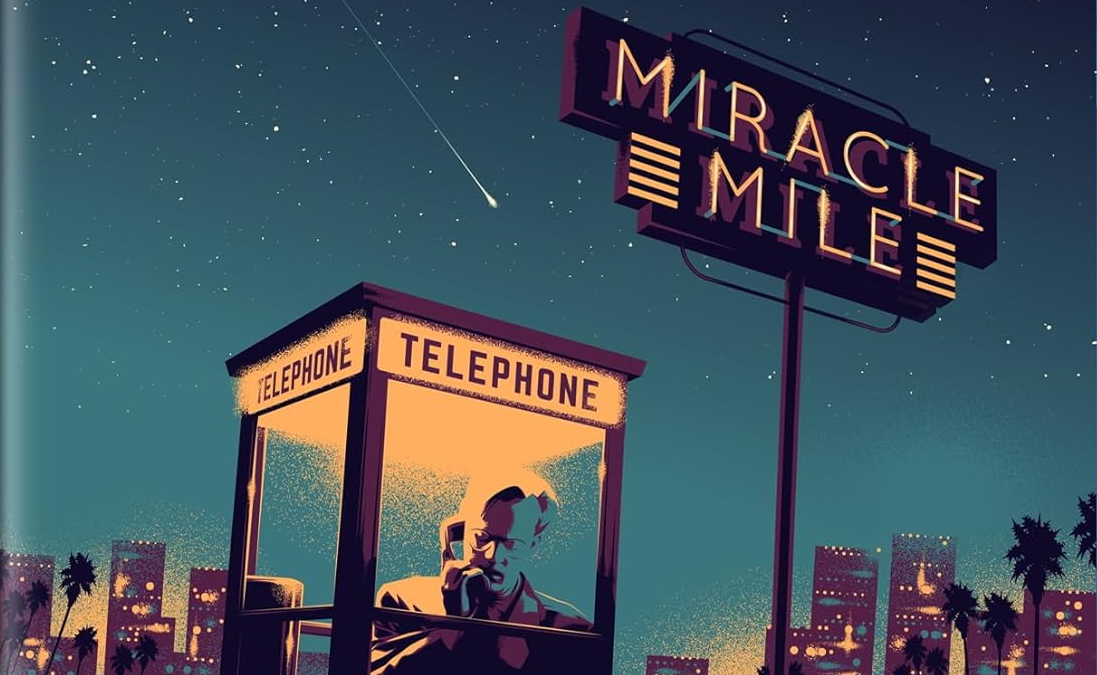
It’s the end of the world as they knew it, and Anthony Edwards is just trying to find the love of his life in director Steve De Jarnatt’s cult classic apocalyptic romance Miracle Mile. Kino Lorber has given it a filled-to-the-gill Blu-ray special edition.
The Film
I watched Miracle Mile for the first time as the 2025 LA Fires raged. It was the second night. I had gotten evacuation orders. We left and after a few hours, we were allowed to come back having gotten that portion of the fire (which they called the Kenneth Fire) under control. Unable to sleep I gave this film a spin. I give context because this film has been indelibly seared into my brain. Miracle Mile is the kind of end-of-world ticking time bomb that is a perfect distillation of the anxiety and calamity one would find themselves in if they only had 60 minutes until their world would turn to ash.
Harry (Anthony Edwards) and Julie (Mare Winningham) meet cute at the La Brea Tar Pits. It’s love at first sight. They spend the day together – connecting in a way that only Harry and Julie could connect. At the end of the day, Harry leaves Julie at her job at Johnie’s (a local diner), but not before he promises her to be back at the end of her shift. Harry misses his moment by oversleeping. He rushes to Johnie’s but it’s too late. She’s gone home. He tries to call her and gets her machine. Hangs up. The phone instantly rings – thinking it’s Julie picks it up. It isn’t Julie. The voice on the other end of the line tells him that an arsenal of Russian nukes are on its way to the United States. Going back into Johnie’s he tries to figure out if the news he’s been given is true. Slowly but surely, Harry begins to realize this may be true and with sixty minutes left he has one thought … get to Julie.
Writer/Director Steve De Jarnatt has created a stone-cold classic. A film of uncompromised darkness and beauty as it inches slowly to the end of the world. The script so precise at every moment finds the humanity, the darkness, and the humor of those final sixty minutes. The way the film escalates the problems and eventually the mania and violence as the world is let in on the news is the kind of sobering depiction of what one would feel the end would be like. Though never too far away pockets of pure humanity and love aches through the screen.
The ensemble cast is wonderful in the way they keep the heightened tone so consistent. It’s rare to find a film that has zero issues with its cast. Miracle Mile is one of those films. From Anthony Edwards to Mare Winningham to Denise Crosby to Mykelti Williamson to Eddie Bunker to Kurt Fuller to Alan Rosenberg to O-Lan Jones to Brian Thompson – all do wonderful lively unexpected work.
Miracle Mile is a minor miracle. A romance at the end of days that feels uncompromisingly beautiful from its opening moments to its final frame.
The Transfer
Brand New HD Master – From a 16-bit 4K Scan of the 35mm Original Camera Negative (Supervised and Approved by Writer/Director Steve De Jarnatt & Cinematographer Theo van de Sande) is a perfect update to the initial Blu-ray release from Kino Lorber. The image is sharp with a beautiful filmic look that retains the grain structure of van de Sande’s luminous nighttime photography of Los Angeles. There isn’t a single scratch or blemish on the image. No digital issues like artificing or DNR. It’s safe to assume that this is the best Miracle Mile has ever looked on the big or small screen.
The Extras
They include the following;
DISC 1:
DISC 2:
DISC 1:
In the all-new Audio Commentary by Los Angeles Literary Mavens Janet Fitch and Matthew Spector begin with their purpose as they dissect LA as a character in LA. Some of the details include the accuracy of the various locations which is never the case in most films; why Miracle Mile the location is called Miracle Mile – and is history; a discussion of the score by Tangerine Dream; Park Le Brea Apartments – that features prominently in the film; a great discussion of all-night diners that used to be a staple of Los Angeles – and the few that are currently still around; a great discussion about freeways and what their called in LA – and in the film; a larger discussion of the various locations that appear in the film and their history, factoids about the location and how the film used it; and much more. Fitch and Spector provide a unique and informative commentary track.
The second audio commentary is an archival one with Writer/Director Steve De Jarnatt and Film Critic Walter Chaw begins with the oblique opening and why De Jarnatt opened the film this way. Some of the details include credit misspelling and why they could not change it; Peter Berg cameo – which De Jarnatt said that the role got him his SAG card; working with comic book artist Paul Chadwick on the storyboards for the film; when the switch over to “real time” in the narrative; the development of the script and its more cynical and darker tone and ending – because of how the film was written in the 1970s, how much has changed since making the film with endings not allowed to be as dark as this; how they got the Cosmos the TV series and almost got Carl Sagan as a cameo; nightmares and the dreamscapes of De Jarnatt’s childhood and adulthood of nuclear war and how the script was his way to work through this; work of Mykelti Williamson and the original conception of his character; the appearance of Eddie Bunker in the film; the importance of the budget and schedule and the importance of staying on budget and on schedule – and some personal anecdotes of how stressful it was; the alternate ending and discussion of the post-production process; a larger discussion of Miracle Mile and it being a character in the film; a larger discussion of the unreliable nature of media which has become a bigger theme in our current era; a larger discussion of the various cast and crew; and much more. De Jarnatt and Chaw provide a fascinating look back at this very special film.
The third and final audio commentary is another archival track with Steve De Jarnatt, Cinematographer Theo van de Sande, and Production Designer Chris Horner. The trio begins with introductions before discussing the Carl Sagan would-be cameo. Some of the other details include the collaboration between van de Sande and Horner working cleverly at the Page Museum and how the visuals were accomplished; the hard work to ensure lighting was accurate throughout the various locations; the astoundingly low budget for visual effects; the film stock they used during the production; some of the reshoots and the difficulty in doing reshoots months later; artist Paul Chadwick’s storyboards heavy influence for the visual type of the film; the various tricks they use to accomplish the car process shots; a larger discussion of how they accomplished many of the trickier shots in the film; and much more. The final commentary track is a great technical conversation between the three visual primary architects of the film.
Theatrical Trailers for Cherry 2000 (2:25); Miracle Mile (2:16);
DISC 2:
Tarzana (1978 35mm Short Film Noir by Steve De Jarnatt) – This black and white hardboiled detective mystery is fantastic. The style and De Jarnatt’s ability to mimic the style and visuals of the 1950s detective fiction specifically Robert Aldrich’s Kiss Me Deadly is masterful in a way that it makes sense he got heat off of this short. The way he deftly satirizes the genre with his tale of a tale so twisty that it gives The Big Sleep a run for its money blurs the line between satire and true homage – which is this reviewer’s sweet spot. Starring Michael C. Gwynne, Eddie Constantine, Timothy Carey, Edie Adams, Pete Candoli, Reni Santoni, Charles Knapp, Kate Murtagh, Ann Dusenberry and Carel Struycken.
Eat the Sun (16mm Award-Winning Short by Jim Cox and Co-Written and Co-Directed by Steve De Jarnatt) – this short from 1975 feels the strong pull of both George Lucas’ THX-1138 short and feature film. Though it takes on the concept of TV, alternate dimensions and religion are very different than Lucas’ classics. A melding of faux-documentary and narrative the film charts the rise of a new religion and a guru within its ranks – is a cheeky look at the melding of technology and spirituality well before things like Altered States or Brain Scan.
Grace for Grace: Audio Readings of Two Award-Winning Stories by Steve De Jarnatt (115:05) – Yes, there are two stories, but you get three with one being performed twice. This is a gold mine and not just audiobooks but radio plays with accompanying scores by Ben Landsverk & Rachel Taylor Brown, and Stephen Day. The introduction gives everyone much-needed context to “what happened to Steve De Jarnatt” after these two cult classics.
This two-hour collection is a fascinating look and taste into De Jarnatt’s second-half career as a novelist. I will say that both stories intrigued me enough to investigate his written work. If you are as well the featurette lists a discount code to purchase from his website.
Johnie’s Supporting Cast Reunion: Part 1 (14:25) – meeting at Johnie’s diner, either virtually or in person, this is a great featurette with the cast that inhabits the world of Miracle Mile. Hosted by director Steven De Jarnatt this is a wild, loose, and very fun look back at the making of the film with a cast that has a lot of affection for the film and their director. Discussing rehearsing, the performances, the character work, filming at night, anecdotes from the set, and more. Featuring cinematographer Theo van de Sande, actors Denise Crosby, Diane Delano, Alan Rosenberg, Oland Jones, Danny Delaponce, Howard Swain, Jeanette Goldstein, Kelly Jo Minter, Kurt Fuller, and Brian Thompson.
Johnie’s Supporting Cast Reunion – Part 2 (24:59) – this is a continuation of the interviews from the first featurette. This is odd bits and ends of the cast coming together before the interview that begins this featurette. They do discuss some of the missing cast who were not there being filmed separately (Edwards and Winningham) and those who have passed. Other talking points include the fact Miracle Mile was one of the first “best-unproduced scripts” listed in the trades, the phone booth scene where Edwards had no one on the other end of the phone, and a lot more anecdotes from the production. Featuring cinematographer Theo van de Sande, actors Denise Crosby, Diane Delano, Alan Rosenberg, Oland Jones, Danny Delaponce, Howard Swain, Jeanette Goldstein, Kelly Jo Minter, Kurt Fuller, and Brian Thompson.
Harry and Julie: 2015 Interview with Stars Anthony Edwards and Mare Winningham (12:24) – a great interview with both Edwards and Winningham opens with how they were almost cast as the romantic leads in The Sure Thing. Some of the details include how Edwards suggested Winningham for the road; their love of the script and how dark it was; working with director Steven De Jarnatt; the film’s rise as a cult classic; and more. The chemistry is palpable in this interview and it should be noted that they ended up marrying in 2021 after knowing each other as kids.
Scoring Miracle Mile: Interview with Paul Hasunger (16:38) – in this all-new interview with Paul Hasunger begins with how Tangerine Dream began scoring Fassbender films before going to Hollywood Studio to work with Friedkin’s Sorcerer and ends with Miracle Mile. Hasunger discusses how the score came together under some duress and outside of their normal studio in Germany but in Austria; how Chris and Edgar worked as composers – dividing the work, and also when Chris left what Paul was responsible for; an interesting note about the Sorcerer score and how it came to be; they’re not being at the final mix of Miracle Mile – and how that affected the score and their intention; a great discussion of being offered Conan; how they came onto Miracle Mile; and much more.
Excavations From the Editing Room Tar Pits (11:20) – another great featurette, focusing on the editing and missing bits through the entirety of the film. By showing us VHS rips of the various Deleted Scenes, Outtakes, and Bloopers from that scene we get an idea of how the entire narrative was shaped and how much of the dialog was not necessary to create a feeling. These deleted scenes and outtakes definitely have a goofier, lighter tone that just wouldn’t have worked for the film they eventually made. There are some truly great bloopers and unscripted moments throughout. Also, look out for more Peter Berg and a nastier/bloodier ending for Mykelti Williamson and his sister’s characters.
Diamond in the Rough – Refining the Diner Scene (14:11) – a great featurette that uses various pieces like Script Text, Paul Chadwick’s Storyboards, Stills from the production, Clips from the film, and most importantly VHS Rehearsal Footage to show how the climatic diner scene where Harry has just been told about the end of the world was shaped from written word to finished product.
Miracle Mile Storyboard by Paul Chadwick (35:58) – similar to Cherry 2000’s featurettes about the amazing storyboards by Comic Book artist Paul Chadwick. This is accompanied by the great score by Tangerine Dream, this featurette charts all the storyboards in sequence basically giving you a pre-viz version of the film. A very interesting look at how the visual style adhered to and sometimes changed from Chadwick’s work.
The Extra Extras: Several Small Pieces and Short Films (27:26) – a fascinating featurette taking us through the early career of De Jarnatt. Beginning with a bit of TV ephemera from Occidental College program Steve De Jarnatt appeared as a “character”. It’s an interesting look back at something we rarely get a look at: a director’s early efforts. Included in the show is a short film that De Jarnatt created specifically for his character’s appearance. There is also a discussion of another appearance of the character at least a decade later on of all things The Ringo Starr Television special that aired in the late 70s. Another short film that’s shown at 10x speed that De Jarnatt all but absolves himself of. A discussion of the truly great Tarzan and storyboards of the film and outtakes from the film. As they go through various pieces of video and text explain the twists and turns De Jarnatt’s career took to get to his two feature films Cherry 2000 and Miracle Mile. All done in a very cheeky and witty style.
A Tribute to the Crew, Cast, and Staff – Photo Montage (16:17) – beginning with a text introduction speaking to the four producers that made the film possible, De Jarnatt dedicates the film to the tireless work of the crew many of which are pointed out in this featurette of photos hard at work in the film. The montage is accompanied by the score by Tangerine Dream. This is truly a wonderful document for all of the above and below-the-line crews, many of who never get any credit other than a piece of fleeting text at the end of the film. Bravo to De Jarnatt and the Kino Lorber producers for ensuring this is on the disc.
Alternate Diamond Ending (4:28) – an alternate more “positive” ending that De Jarnatt discusses in two of his commentary tracks. It’s alright but the original theatrical ending is much better.
The Final Thought
Kino has given Miracle Mile its due with this massive updated Special Edition. Highest possible recommendations!!!
Kino Lorber’s Blu-Ray edition of Miracle Mile is out now.
Share this:
Like this:
Discover more from The Movie Isle
Subscribe to get the latest posts sent to your email.