
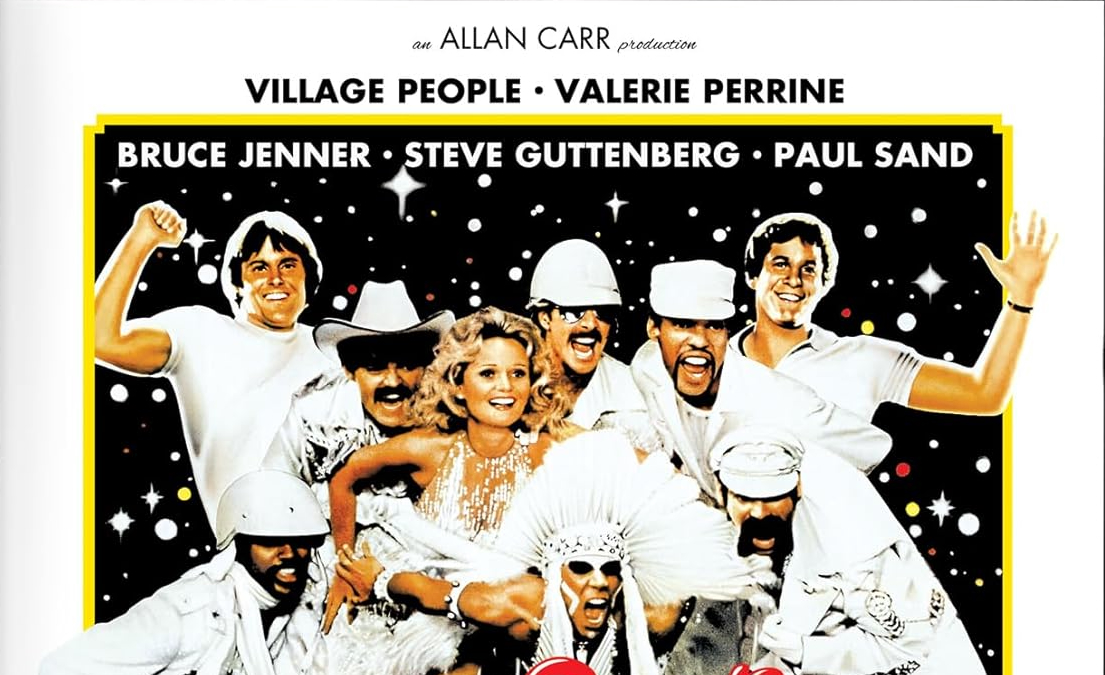
Delight in the high camp that is the Can’t Stop the Music, the fictionalized story of the Village People. Kino Lorber’s 4K UHD edition stuns with picture and sound.
The Film
Back in 2019, the Met Gala’s theme was “Camp”… which one only has to look up what stars wore to get a glimpse that many had no idea what exactly camp was/is. I mention this because Can’t Stop the Music may be the biggest piece of high camp this Film Critic has seen. This is not meant as any sort of insult, but rather the boldest and best of compliments to this magical musical that is guaranteed to make as many smile as it will enrage others.
Can’t Stop the Music tells the fictionalized story of how the Village People were formed and for a very-very-very-very, short time became a worldwide sensation. Jack Morell (Steve “The Goot” Guttenberg) is a happy-go-lucky wannabe Music Producer who’s just quit his job to DJ at a local disco and play his music. Playing his “Club Banger” called Sam proves to him that he needs to form a group to follow his dreams of fame and fortune. On this road Morell is helped by his Retired Model Friend Sam (Valerie Perrine), Felipe Rose (aka the man who would eventually become The Indian), and a Lawyer (played by Bruce Jenner nee Caitlin Jenner) informing the X-Men of Disco Music; VILLAGE PEOPLE!
There isn’t any way to prepare you for the glitter-infused awesomeness of this musical confection. The film is extra-extra-on-Spinal-Tap’s-11 from the opening moments to the final dance number finale. One needs to only watch the uncensored version of YMCA to understand the kind of film you’re watching. The amount of split screen, greased men performing various gymnastic stunts, penis, mustaches, and choreographed suggestive dance numbers that fill this 5-minute set piece is enough to fill four or five movies in 2024.
This is one of the rarest of rare films; one that cannot be truly critiqued or reviewed in the traditional sense. The film stands as a document to the excess and cocaine-fueled dreams of the 1970s and the height of the disco era. Now, if this was something released by say… The Bee Gee’s we could critique it for all its crass money grab (see: Sgt. Pepper’s Lonely Hearts Club Band). Can’t Stop the Music is NOT that and though some of the cash-grab intent is there, with how much Producer Allan Carr, director Nancy Walker, and the Village People did get away with this film. This is what Camp is the excessiveness and over-exaggeration to the point of almost self-parody. But within that camp Can’t Stop the Music is able to get away with so much that even now in our more supposedly liberated times would not be able to be done. There has to be a “hat’s off” moment of gratitude at how through excessive and coke-addled thought processes they have created one of the most liberated gay films of an era but one that hardly anyone has seen.
There is no verisimilitude to anything that happens during the 123-minute run time. But that isn’t the point. Can’t Stop the Music is a victory lap for the Village People and everything they stand for (including the crass commercialism of forming a “formula band”). What makes it a great film is the sort of fantasia of New York created in the film. This is as wonderful a dream of New York as the dream of Paris created in Amelie.
The Transfer
The 2018 UHD SDR Master by StudioCanal – From a 4K Scan of the 35mm Original Camera Negatives has done justice to this bright and bold film. With Optical Splits, lots of optical flares, deep reds, and neon-drenched photography this transfer could have been a nightmare. Luckily, for us, the 4K transfer handles everything perfectly. There si definitely generation loss with the different optical splits but that is not the fault of the transfer as much the work in the 70s with Optical Printers. Everything else is spot-on perfection. From grain structure, contrast, sharpness, and color reproduction are perfectly rendered on the Transfer. One may worry about the lack of an HDR but the film’s color spectrum looks amazing without HDR-10 or Dolby Vision. Bravo, to Kino and CanalPlus for taking the time and effort to make this transfer truly pop.
The Extras
Note: as the disc begins there is a lovely dedication to Critic Lee Gambin who recently passed.
They include the following;
DISC 1 (4KUHD):
- NEW Audio commentary by Film Critic/Historian Lee Gambin with Podcaster and Village People Expert DJ Maynard
- Audio Commentary by The Fabulous Allan Carr Director Jeffrey Schwarz and Comedy Writer Bruce Vilanch
DISC 2 (BLU-RAY):
- NEW Audio commentary by Film Critic/Historian Lee Gambin with Podcaster and Village People Expert DJ Maynard
- Audio Commentary by The Fabulous Allan Carr Director Jeffrey Schwarz and Comedy Writer Bruce Vilanch
- Interview with Village People’s Randy Jones
- Theatrical Trailer and TV Spots
The first of two Audio commentaries is an all-new track by Film Critic/Historian Lee Gambin with Podcaster and Village People Expert DJ Maynard begins with the film’s open is an ode to classic musicals and how much of the film is a love letter of classic musical. Some of the other details include how the film is a New Year’s Eve staple in Australia – including regular TV showing on New Years Eve since its release on home video during the early 1980s; the musicals that were released in 1980; the work and career of actor Valerie Perrine ; the work and career of actor Steve Guttenberg; the casting “what if” of Olivia Newton John that was asked but she told Xanadu instead; a cross promotion between the film at 31 Flavors/Baskin Robbins – and the flavor they created for the film; the work of choreographer of Arlene Phillips throughout the film – including a larger discussion of the dancers they used, the numbers themselves, the costuming, the themes in the dance numbers, and more; a larger discussion of the social themes in the films as they relate to the musical, the LBGTQ+ community; New York, and much more; a larger discussion about the Village People – the history behind the band, the making of this film, where they are currently, touring, and much more; the success of the film or the failure in various countries; the missing of the zeitgeist of disco with this film– a larger discussion about how Hollywood consistently misses those cultural relevance touchstones; a larger discussion of the work of director Nancy Walker – some of the stories from the production from various sources of her attitude on set and her dislike of making this film; their own personal history with the Village People; a larger discussion of the state of the movie musical at the time – where the film lands within the genre; a larger discussion of the various actors, personalities, musicians, and others cultural touchstones throughout the film; and much more. Gambin and Maynard give a wonderful commentary track for this cult masterpiece.
The second track is an archival Audio Commentary featuring Allan Carr, Jeffrey Schwarz, and Bruce Vilanch and is almost as much fun as the film itself. The commentary is one long entertaining bit as Carr, Schwarz, and Vilanch discuss the film, the times, the culture, and just about everything you could want. The track is hard to do a play-by-play with as the conversation goes everywhere and off on particular tangents. It’s definitely best experienced rather than just recounted. I will say this if you loved the film you’re going to extra-extra this Commentary.
A Wink, A Wiggle, and A Weave: Interview with Village People’s Randy Jones (25:15) – is an archival interview with Jones. The actor/singer discusses his childhood, his college years at UNC, moving to NYC, and getting involved in the dance/model scene with the likes of Grace Jones, Iman, and the like. This interview is more a career retrospective but pulled from the same interview that the Can’t Stop the Cowboy featurette is pulled from.
Can’t Stop the Cowboy: Interview Village People’s Randy Jones (40:59) – is an archival interview with Jones. He begins with a story of how Can’t Stop the Music was the First Golden Raspberry for the Worst film of 1980 (it really wasn’t). This is more of a making-of interview and how the Village People got involved with the film. This interview is better to be watched as there are so many great anecdotes about how this came to be and stories from the production, one tidbit is that Jacqueline Bisset was almost cast as Samantha (the role that eventually went to Valerie Perrine). The featurette is pulled from the same interview that A Wink, A Wiggle, and A Weave was.
TV Spots (0:59) – two 30-second TV spots.
Theatrical Trailer (2:57)
The Final Thought
Can’t Stop the Music is a Camp-Classic that needs to be experienced. You will never see anything like this as Kino Lorber has put the biggest rainbow-colored 4K UHD atop the package. HIGHEST POSSIBLE RECOMMENDATIONS!!!
Kino Lorber’s 4K UHD Edition of Can’t Stop the Music is out now
Discover more from The Movie Isle
Subscribe to get the latest posts sent to your email.
Pingback: Blu-ray review: The Best Little Whorehouse in Texas (Special Edition) – The Movie Isle