Scarlet Street is the kind of film that does not end well for any of the dolts that think they’re smarter than they really are. The Fritz Lang noir has Edward G. Robinson, Joan Bennett, and Dan Duryea in a triangle of deceit and conning that can only end one way, with someone dead.
Kitty (Bennett) and Johnnie (Duryea) think they’ve found the ultimate mark in Christopher Cross (Robinson). A lonely man whose art sells upwards of $50K a pop. The toxic couple sees greenbacks but there’s a hitch. Cross isn’t a famous artist, he’s a married Bank Cashier. As they begin to work their con, life twists and turns like a sharp dagger to conspire against everyone – including Cross himself. By the end no one is clean especially Cross who takes his vegance upon the low-level criminals.
Lang’s film is an oft-told tale – though done in different eras, places, and circumstances – but none as darkly funny and jaggedly cynical as Scarlet Street. This is a film that leaves no one untouched and how desire infects us all. That desire like a flu or virus making one do unspeakable things one would think impossible. The script by Dudley Nichols cuts to the very soul of these characters and their wanton desires that supersedes others around them. The brilliance of the film isn’t in the violence that erupts but in how the violence occurred. How with a bit more distance each of these characters – may – make better decisions.
Edward G. Robinson is brilliant here playing the mark. Going from Gangsters to Cuckold is no easy task and the actor does it brilliantly here. There’s something of a mystery to Robinson’s Cross. A contradiction in terms that Robinson plays to the fullest. The way that Cross wants desperately to please Kitty with all his fiber could come off as unbelievable, but Robinson gives the man a dignity and pride that’s greater than any rational instinct in the man. You can see the baser instincts take over in Cross after he “saves” Kitty from an attacker. It’s also his downfall and tragic end. Though, Robinson never gives us the obvious performance so when Cross does begin to act violently it’s that tricky balance of “unexpected but not out of the question”.
Lang’s film soars from its opening moments though it is a long fuse narrative. Those willing to go along with what can sometimes feel like stupidity on all character’s parts will be rewarded with the starkest of noir outcomes. One that is befitting to the most cynical of storytellers and audiences. One that brilliantly ends during Christmas time. Good will towards men – hogwash!!!
In the eyes of Scarlet Street, good will is just a sucker’s bet.
The Transfer
The all-new HD Master – From a 16bit 4K Scan of the 35mm Nitrate Composite Fine Grain (courtesy of Universal Pictures and UCLA) is a marvel of image quality and what is possible with Blu-ray and its image compression tools. Kino Lorber has made a Blu-ray transfer that’s in every way FLAWLESS. There’s a clarity, though never at the expense of the film’s more cinematic qualities, that’s unrivaled in most of what we’ve seen on home video three months into 2024 (with a few exceptions). Needless to say, anyone purchasing Scarlet Street is in for a huge treat. Watch this one on the biggest screen you have.
Note: KL has released a 4K UHD version of the film.
The Extras
They include the following;
NEW Audio Commentary by Film Historian Imogen Sara Smith
Audio Commentary by David Kalat, the Author of The Strange Case of Dr. Mabuse
Trailers
The all-new Audio Commentary by Film Historian Imogen Sara Smith begins by discussing how the film is a mirror of Lang’s own The Woman in the Window even starring the same three stars. Some of the other details including how the film was filmed on sets at studio and why Lang preferred studio work rather than location shooting; the Renoir film and the source novel the film is based on – but very different; the lack of sympathetic characters; Ernst Lubitsch’s first person that attempted to develop this version; the way the film constructs its story and characters – within the confines of the production of the time; the work and life of screenwriter Dudley Nichols; the work here and personal history of star Edward G Robinson – including the various later era work and HUAC preying upon him and how that effected career post 1950s; the work and personal history of Joan Bennett – including Lang’s thoughts on the actor and Robinson’s views of their relationship, a discussion of her transition from ingenue to star/actor; a larger discussion of Lang and his abusive ways to his cast, crew, and the Producers; a deep dive into the history of Femme Fatale and their evolution in the Noir in post-war America; the work of actor Rosalind Ivan; the work and personal history of actor Dan Duryea; a conversation of the art that’s featured in the film and the artist John Decker; a larger conversation of the various actors that appear in the film in supporting roles; a larger conversation about the Renoir film vs the Lang Film – their themes, their similarities, their differences, the endings; and much more. Smith provides a breezy, entertaining, and informative discussion of one of Lang’s greatest works, those involved, the themes, and the history and context in which it was made.
The next Audio Commentary is an archival one by David Kalat, the Author of The Strange Case of Dr. Mabuse opens with Scarlet Street being Fritz Lang’s favorite English Language film. Some of the details include The Woman in the Window being the first collaboration between Lang, Bennett, Duryea; Lang’s preference to working within the studio bound sets for control; how Scarlet Street was developed both getting the novel which the film was based on and the work between Lang and screenwriter Dudley Nichols; a discussion of how they came up with the title of the film; quotes from Lang’s own notes on the development of the screenplay and his thoughts on the characters; a larger discussion of the art both in the film, their themes, the style of the painting, and the work done by artist John Decker; a larger discussion of the costuming done by Travis Banton – how they helped Lang’s codify the film; a larger discussion of the deleted scenes, censored scenes by Lang and the studio, deleted sections from the script; and more. Kalat provides an educational/informative look at the film including some great quoted sources.
Rounding out the special features are trailers for The Woman in the Window (1:45); The Stranger (1:18); Night has a Thousand Eyes (2:23); Black Tuesday (1:52); A Bullet for Joey (2:08); One Way Street (2:12); Human Desire (1:57); Touch of Evil (2:12)
The Final Thought
Scarlett Street is a Noir Classic and has been treated as such by Kino Lorber. Highest Recommendations!

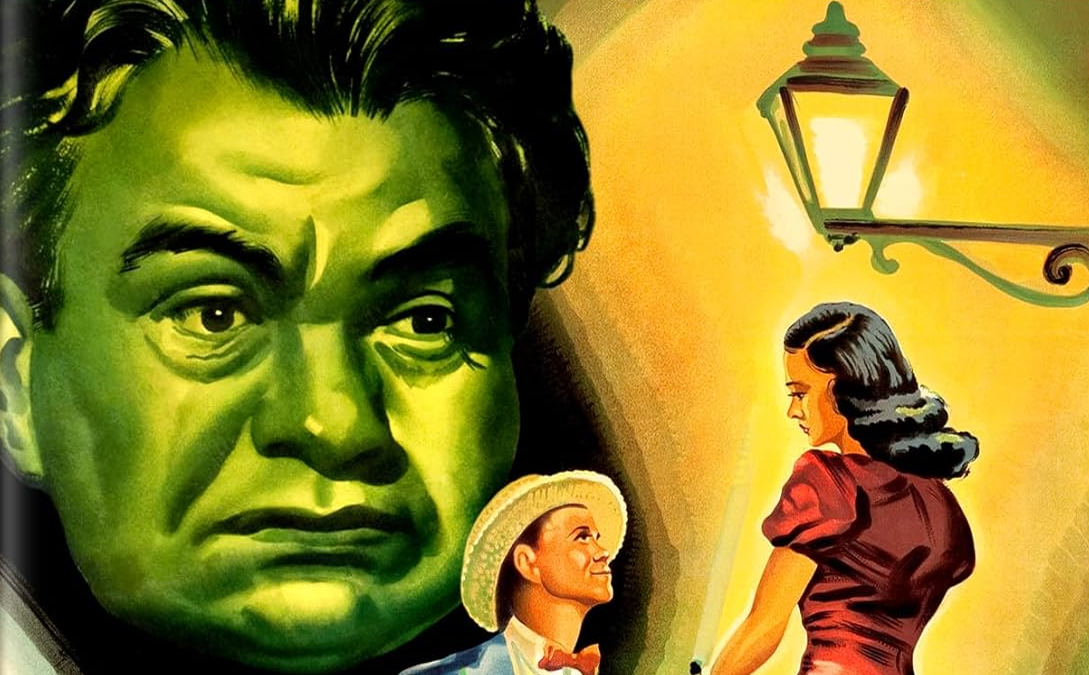
Fritz Lang’s Scarlet Street is at his noirish and darkly comedic cynical best. Kino Lorber has given us an upgraded Blu-ray with new HD Master.
The Film
Scarlet Street is the kind of film that does not end well for any of the dolts that think they’re smarter than they really are. The Fritz Lang noir has Edward G. Robinson, Joan Bennett, and Dan Duryea in a triangle of deceit and conning that can only end one way, with someone dead.
Kitty (Bennett) and Johnnie (Duryea) think they’ve found the ultimate mark in Christopher Cross (Robinson). A lonely man whose art sells upwards of $50K a pop. The toxic couple sees greenbacks but there’s a hitch. Cross isn’t a famous artist, he’s a married Bank Cashier. As they begin to work their con, life twists and turns like a sharp dagger to conspire against everyone – including Cross himself. By the end no one is clean especially Cross who takes his vegance upon the low-level criminals.
Lang’s film is an oft-told tale – though done in different eras, places, and circumstances – but none as darkly funny and jaggedly cynical as Scarlet Street. This is a film that leaves no one untouched and how desire infects us all. That desire like a flu or virus making one do unspeakable things one would think impossible. The script by Dudley Nichols cuts to the very soul of these characters and their wanton desires that supersedes others around them. The brilliance of the film isn’t in the violence that erupts but in how the violence occurred. How with a bit more distance each of these characters – may – make better decisions.
Edward G. Robinson is brilliant here playing the mark. Going from Gangsters to Cuckold is no easy task and the actor does it brilliantly here. There’s something of a mystery to Robinson’s Cross. A contradiction in terms that Robinson plays to the fullest. The way that Cross wants desperately to please Kitty with all his fiber could come off as unbelievable, but Robinson gives the man a dignity and pride that’s greater than any rational instinct in the man. You can see the baser instincts take over in Cross after he “saves” Kitty from an attacker. It’s also his downfall and tragic end. Though, Robinson never gives us the obvious performance so when Cross does begin to act violently it’s that tricky balance of “unexpected but not out of the question”.
Lang’s film soars from its opening moments though it is a long fuse narrative. Those willing to go along with what can sometimes feel like stupidity on all character’s parts will be rewarded with the starkest of noir outcomes. One that is befitting to the most cynical of storytellers and audiences. One that brilliantly ends during Christmas time. Good will towards men – hogwash!!!
In the eyes of Scarlet Street, good will is just a sucker’s bet.
The Transfer
The all-new HD Master – From a 16bit 4K Scan of the 35mm Nitrate Composite Fine Grain (courtesy of Universal Pictures and UCLA) is a marvel of image quality and what is possible with Blu-ray and its image compression tools. Kino Lorber has made a Blu-ray transfer that’s in every way FLAWLESS. There’s a clarity, though never at the expense of the film’s more cinematic qualities, that’s unrivaled in most of what we’ve seen on home video three months into 2024 (with a few exceptions). Needless to say, anyone purchasing Scarlet Street is in for a huge treat. Watch this one on the biggest screen you have.
Note: KL has released a 4K UHD version of the film.
The Extras
They include the following;
The all-new Audio Commentary by Film Historian Imogen Sara Smith begins by discussing how the film is a mirror of Lang’s own The Woman in the Window even starring the same three stars. Some of the other details including how the film was filmed on sets at studio and why Lang preferred studio work rather than location shooting; the Renoir film and the source novel the film is based on – but very different; the lack of sympathetic characters; Ernst Lubitsch’s first person that attempted to develop this version; the way the film constructs its story and characters – within the confines of the production of the time; the work and life of screenwriter Dudley Nichols; the work here and personal history of star Edward G Robinson – including the various later era work and HUAC preying upon him and how that effected career post 1950s; the work and personal history of Joan Bennett – including Lang’s thoughts on the actor and Robinson’s views of their relationship, a discussion of her transition from ingenue to star/actor; a larger discussion of Lang and his abusive ways to his cast, crew, and the Producers; a deep dive into the history of Femme Fatale and their evolution in the Noir in post-war America; the work of actor Rosalind Ivan; the work and personal history of actor Dan Duryea; a conversation of the art that’s featured in the film and the artist John Decker; a larger conversation of the various actors that appear in the film in supporting roles; a larger conversation about the Renoir film vs the Lang Film – their themes, their similarities, their differences, the endings; and much more. Smith provides a breezy, entertaining, and informative discussion of one of Lang’s greatest works, those involved, the themes, and the history and context in which it was made.
The next Audio Commentary is an archival one by David Kalat, the Author of The Strange Case of Dr. Mabuse opens with Scarlet Street being Fritz Lang’s favorite English Language film. Some of the details include The Woman in the Window being the first collaboration between Lang, Bennett, Duryea; Lang’s preference to working within the studio bound sets for control; how Scarlet Street was developed both getting the novel which the film was based on and the work between Lang and screenwriter Dudley Nichols; a discussion of how they came up with the title of the film; quotes from Lang’s own notes on the development of the screenplay and his thoughts on the characters; a larger discussion of the art both in the film, their themes, the style of the painting, and the work done by artist John Decker; a larger discussion of the costuming done by Travis Banton – how they helped Lang’s codify the film; a larger discussion of the deleted scenes, censored scenes by Lang and the studio, deleted sections from the script; and more. Kalat provides an educational/informative look at the film including some great quoted sources.
Rounding out the special features are trailers for The Woman in the Window (1:45); The Stranger (1:18); Night has a Thousand Eyes (2:23); Black Tuesday (1:52); A Bullet for Joey (2:08); One Way Street (2:12); Human Desire (1:57); Touch of Evil (2:12)
The Final Thought
Scarlett Street is a Noir Classic and has been treated as such by Kino Lorber. Highest Recommendations!
Kino Lorber’s Blu-Ray edition of Scarlet Street is out now.
Share this:
Like this:
Discover more from The Movie Isle
Subscribe to get the latest posts sent to your email.