Joe Dante’s 80s sci-fi action comedy cult classic Innerspace comes to 4K UHD, with an all-new director-approved restoration and special features from Arrow Video.
The Film
When I was a kid, I thought Tuck Pendleton was one of the coolest screen heroes in cinematic history. Little did I know my hero worship was for a washed-up alcoholic reprobate. It says much about the charm of Dennis Quaid in his star era that he was able to make Tuck the most charming of rapscallions who manages to help Jack Putter through the corporate tech espionage plot of Joe Dante’s cult classic action sci-fi comedy Innerspace.
The idea of updating the Martin and Lewis comedy film for the 1980s, adroitly mashed up with a Spielbergian “fantastic” adventure (he produced the film), is an ingenious one. One so clever it was lost on the theatrical audience not once but twice (Warner Brothers was so confident they had something rereleased the film at its initial failure). Like many of Dante’s films in the video era, it found its audience on VHS. Innerspace became a smash hit on home video, making more in rentals than it did theatrically, where it and the likes of Explorers, The Burbs, and other Dante Cult Classics had similar fates.
The fun of Innerspace is in the conceit that Tuck (Quaid), the true man of action, has been miniaturized in a craft and injected into Jack Putter (Martin Short). Tuck must work with Jack to rise to the occasion to be the hero with a capital “H” if both are going to live the ordeal, and Tuck can get out of Jack’s body and be enlarged to normal size. Watching hypochondriac, to put it mildly, Jack figure his way through action set piece after set piece is both hilarious and thrilling as it is to watch Tuck inside his craft navigate Jack’s hostile body.
Martin Short proves to be a nimble physical performer who’s adept at the action and makes you feel the moments of danger. None more truly wonderful than the mid chase/escape from the frozen truck, which has Short literally hanging from the doors of the frozen food truck while Meg Ryan’s Lydia attempts to rescue him. Dante, along with stunt coordinator Glenn Randall Jr., wisely (or unwisely) put Short in the middle of the action during key moments with a “how did they do that” bit of movie magic that sells everything in the way that 1980s films with the lack of CGI sell so much better than anything four decades later.
Every choice Dante makes turns out to be the smartest choice for the film, including the insistence on using Dennis Muren and ILM’s movie magicians for the visual effects. The analog/photochemical wizardry on display is still gorgeous and stunning in 2026 as it was upon initial release. There is a sense of verisimilitude on display in the work that dares you to attempt to find the seams in the work. It is no small task and accomplishment here that everything is flawlessly executed and rendered. Saying that this is one of the truly magnificent visual effects productions of the 1980s is an understatement.
Innerspace is not just one of Dante’s finest hours as a commercial filmmaker but one of the true gems of the 1980s.
The Transfer
The all-new restoration from the original 35mm negative by Arrow Films, approved by director Joe Dante, presented in Dolby Vision (HDR10 compatible), is a flawless representation of the film. The restoration work done by Arrow may be their best yet. The image is clean of any dirt, scratches, or issues/defects throughout the entire runtime. The color reproduction accurately represents the film’s look and feel from prior home video iterations, just with an added depth and detail that can only be found in HDR encoding. The same can be said of the black, contrast levels, and grain structure, all surpassing anything done in the previous Blu-ray release or even in 35mm release prints (this reviewer having seen a rep screening of a near flawless print at the New Beverly years ago). Arrow Video’s collaboration with Warner Bros continues to bear the sweetest of 4K UHD releases. Collectors rejoice, we have yet another winner on our hands.
The Extras
They include the following;
Brand new audio commentary by film critic Drew McWeeny
Archive audio commentary with director Joe Dante, producer Michael Finnell, visual effects supervisor Dennis Muren, and actors Kevin McCarthy and Robert Picardo
Shrinkage: The Making of Innerspace
Joe Dante’s Behind the Scenes Video Compilation
ILM Behind the Scenes
Storyboard Gallery
Polaroids: Continuity and Behind the Scenes Gallery
Production stills gallery
Posters gallery
Theatrical trailer
The first of two audio commentaries is an all-new track by film critic Drew McWeeny. McWeeny opens with his love of Dante and a discussion of the team and company of actors he continually worked with. Some of the other details include the work of both Dennis Quaid and Meg Ryan, who met here and eventually fell in love; a discussion of the trope in the 1980s of the horrible/mess of a lead character, which Quaid’s character is a part of; how Dante became attached to the project; the development of the screenplay and what Chip Proser and Jeffery Boam brought to the story and tone of the eventual film; the building of Tuck’s craft that was a collaboration between the production and ILM for both a life size set inside and out and also miniature versions which there were multiple of and their purposes; a larger detailed discussion of the work and challenged fact (during preproduction, production and post production) of Dennis Murren and ILM (including larger discussions throughout of the other now famous crew members like John Knoll) and how it was accomplished; a larger discussion of the work of Martin Short here and his personal and professional history; a discussion of the advertising, release of the film and its eventual success on home video; a discussion of the stunt work in the film; the work of make-up effect supervisor Rob Bottin and a larger discussion of his career; a discussion of the fetus effects moment and the work that went into it; a discussion of how they accomplished the Igoe vs Tuck set piece; a larger discussion about how Hora and Dante shot almost the entire film in POV to be edited into Tuck’s screens on his pod; a larger discussion of the various locations used by the production; a larger discussion of the various actors that appear in the film, their personal and professional histories; and much more. McWeeny provides a thorough and informative (and highly entertaining) track on the making of the film and the hard work done by the craftspeople to accomplish this visually stunning sci-fi action comedy, and his huge shoutout to the magazine Cinefex at the end of the track.
The second audio commentary is an archival track with director Joe Dante, producer Michael Finnell, visual effects supervisor Dennis Muren, and actors Kevin McCarthy and Robert Picardo. They all begin with introductions (exception for Picardo, who doesn’t show up until midway through the track) before diving into the fact that they tried different titles, which Dante admits is a terrible title. Some of the other details include how Peter Gruber brought the film to them first and how they, after years, came back to the project; the practical reason why he tries to give acting roles to all his writers; how they came to cast Dennis Quaid; how they eventually cast Meg Ryan, at the last minute; the Dick Miller cameo; the way that John Hora, Dante’s normal cinematographer, was cast in the film; how they were able to cast real scientists from JPL in the film; a larger discussion of how Dante and 2nd unit director/stunt coordinator Glenn Randall divided the work; how they accomplished the POV footage that is seen throughout the film; how Joe Flaherty and Andrea Martin ended up in cameo roles; a larger discussion of the various visual effect shots and how Muren and ILM were able to accomplish them; a larger discussion of the various inside jokes and visual gags that Dante placed in the film; a larger discussion of the various locations in San Francisco and Los Angeles they used; the various cameos and inside jokes throughout the film; and much more.
Shrinkage: The Making of Innerspace (58:33) – the all-new making-of documentary is a fascinating look at the making of this cult action-comedy classic. The documentary charts not just the development of the screenplay from a serious sci-fi to a sci-fi comedy, but also Dante’s career and where he was when he decided to make the film. The various directors who wanted to make the film (who included, among others, John Carpenter and Robert Zemeckis). The casting of the film, getting the various Dante regulars, Martin Short, and Denis Quaid, including a great anecdote about Cate Capshaw wanting the role that went to Meg Ryan (also how Meg Ryan was cast in the film). The production and all of the various issues, concerns, and more that come with a production; the fact that Warner Bros executives did not believe in the film; the executives wanted to fire Martin Short, and how Dante’s resolved the issue; and other stories from the production. The post-production process with the visual effects by ILM and how it came to the FX House; the challenges the film posed, the amount of improvisation within individual shots, there was with the help of Dennis Muren, and how they imposed a specific style working with Dante. The unsuccessful release and ad campaign, and its rise as a huge hit on VHS, leading the film to become a cult classic. The documentary does a great job of charting the making of and release of Innerspace with great detail. Featuring interviews with director Joe Dante, producer Michael Finnell, visual effects supervisor Dennis Muren, visual effects artists Harley Jessup and Bill George, and actor Robert Picardo.
Joe Dante’s Behind the Scenes Video Compilation (23:32) – this never-before-seen video footage shot by director Joe Dante during the production of Innerspace. The first half of the footage is from a day on set that appears to have had horrible weather that allowed for a little bit of goofing off with the cast and crew (including Martin Short and Kevin McCarthy hamming it up). The second half is a mashup from various days with the crew and cast that’s more a fly-on-the-wall look at what a production is really like … people standing while others are working and waiting for that perfect moment to shoot (see if you can count how many times you see Dennis Quaid in the background smoking).
ILM Behind the Scenes (20:16) – this never-before-seen video footage shot by visual effects supervisor Dennis Muren during production gives us a rare look at the visual effects production for Innerspace. This is a goldmine for anyone who worshiped the work that ILM did during its true heyday, getting a look at how things were practically done with a lot of goofy charm by the artists who made the film. Muren guides you through the model shop (those Back to the Future II, X-Wing, Vader’s Tie Fighter models!), the miniature sets from inside the body, shooting fetus, and everything that was required to accomplish it, and more. This fly-on-the-wall look at how much of the film was done by literal hand is a delight for anyone who loves the analog FX work of the 1980s, but one of the most interesting aspects is the discussion (back in 1987) they were having about tests from Computer Graphics they would be reviewing.
Storyboard Gallery (8:27) – these original storyboards (which are beautifully detailed) are edited together, accompanied by Jerry Goldsmith’s score. Some of the biggest visual effects set pieces are here in storyboard form, but also included are the VFX breakdowns of what will be needed to accomplish the shot.
Polaroids: Continuity and Behind the Scenes Gallery (10:23) – this collection of polaroids from the production offers a rare behind-the-scenes glimpse at candid moments and some of the continuity stills (kept to ensure that the actor’s hair, makeup, and costumes remain the same). This is, by far, one of the best galleries in recent memory, especially for fans of the film. The gallery runs automatically, accompanied by Jerry Goldsmith’s score and one of Sam Cooke’s songs used in the film.
Production stills (14:34) – the gallery consists of production stills (many of which are of the VFX work) and cast publicity stills taken for the film. Another gallery that runs automatically, accompanied by Jerry Goldsmith’s score (if one watches all the galleries, they get the entire Goldsmith score for free, essentially).
Posters gallery (1:37) – the various posters (some used and some unused), home video, and publicity art used for the film around the world.
Theatrical trailer (1:31)
The Final Thought
Arrow has outdone themselves with a truly definitive edition of Innerspace. Highest Possible Recommendations!!

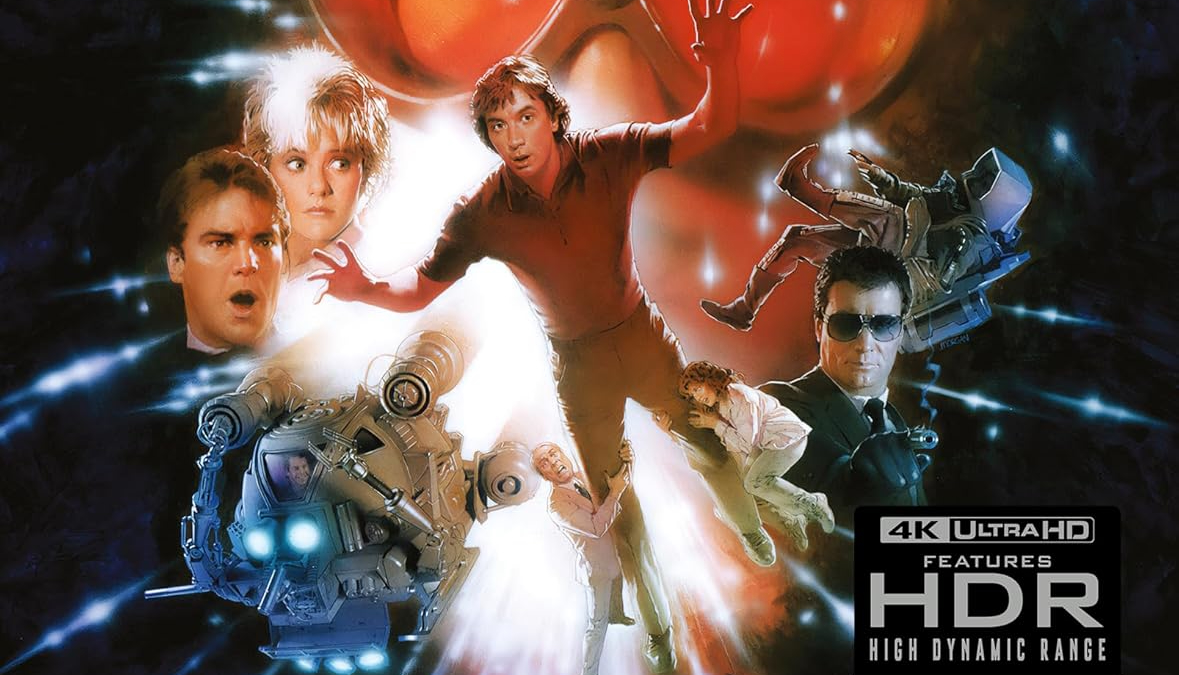
Joe Dante’s 80s sci-fi action comedy cult classic Innerspace comes to 4K UHD, with an all-new director-approved restoration and special features from Arrow Video.
The Film
When I was a kid, I thought Tuck Pendleton was one of the coolest screen heroes in cinematic history. Little did I know my hero worship was for a washed-up alcoholic reprobate. It says much about the charm of Dennis Quaid in his star era that he was able to make Tuck the most charming of rapscallions who manages to help Jack Putter through the corporate tech espionage plot of Joe Dante’s cult classic action sci-fi comedy Innerspace.
The idea of updating the Martin and Lewis comedy film for the 1980s, adroitly mashed up with a Spielbergian “fantastic” adventure (he produced the film), is an ingenious one. One so clever it was lost on the theatrical audience not once but twice (Warner Brothers was so confident they had something rereleased the film at its initial failure). Like many of Dante’s films in the video era, it found its audience on VHS. Innerspace became a smash hit on home video, making more in rentals than it did theatrically, where it and the likes of Explorers, The Burbs, and other Dante Cult Classics had similar fates.
The fun of Innerspace is in the conceit that Tuck (Quaid), the true man of action, has been miniaturized in a craft and injected into Jack Putter (Martin Short). Tuck must work with Jack to rise to the occasion to be the hero with a capital “H” if both are going to live the ordeal, and Tuck can get out of Jack’s body and be enlarged to normal size. Watching hypochondriac, to put it mildly, Jack figure his way through action set piece after set piece is both hilarious and thrilling as it is to watch Tuck inside his craft navigate Jack’s hostile body.
Martin Short proves to be a nimble physical performer who’s adept at the action and makes you feel the moments of danger. None more truly wonderful than the mid chase/escape from the frozen truck, which has Short literally hanging from the doors of the frozen food truck while Meg Ryan’s Lydia attempts to rescue him. Dante, along with stunt coordinator Glenn Randall Jr., wisely (or unwisely) put Short in the middle of the action during key moments with a “how did they do that” bit of movie magic that sells everything in the way that 1980s films with the lack of CGI sell so much better than anything four decades later.
Every choice Dante makes turns out to be the smartest choice for the film, including the insistence on using Dennis Muren and ILM’s movie magicians for the visual effects. The analog/photochemical wizardry on display is still gorgeous and stunning in 2026 as it was upon initial release. There is a sense of verisimilitude on display in the work that dares you to attempt to find the seams in the work. It is no small task and accomplishment here that everything is flawlessly executed and rendered. Saying that this is one of the truly magnificent visual effects productions of the 1980s is an understatement.
Innerspace is not just one of Dante’s finest hours as a commercial filmmaker but one of the true gems of the 1980s.
The Transfer
The all-new restoration from the original 35mm negative by Arrow Films, approved by director Joe Dante, presented in Dolby Vision (HDR10 compatible), is a flawless representation of the film. The restoration work done by Arrow may be their best yet. The image is clean of any dirt, scratches, or issues/defects throughout the entire runtime. The color reproduction accurately represents the film’s look and feel from prior home video iterations, just with an added depth and detail that can only be found in HDR encoding. The same can be said of the black, contrast levels, and grain structure, all surpassing anything done in the previous Blu-ray release or even in 35mm release prints (this reviewer having seen a rep screening of a near flawless print at the New Beverly years ago). Arrow Video’s collaboration with Warner Bros continues to bear the sweetest of 4K UHD releases. Collectors rejoice, we have yet another winner on our hands.
The Extras
They include the following;
The first of two audio commentaries is an all-new track by film critic Drew McWeeny. McWeeny opens with his love of Dante and a discussion of the team and company of actors he continually worked with. Some of the other details include the work of both Dennis Quaid and Meg Ryan, who met here and eventually fell in love; a discussion of the trope in the 1980s of the horrible/mess of a lead character, which Quaid’s character is a part of; how Dante became attached to the project; the development of the screenplay and what Chip Proser and Jeffery Boam brought to the story and tone of the eventual film; the building of Tuck’s craft that was a collaboration between the production and ILM for both a life size set inside and out and also miniature versions which there were multiple of and their purposes; a larger detailed discussion of the work and challenged fact (during preproduction, production and post production) of Dennis Murren and ILM (including larger discussions throughout of the other now famous crew members like John Knoll) and how it was accomplished; a larger discussion of the work of Martin Short here and his personal and professional history; a discussion of the advertising, release of the film and its eventual success on home video; a discussion of the stunt work in the film; the work of make-up effect supervisor Rob Bottin and a larger discussion of his career; a discussion of the fetus effects moment and the work that went into it; a discussion of how they accomplished the Igoe vs Tuck set piece; a larger discussion about how Hora and Dante shot almost the entire film in POV to be edited into Tuck’s screens on his pod; a larger discussion of the various locations used by the production; a larger discussion of the various actors that appear in the film, their personal and professional histories; and much more. McWeeny provides a thorough and informative (and highly entertaining) track on the making of the film and the hard work done by the craftspeople to accomplish this visually stunning sci-fi action comedy, and his huge shoutout to the magazine Cinefex at the end of the track.
The second audio commentary is an archival track with director Joe Dante, producer Michael Finnell, visual effects supervisor Dennis Muren, and actors Kevin McCarthy and Robert Picardo. They all begin with introductions (exception for Picardo, who doesn’t show up until midway through the track) before diving into the fact that they tried different titles, which Dante admits is a terrible title. Some of the other details include how Peter Gruber brought the film to them first and how they, after years, came back to the project; the practical reason why he tries to give acting roles to all his writers; how they came to cast Dennis Quaid; how they eventually cast Meg Ryan, at the last minute; the Dick Miller cameo; the way that John Hora, Dante’s normal cinematographer, was cast in the film; how they were able to cast real scientists from JPL in the film; a larger discussion of how Dante and 2nd unit director/stunt coordinator Glenn Randall divided the work; how they accomplished the POV footage that is seen throughout the film; how Joe Flaherty and Andrea Martin ended up in cameo roles; a larger discussion of the various visual effect shots and how Muren and ILM were able to accomplish them; a larger discussion of the various inside jokes and visual gags that Dante placed in the film; a larger discussion of the various locations in San Francisco and Los Angeles they used; the various cameos and inside jokes throughout the film; and much more.
Shrinkage: The Making of Innerspace (58:33) – the all-new making-of documentary is a fascinating look at the making of this cult action-comedy classic. The documentary charts not just the development of the screenplay from a serious sci-fi to a sci-fi comedy, but also Dante’s career and where he was when he decided to make the film. The various directors who wanted to make the film (who included, among others, John Carpenter and Robert Zemeckis). The casting of the film, getting the various Dante regulars, Martin Short, and Denis Quaid, including a great anecdote about Cate Capshaw wanting the role that went to Meg Ryan (also how Meg Ryan was cast in the film). The production and all of the various issues, concerns, and more that come with a production; the fact that Warner Bros executives did not believe in the film; the executives wanted to fire Martin Short, and how Dante’s resolved the issue; and other stories from the production. The post-production process with the visual effects by ILM and how it came to the FX House; the challenges the film posed, the amount of improvisation within individual shots, there was with the help of Dennis Muren, and how they imposed a specific style working with Dante. The unsuccessful release and ad campaign, and its rise as a huge hit on VHS, leading the film to become a cult classic. The documentary does a great job of charting the making of and release of Innerspace with great detail. Featuring interviews with director Joe Dante, producer Michael Finnell, visual effects supervisor Dennis Muren, visual effects artists Harley Jessup and Bill George, and actor Robert Picardo.
Joe Dante’s Behind the Scenes Video Compilation (23:32) – this never-before-seen video footage shot by director Joe Dante during the production of Innerspace. The first half of the footage is from a day on set that appears to have had horrible weather that allowed for a little bit of goofing off with the cast and crew (including Martin Short and Kevin McCarthy hamming it up). The second half is a mashup from various days with the crew and cast that’s more a fly-on-the-wall look at what a production is really like … people standing while others are working and waiting for that perfect moment to shoot (see if you can count how many times you see Dennis Quaid in the background smoking).
ILM Behind the Scenes (20:16) – this never-before-seen video footage shot by visual effects supervisor Dennis Muren during production gives us a rare look at the visual effects production for Innerspace. This is a goldmine for anyone who worshiped the work that ILM did during its true heyday, getting a look at how things were practically done with a lot of goofy charm by the artists who made the film. Muren guides you through the model shop (those Back to the Future II, X-Wing, Vader’s Tie Fighter models!), the miniature sets from inside the body, shooting fetus, and everything that was required to accomplish it, and more. This fly-on-the-wall look at how much of the film was done by literal hand is a delight for anyone who loves the analog FX work of the 1980s, but one of the most interesting aspects is the discussion (back in 1987) they were having about tests from Computer Graphics they would be reviewing.
Storyboard Gallery (8:27) – these original storyboards (which are beautifully detailed) are edited together, accompanied by Jerry Goldsmith’s score. Some of the biggest visual effects set pieces are here in storyboard form, but also included are the VFX breakdowns of what will be needed to accomplish the shot.
Polaroids: Continuity and Behind the Scenes Gallery (10:23) – this collection of polaroids from the production offers a rare behind-the-scenes glimpse at candid moments and some of the continuity stills (kept to ensure that the actor’s hair, makeup, and costumes remain the same). This is, by far, one of the best galleries in recent memory, especially for fans of the film. The gallery runs automatically, accompanied by Jerry Goldsmith’s score and one of Sam Cooke’s songs used in the film.
Production stills (14:34) – the gallery consists of production stills (many of which are of the VFX work) and cast publicity stills taken for the film. Another gallery that runs automatically, accompanied by Jerry Goldsmith’s score (if one watches all the galleries, they get the entire Goldsmith score for free, essentially).
Posters gallery (1:37) – the various posters (some used and some unused), home video, and publicity art used for the film around the world.
Theatrical trailer (1:31)
The Final Thought
Arrow has outdone themselves with a truly definitive edition of Innerspace. Highest Possible Recommendations!!
Arrow Video’s 4K UHD Edition of Innerspace is out April 28th.
Share this:
Like this:
Discover more from The Movie Isle
Subscribe to get the latest posts sent to your email.