An English language film from French legend Claire Denis, who visits Africa again for a tense standoff between a local man and the workers at the western-owned industrial site on their doorstep. The Fence plays at Manchester Film Festival 2026.
The director and cast alone should be enough to pique the curiosity of any filmgoer; Claire Denis directs Isaach de Bankolé, Matt Dillon, Mia McKenna-Bruce and Tom Blyth in what should be a tense drama which takes place in west Africa over the course of a day and night.
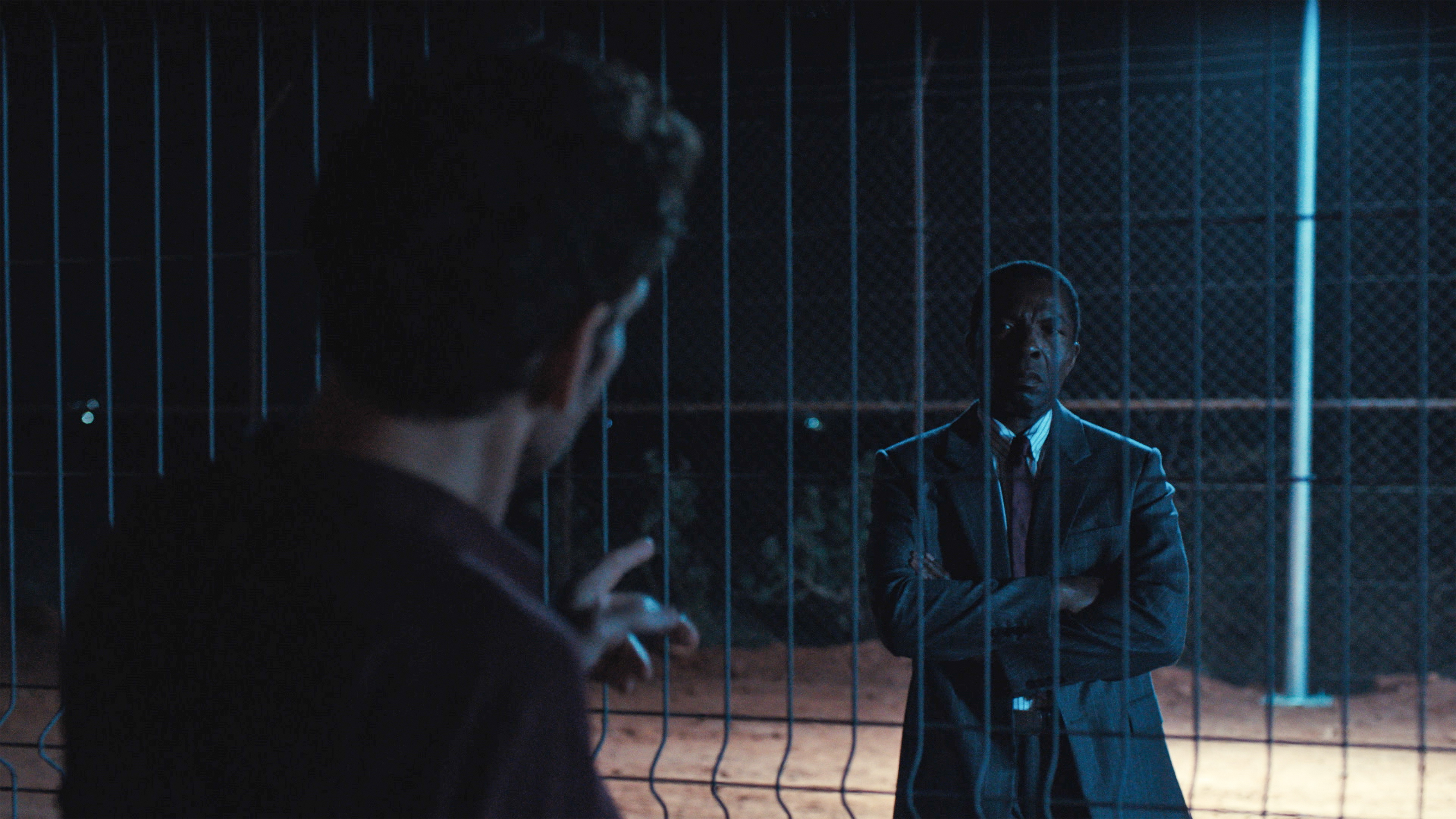
De Bankolé‘s character Alboury comes to the construction site near his village one evening, to request the collection of the body of his brother, who has died in a work-related accident that day. Project Manager Horn (Dillon) seems reluctant to hand over the body, and offers Alboury money to go home for the night, promising that the body will be handed over at daybreak. At the same time, Horn’s deputy Cal (Blyth) is on his way to the rural airport to collect Horn’s new wife Leonie (McKenna-Bruce), who is arriving to start a new life with her husband.
Mia McKenna-Bruce is quickly becoming one of my favourite young British actors to watch, and together with de Bankolé’s steady, imposing presence, these were my two favourite things about The Fence.
Sadly, it’s a film which was otherwise disappointing. The Fence was originally written as a play (Combat de nègre et de chiens) by Bernard-Marie Koltès, and it’s all too obvious in the dialogue. In the context of a cinematic rather than theatrical experience, it’s very stodgy and repetitive, and Dillon in particular struggles to deliver the lines convincingly. Additionally, I was irked by the casting of Dillon opposite McKenna-Bruce. There is clearly supposed to be some ambiguity in the narrative around the reason that they became a couple, but the 34 year age gap was tricky to stomach. I was also a little frustrated by the speed at which the conclusion was reached, which seemed rushed after spending the previous hour and a half wading through the treacle of dialogue.
Making this film has clearly been a work of love in memory of Denis’ late friend Koltès (who died of Aids-related issues in 1989) and it has taken her quite a while to bring it to fruition. It could be that The Fence has suffered from the transition from stage to screen, or from French to English, or perhaps it has just missed its moment. Either way, something was just slightly lacking.
The Fence plays at Manchester Film Festival (19th – 29th March 2026).

An English language film from French legend Claire Denis, who visits Africa again for a tense standoff between a local man and the workers at the western-owned industrial site on their doorstep. The Fence plays at Manchester Film Festival 2026.
The director and cast alone should be enough to pique the curiosity of any filmgoer; Claire Denis directs Isaach de Bankolé, Matt Dillon, Mia McKenna-Bruce and Tom Blyth in what should be a tense drama which takes place in west Africa over the course of a day and night.
De Bankolé‘s character Alboury comes to the construction site near his village one evening, to request the collection of the body of his brother, who has died in a work-related accident that day. Project Manager Horn (Dillon) seems reluctant to hand over the body, and offers Alboury money to go home for the night, promising that the body will be handed over at daybreak. At the same time, Horn’s deputy Cal (Blyth) is on his way to the rural airport to collect Horn’s new wife Leonie (McKenna-Bruce), who is arriving to start a new life with her husband.
Mia McKenna-Bruce is quickly becoming one of my favourite young British actors to watch, and together with de Bankolé’s steady, imposing presence, these were my two favourite things about The Fence.
Sadly, it’s a film which was otherwise disappointing. The Fence was originally written as a play (Combat de nègre et de chiens) by Bernard-Marie Koltès, and it’s all too obvious in the dialogue. In the context of a cinematic rather than theatrical experience, it’s very stodgy and repetitive, and Dillon in particular struggles to deliver the lines convincingly. Additionally, I was irked by the casting of Dillon opposite McKenna-Bruce. There is clearly supposed to be some ambiguity in the narrative around the reason that they became a couple, but the 34 year age gap was tricky to stomach. I was also a little frustrated by the speed at which the conclusion was reached, which seemed rushed after spending the previous hour and a half wading through the treacle of dialogue.
Making this film has clearly been a work of love in memory of Denis’ late friend Koltès (who died of Aids-related issues in 1989) and it has taken her quite a while to bring it to fruition. It could be that The Fence has suffered from the transition from stage to screen, or from French to English, or perhaps it has just missed its moment. Either way, something was just slightly lacking.
The Fence plays at Manchester Film Festival (19th – 29th March 2026).
Share this:
Like this: