Jeff Bridges and John Heard play men on the fringes in over their heads with a blackmail scheme gone awry in the 1980s forgotten masterpiece, Cutter’s Way. Newly restored on 4K UHD from Radiance Films.
The Film
Cutter’s Way, though released in 1980, feels through and through like a film deeply embedded in the 1970s. Heartfelt. Sad. Bruised. Paranoid. Thrilling. The film was almost entirely forgotten in its initial release, but it has found a devoted rabid following. It is easy to see why, with ties to the 1970s and the rise of capitalism and the “greed is good ethos” of the 1980s very present in the film, it melds the two in a way that feels more akin to the 2020s.
Cutter (John Heard) and Bone (Jeff Bridges) are two men who never found their way out of the late 1960s for very different reasons. Cutter’s tour in Vietnam cost him an arm, a leg, and an eye. Bone’s time at Harvard as a Lothario was everything that the Summer of Love promised. Each man, though on different journeys, never moved past and settled into a drunken stupor or rage (for Cutter) and meaningless sex (for Bone). After Bone sees a body disposed of and is questioned by the Santa Barbara police about it, it’s on a parade day, drinking with Cutter’s wife, Mo (Lisa Eichhorn), that sets everything in motion. There, Bone recognizes JJ Cord (Stephen Elliot) – local billionaire tycoon – as the man who dumped the body. Cutter quickly sees both injustices and an opportunity. One that could get them some payback.
There is a messiness to everything in Cutter’s Way that the best neo-noirs have. Part of the beauty of the film is how much time we spend with Bone and Cutter before the plot begins proper. That languid pace, throughout, allows for the characters and their lives to seep into your soul. Bone, Cutter, and Mo are losers in the way that Springsteen wrote about losers in his early albums. People corrupted by loss and decisions out of their control. Their triangle isn’t just one of love. Love left all three a long time ago. It’s a triangle of codependency.
The way that Heard, Bridges, and Eichhorn all play against each other is magical in the way that broken souls truly circle and play against each other. Heard is electric as Cutter, the man whose soul was left in Vietnam and continues to pull everyone into his heart of darkness. Bridges plays Bone as the good-intentioned, beautiful loser who never realizes the gravity of his decisions until it is far too late. Eichhorn may be the most delicate of the three and the best; her Mo is the balancing act between Bone and Cutter, and after a decade (or more), is just too tired of both men’s respective bullshit. This combination creates a searing and heartbreaking drama that is perfectly layered upon the more noirish thriller elements that play out over the course of the film.
The other piece to the puzzle of brilliance that is Cutter’s Way comes from not just the visual style employed by director Ivan Passer and cinematographer Jordan Cronenweth. The film is masterfully bathed in the dusky light of Southern California’s beach towns, but that belies the sinister deeds playing out in the shadows. The film, perpetually shot between the early morning and late afternoon, gives angular shadows to everything seen. Even the nights retain that beautiful angular look that obscures as much as it enlightens imagery. Cornenweth’s work here is as accomplished as anything in his career (see Bladerunner, State of Grace, or any other number of the films he shot before his untimely passing), but the way that Cutter’s Way so accurately captures the lazy look of Southern California that is rarely captured so uniquely and artfully.
There are few films from the 1980s as subtly sharp and acutely cynical as Cutter’s Way. It may be the reason why it was rejected at the time, only to be rightfully rediscovered. Even now, close to five decades later, it remains as haunting and searing as ever.
The Transfer
The all-new 4K restoration from the original camera negative, presented in Dolby Vision HD, making its world premiere on 4K UHD, is nothing short of stunning. Radiance Films has taken the care that one would want in protecting all that makes Jordan Cornenweth’s cinematography so special. The grain, the contrast, and the deep blacks are all flawlessly rendered in the uncompressed beauty of 4K UHD. The image remains beautifully cinematic without a scratch or blemish through the entire runtime. For cineastes, this will be one of the hallowed discs that they reference when they talk about the beauty that can be produced on the format. It is early in 2026, but this restoration could possibly be one of the best of the year. Bravo to Radiance Films.
The Extras
They include the following;
Archival audio commentary by novelist Matthew Specktor
Archival audio commentary by film historians Julie Kirgo and Nick Redman
Archival audio commentary by assistant director Larry Franco and unit production manager Barrie Osborne
Isolated music track
Piety, Patriotism, and Violence: The Legacy of Cutter and Bone
Archival video interviews with actor Lisa Eichhorn, UA Classics exec Ira Deutchman, director Ivan Passer, and producer Paul Gurian
Cut to the Bone: Inside the Score
Archival audio introduction by star Jeff Bridges
Archival video introduction by director Bertrand Tavernier
Theatrical trailers
Archival audio introduction by star Jeff Bridges (5:42) – this introduction from 2022 can be listened to before you watch the film. Bridges audio only interview is intercut with photos and video for context and is hilarious. The frightening way he was cast in the film. The star goes on to discuss the film, the cast, and the brilliance of everything from the score by Jack Nitzsche and the cinematography by Jordan Cronenweth, its critical reception upon release, and also upon reassessment.
The first of three audio commentary tracks is an archival one by novelist Matthew Specktor. Opens with his history with Cutter’s Way and association with reading the script and eventually seeing it opening weekend (the same weekend as DePalma’s Blow Out). Some of the details include a discussion of the differences between the novel and the film -which are plenty and very different experiences; the original incarnation of the film with Robert Mulligan directing and Dustin Hoffman starring – how the current film with Jeff Bridges and John Heard came to star in it; a discussion of the milieu that the film plays with of California of the late 1970s; a larger discussion of the various actors that appear in the film; and much more. Much of the commentary track is Specktor’s personal recollections of the film and his personal history, as his father has professional ties to Bridges.
The second audio commentary track is an archival one by assistant director Larry Franco and unit production manager Barrie Osborne, hosted by Gillian Wallace Horvat. The trio opens with their associations with the film before diving into a professional and personal history of director Ivan Passer during the opening title sequence. Some of the details include how both Franco and Osborne were hired into the production; a discussion of producer Paul R. Gurian and his involvement in the development and his contentious relationship between him and Passer; the casting of John Heard including some great quotes by Tim Mathieson; the casting of Jeff Bridges; a discussion of the work and working with Lisa Eichhorn; a discussion about working with Passer and what did it entail working with specifically him; the various primary production heads that went onto huge and important careers in the studio system; working with cinematographer Jordan Cronenweth; a larger discussion throughout about the various Los Angeles and Santa Barbara locations used for the production; a larger discussion of the various actors and crew members that worked in the film; and much more. Horvat hosts a truly wonderful, insightful commentary track with Franco and Osborne discussing the production.
The third audio commentary track is an archival one by film historians Julie Kirgo and Nick Redman. The duo opens with their credentials before diving into the opening title sequence and their overall thoughts on this almost forgotten neo noir. Some of the details include a discussion of the score by Jack Nitzsche which they feel is a compliment to his lauded work in One Who Flew Over the Cuckoo’s Nest; a discussion of the various locations and their attached to a theme within the film; the career of director Ivan Passer; the work of star John Heard; how this film was developed and ended up at UA/MGM; critic Pauline Kael’s review of the film; the way that this film is still apart of the 1970s style filmmaking released in a very different era of the early 1980s; a discussion of Jeff Bridges both here and his career writ large; a discussion of how much has changed in the Los Angeles beach towns in the years since the film made and how that relates to the film’s themes; a discussion of the different ending between the novel and the movie; and much more.
Isolated music track – this is a great compliment to the featurette about composer Jack Nitzsche. This shows off the score’s very unique score, allowing you to really take in the music, which can sometimes feel diegetic, but it is not. Note: You must access this special feature through the SET-UP submenu.
Piety, Patriotism and Violence: The Legacy of Cutter and Bone (41:43) – is an all-new featurette looking at the novel Cutter and Bone and the film Cutter’s Way, and how it influenced not just film, TV, and novels, but the greater influence it had on various novelists and creatives. The interviewees discuss what makes the book so powerful and lasting. They go on to dissect the politics (gender, sexual, societal), the style, the characters, the themes, the genre and its tropes, the culture at the time contextually, and much more of both the book and the novel, their differences and similarities. Featuring interviews with writers Megan Abbott, Jordan Harper, and George Pelecanos.
Ivan Passer (37:43) – in this archival the director opens with how taking a meeting and passing on Cross of Iron (which would eventually be made by Sam Peckinpah) brought him the script of Cutter’s Way, what drew him to the project that he would eventually direct. Passer goes on to discuss all of the various aspects of the film, including casting, production, post-production, and more. This interview, in lieu of a commentary track, is the next best thing from the director who passed away in 2021.
Lisa Eichhorn (38:53) – in this archival interview, actor Lisa Eichhorn opens with her beginnings and wanting to be an actor at an early age, and how that was tied to troubles in her life. Eichhorn goes on to discuss her education and eventually acting abroad at a young age; the help and advice she received from Alan Rickman, which eventually turned into a lifelong friendship; the casting process on John Schlesinger’s Yanks; the various projects she worked on until eventually being cast in Cutter’s Way; an interesting discussion about how different productions and sets were at the time as compared to now – and just how hard it was but how that got her the role; working with John Heard and Jeff Bridges; the dynamics in the work that she played with her performance; and much more.
Paul Gurian (26:21) – in this archival interview, producer Paul Gurian opens with how much he saw and put of his father into the character of Alex Cutter. Gurian goes on to discuss his first impression of the novel when he read it; after the deal is made, how a Times book review of Cutter and Bone helped move forward the film; the various filmmakers that came in and out of the film before Ivan Passer came on as director, including Martin Ritt, Alan J. Pakula, Robert Mulligan; the casting ideas he initially had of Michael Douglas and Harrison Ford for Cutter and Bone; the budget and casting battles they had; the themes of the film that have only become more prescient in the intervening years; and much more.
Ira Deutchman (11:17) – in this archival interview, UA Classics exec Ira Deutchman discusses his beginnings before joining United Artists, writing synopsis for their Distribution Catalog. Deutchman goes on to discuss how UA Classics was formed and what their purpose was in producing and purchasing specific films; the distribution of Cutter’s Way(when it was called Cutter and Bone) and how it was essentially opened and closed; how UA Classics took the film, renamed it Cutter’s Way, and re distribution first at the Toronto Film Festival, then a more appropriate distribution that was much more successful; the other films that they ended up taking over to help redistribution including Chilly Scenes of Winter and Heaven’s Gate; and much more.
Cut to the Bone: Inside the Score (11:55) – in this archival interview, Music Editor Curt Sobel discusses collaborating with composer Jack Nitzsche on the score for Cutter’s Way. Sobel discusses how this film began in the middle of a musician’s strike that made him and Nietzsche record the score in Canada; what it was like working with the composer; the use of the glass harmonica, but in a very different way than Cuckoo’s Nest; how they collaborated and created the score; and much more.
Bertrand Tavernier (26:27) – this archival video introduction by director Bertrand Tavernier (director of The Clockmaker) is as much an appreciation for Passer’s film as it is an argument, and a very convincing one, that Cutter’s Way is one of the great masterpieces of the 1980s. Filmed in 2020 for a French Blu-ray release of the film all of Tavernier’s insights are relevant to the film when it was first released as it is today. A truly wonderful piece that probably should be watched after and not before though it does give some great context to watch the film, director Ivan Passer’s career and much more. In French with English subtitles.
Theatrical trailers (1:53)
Gallery – the image gallery consists of 25 production stills and pieces of poster art.
The Final Thought
Cutter’s Way is one of the truly undiscovered gems of the 1980s. Radiance Films has given it a worthy 4K UHD, overstuffed with special features. Highest Possible Recommendations!!

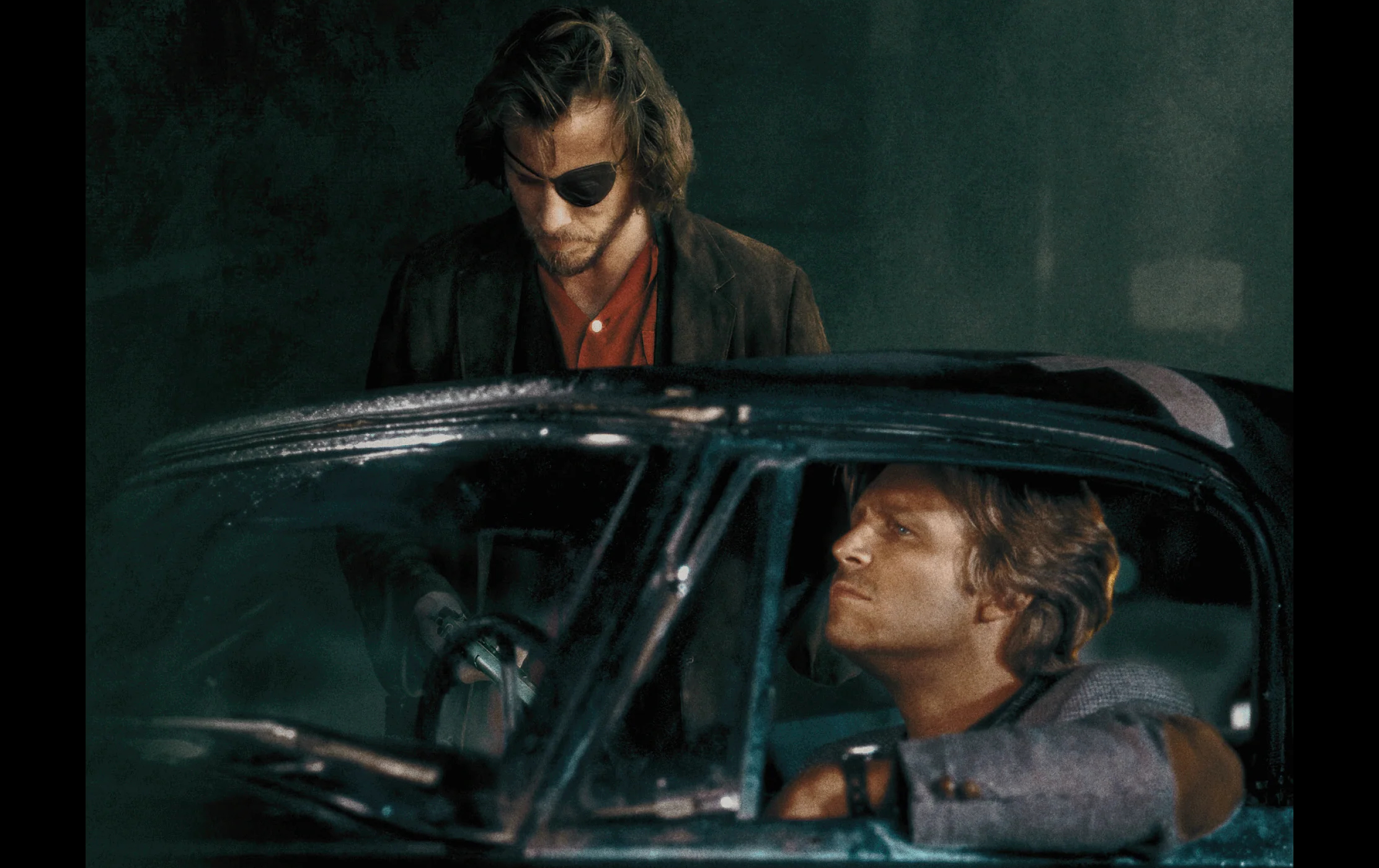
Jeff Bridges and John Heard play men on the fringes in over their heads with a blackmail scheme gone awry in the 1980s forgotten masterpiece, Cutter’s Way. Newly restored on 4K UHD from Radiance Films.
The Film
Cutter’s Way, though released in 1980, feels through and through like a film deeply embedded in the 1970s. Heartfelt. Sad. Bruised. Paranoid. Thrilling. The film was almost entirely forgotten in its initial release, but it has found a devoted rabid following. It is easy to see why, with ties to the 1970s and the rise of capitalism and the “greed is good ethos” of the 1980s very present in the film, it melds the two in a way that feels more akin to the 2020s.
Cutter (John Heard) and Bone (Jeff Bridges) are two men who never found their way out of the late 1960s for very different reasons. Cutter’s tour in Vietnam cost him an arm, a leg, and an eye. Bone’s time at Harvard as a Lothario was everything that the Summer of Love promised. Each man, though on different journeys, never moved past and settled into a drunken stupor or rage (for Cutter) and meaningless sex (for Bone). After Bone sees a body disposed of and is questioned by the Santa Barbara police about it, it’s on a parade day, drinking with Cutter’s wife, Mo (Lisa Eichhorn), that sets everything in motion. There, Bone recognizes JJ Cord (Stephen Elliot) – local billionaire tycoon – as the man who dumped the body. Cutter quickly sees both injustices and an opportunity. One that could get them some payback.
There is a messiness to everything in Cutter’s Way that the best neo-noirs have. Part of the beauty of the film is how much time we spend with Bone and Cutter before the plot begins proper. That languid pace, throughout, allows for the characters and their lives to seep into your soul. Bone, Cutter, and Mo are losers in the way that Springsteen wrote about losers in his early albums. People corrupted by loss and decisions out of their control. Their triangle isn’t just one of love. Love left all three a long time ago. It’s a triangle of codependency.
The way that Heard, Bridges, and Eichhorn all play against each other is magical in the way that broken souls truly circle and play against each other. Heard is electric as Cutter, the man whose soul was left in Vietnam and continues to pull everyone into his heart of darkness. Bridges plays Bone as the good-intentioned, beautiful loser who never realizes the gravity of his decisions until it is far too late. Eichhorn may be the most delicate of the three and the best; her Mo is the balancing act between Bone and Cutter, and after a decade (or more), is just too tired of both men’s respective bullshit. This combination creates a searing and heartbreaking drama that is perfectly layered upon the more noirish thriller elements that play out over the course of the film.
The other piece to the puzzle of brilliance that is Cutter’s Way comes from not just the visual style employed by director Ivan Passer and cinematographer Jordan Cronenweth. The film is masterfully bathed in the dusky light of Southern California’s beach towns, but that belies the sinister deeds playing out in the shadows. The film, perpetually shot between the early morning and late afternoon, gives angular shadows to everything seen. Even the nights retain that beautiful angular look that obscures as much as it enlightens imagery. Cornenweth’s work here is as accomplished as anything in his career (see Bladerunner, State of Grace, or any other number of the films he shot before his untimely passing), but the way that Cutter’s Way so accurately captures the lazy look of Southern California that is rarely captured so uniquely and artfully.
There are few films from the 1980s as subtly sharp and acutely cynical as Cutter’s Way. It may be the reason why it was rejected at the time, only to be rightfully rediscovered. Even now, close to five decades later, it remains as haunting and searing as ever.
The Transfer
The all-new 4K restoration from the original camera negative, presented in Dolby Vision HD, making its world premiere on 4K UHD, is nothing short of stunning. Radiance Films has taken the care that one would want in protecting all that makes Jordan Cornenweth’s cinematography so special. The grain, the contrast, and the deep blacks are all flawlessly rendered in the uncompressed beauty of 4K UHD. The image remains beautifully cinematic without a scratch or blemish through the entire runtime. For cineastes, this will be one of the hallowed discs that they reference when they talk about the beauty that can be produced on the format. It is early in 2026, but this restoration could possibly be one of the best of the year. Bravo to Radiance Films.
The Extras
They include the following;
Archival audio introduction by star Jeff Bridges (5:42) – this introduction from 2022 can be listened to before you watch the film. Bridges audio only interview is intercut with photos and video for context and is hilarious. The frightening way he was cast in the film. The star goes on to discuss the film, the cast, and the brilliance of everything from the score by Jack Nitzsche and the cinematography by Jordan Cronenweth, its critical reception upon release, and also upon reassessment.
The first of three audio commentary tracks is an archival one by novelist Matthew Specktor. Opens with his history with Cutter’s Way and association with reading the script and eventually seeing it opening weekend (the same weekend as DePalma’s Blow Out). Some of the details include a discussion of the differences between the novel and the film -which are plenty and very different experiences; the original incarnation of the film with Robert Mulligan directing and Dustin Hoffman starring – how the current film with Jeff Bridges and John Heard came to star in it; a discussion of the milieu that the film plays with of California of the late 1970s; a larger discussion of the various actors that appear in the film; and much more. Much of the commentary track is Specktor’s personal recollections of the film and his personal history, as his father has professional ties to Bridges.
The second audio commentary track is an archival one by assistant director Larry Franco and unit production manager Barrie Osborne, hosted by Gillian Wallace Horvat. The trio opens with their associations with the film before diving into a professional and personal history of director Ivan Passer during the opening title sequence. Some of the details include how both Franco and Osborne were hired into the production; a discussion of producer Paul R. Gurian and his involvement in the development and his contentious relationship between him and Passer; the casting of John Heard including some great quotes by Tim Mathieson; the casting of Jeff Bridges; a discussion of the work and working with Lisa Eichhorn; a discussion about working with Passer and what did it entail working with specifically him; the various primary production heads that went onto huge and important careers in the studio system; working with cinematographer Jordan Cronenweth; a larger discussion throughout about the various Los Angeles and Santa Barbara locations used for the production; a larger discussion of the various actors and crew members that worked in the film; and much more. Horvat hosts a truly wonderful, insightful commentary track with Franco and Osborne discussing the production.
The third audio commentary track is an archival one by film historians Julie Kirgo and Nick Redman. The duo opens with their credentials before diving into the opening title sequence and their overall thoughts on this almost forgotten neo noir. Some of the details include a discussion of the score by Jack Nitzsche which they feel is a compliment to his lauded work in One Who Flew Over the Cuckoo’s Nest; a discussion of the various locations and their attached to a theme within the film; the career of director Ivan Passer; the work of star John Heard; how this film was developed and ended up at UA/MGM; critic Pauline Kael’s review of the film; the way that this film is still apart of the 1970s style filmmaking released in a very different era of the early 1980s; a discussion of Jeff Bridges both here and his career writ large; a discussion of how much has changed in the Los Angeles beach towns in the years since the film made and how that relates to the film’s themes; a discussion of the different ending between the novel and the movie; and much more.
Isolated music track – this is a great compliment to the featurette about composer Jack Nitzsche. This shows off the score’s very unique score, allowing you to really take in the music, which can sometimes feel diegetic, but it is not. Note: You must access this special feature through the SET-UP submenu.
Piety, Patriotism and Violence: The Legacy of Cutter and Bone (41:43) – is an all-new featurette looking at the novel Cutter and Bone and the film Cutter’s Way, and how it influenced not just film, TV, and novels, but the greater influence it had on various novelists and creatives. The interviewees discuss what makes the book so powerful and lasting. They go on to dissect the politics (gender, sexual, societal), the style, the characters, the themes, the genre and its tropes, the culture at the time contextually, and much more of both the book and the novel, their differences and similarities. Featuring interviews with writers Megan Abbott, Jordan Harper, and George Pelecanos.
Ivan Passer (37:43) – in this archival the director opens with how taking a meeting and passing on Cross of Iron (which would eventually be made by Sam Peckinpah) brought him the script of Cutter’s Way, what drew him to the project that he would eventually direct. Passer goes on to discuss all of the various aspects of the film, including casting, production, post-production, and more. This interview, in lieu of a commentary track, is the next best thing from the director who passed away in 2021.
Lisa Eichhorn (38:53) – in this archival interview, actor Lisa Eichhorn opens with her beginnings and wanting to be an actor at an early age, and how that was tied to troubles in her life. Eichhorn goes on to discuss her education and eventually acting abroad at a young age; the help and advice she received from Alan Rickman, which eventually turned into a lifelong friendship; the casting process on John Schlesinger’s Yanks; the various projects she worked on until eventually being cast in Cutter’s Way; an interesting discussion about how different productions and sets were at the time as compared to now – and just how hard it was but how that got her the role; working with John Heard and Jeff Bridges; the dynamics in the work that she played with her performance; and much more.
Paul Gurian (26:21) – in this archival interview, producer Paul Gurian opens with how much he saw and put of his father into the character of Alex Cutter. Gurian goes on to discuss his first impression of the novel when he read it; after the deal is made, how a Times book review of Cutter and Bone helped move forward the film; the various filmmakers that came in and out of the film before Ivan Passer came on as director, including Martin Ritt, Alan J. Pakula, Robert Mulligan; the casting ideas he initially had of Michael Douglas and Harrison Ford for Cutter and Bone; the budget and casting battles they had; the themes of the film that have only become more prescient in the intervening years; and much more.
Ira Deutchman (11:17) – in this archival interview, UA Classics exec Ira Deutchman discusses his beginnings before joining United Artists, writing synopsis for their Distribution Catalog. Deutchman goes on to discuss how UA Classics was formed and what their purpose was in producing and purchasing specific films; the distribution of Cutter’s Way(when it was called Cutter and Bone) and how it was essentially opened and closed; how UA Classics took the film, renamed it Cutter’s Way, and re distribution first at the Toronto Film Festival, then a more appropriate distribution that was much more successful; the other films that they ended up taking over to help redistribution including Chilly Scenes of Winter and Heaven’s Gate; and much more.
Cut to the Bone: Inside the Score (11:55) – in this archival interview, Music Editor Curt Sobel discusses collaborating with composer Jack Nitzsche on the score for Cutter’s Way. Sobel discusses how this film began in the middle of a musician’s strike that made him and Nietzsche record the score in Canada; what it was like working with the composer; the use of the glass harmonica, but in a very different way than Cuckoo’s Nest; how they collaborated and created the score; and much more.
Bertrand Tavernier (26:27) – this archival video introduction by director Bertrand Tavernier (director of The Clockmaker) is as much an appreciation for Passer’s film as it is an argument, and a very convincing one, that Cutter’s Way is one of the great masterpieces of the 1980s. Filmed in 2020 for a French Blu-ray release of the film all of Tavernier’s insights are relevant to the film when it was first released as it is today. A truly wonderful piece that probably should be watched after and not before though it does give some great context to watch the film, director Ivan Passer’s career and much more. In French with English subtitles.
Theatrical trailers (1:53)
Gallery – the image gallery consists of 25 production stills and pieces of poster art.
The Final Thought
Cutter’s Way is one of the truly undiscovered gems of the 1980s. Radiance Films has given it a worthy 4K UHD, overstuffed with special features. Highest Possible Recommendations!!
Radiance Films’ 4K UHD Edition of Cutter’s Way is out now.
Share this:
Like this:
Discover more from The Movie Isle
Subscribe to get the latest posts sent to your email.