John Boorman brings the Arthurian Legend to R-Rated 1980s life in his fantasy masterpiece Excalibur. New to 4K UHD from Arrow Video.
The Films
It’s wild to think how close John Boorman came to making his Lord of the Rings. Sets were built. Costumes made. Scripts written. Actors were being cast. Out of that failure came Excalibur, one of the great High Fantasy Epics of the 1980s. The film was something that Boorman had been trying to make a version of since the release of Point Blank. The result is a film steeped in as much of the grit and grime of medieval lore as it is in the fantasy of swords and sorcery.
Boorman approached Excalibur with the right kind of seriousness that the best genre material of the era was approached with. The director working with screenwriter Rospo Pallenberg did not see a difference between this text and The Lion in the Winter. Where that sort of tone did not work for the director’s wild sci-fi epic Zardoz, in Excalibur, it’s perfect and allows for a film that even now still is one of the foundational films of the genre.
Adding to the text are the striking visuals that were the collaborative work of cinematographer Alex Thompson, production designer Anthony Pratt, art director Tim Hutchinson, and costume designer Bob Ringwood. Working in unison, they create a world that is grounded to the point of being steeped in bone-chilling earth. One where the knight’s armor impedes fighting as much as it does movement. Where the castles are as mighty as they are dank and unforgiving.
That work went beyond just the visuals and text, but also with the casting as well. Led by Nigel Terry as Arthur, there isn’t a single cast member who does not bring a weight and heft to their performance. The film’s cast reads like a who’s who of British (and Irish) acting royalty; Nicol Williamson, Helen Mirren, Patrick Stewart, Liam Neeson, Gabriel Byrne, Nicholas Clay, Cherie Lunghi, Ciaran Hinds, and Paul Geoffery all put in sterling work. Though it is Nicol Williamson as Merlin that steals the show. There’s a sly wit, both hope and disgust for humanity that Williamson brings to the role that feels like the template for so many other Wizards and how they were played throughout pop culture history.
Excalibur’s R-Rated treatment of the Arthurian legend remains fresh and appealing as the day it was released. Maybe even more so, considering the renewed interest in high fantasy with Game of Thrones being omnipresent in pop culture over the last decade.
The Transfers
The all-new 4K restoration from the original 35mm negative by Arrow Films, presented in its original aspect ratio of 1.66:1 for the first time on home video in Dolby Vision (HDR10 compatible), is an excellent iteration of the film. Having seen Excalibur on the big screen multiple times, the Alex Thompson photography has always lost something of an issue, even on Blu-ray, for home video. It’s the diffusion that’s almost oppressively present throughout the entirety of the film. That diffusion (e.g., smoke, fog, rain, all the elements that Ireland threw at this notoriously difficult shoot) just creates digital noise that makes things almost unwatchable at certain points. This is all but resolved with 4K UHD’s transfer from the OCN with the use of Dolby Vision Encoding, which brings a level of fine detail that, for the first time, not on 35mm, there is a sense of clarity even in the worst scenes. The transfer is not unlike seeing the film for the first time and is even better than any of the 35mm prints this reviewer has seen. Arrow Video is starting off with a truly revelatory transfer in 2026 with Excalibur.
The Box Set includes: Reversible sleeve featuring two original artwork options. Collectors’ perfect-bound booklet containing writing by Charlie Brigden, K.A. Laity, Kimberly Lindbergs, Josh Nelson, Philip Kemp, John Reppion, Icy Sedgwick and Jez Winship. Double-sided fold-out poster featuring two original artwork options o Six postcard-sized reproduction art cards
The Extras
They include the following;
DISC 1 – FEATURE (4K ULTRA HD BLU-RAY)
4K Ultra HD Blu-ray presentation of the 141min Theatrical Cut of the film
Brand new audio commentary by Brian Hoyle, author of The Cinema of John Boorman
Brand new audio commentary by filmmaker David Kittredge, director of Boorman and the Devil
Blu-ray presentation of the 120-minute TV Version of the film, previously unavailable on home video
Excalibur: Behind the Movie
DISC 1 – FEATURE (4K ULTRA HD BLU-RAY)
The first of three audio commentary tracks is an archival one by director John Boorman. The director begins with how Orion Pictures finally financed the picture through their relationship with Warner Bros after his 20-year journey in making this film. Some of the details include how his first cinematographer had a breakdown in the first two days of the shoot and was replaced by Alex Thompson; his original idea was to have Geoffrey Unsworth shoot the film, but he passed away; the work of Terry English, the film’s armorer, and how English sold armor to Museums around the world; the problem around casting Nicol Williamson; the making of the Excalibur and the Holy Grail for the film and where they currently reside; how they managed all of the Excalibur effects in the film; how they accomplished some of the visually striking looks in the film with lighting; a larger discussion of the action scenes, the Irish stunt team, and the fight coordination and his theories on building character within the sword fights and action scenes throughout; a larger discussion of the various actors, many of whom this was the first film they worked on, would end up becoming huge stars, how he found them, cast them, and how it was working with them; a larger discussion of the challenges of filming in the green forests of Ireland and how much they contended with weather; the various castles and how they were achieved with real locations and studio work; and much more.
The second audio commentary is an all-new track by Brian Hoyle, author of The Cinema of John Boorman. Hoyle opens with his credentials before his opening thesis for his own commentary track on what he will be covering. Some of the details include a discussion of the use of Wagner in the soundtrack and why he was used so much; how the film’s themes, visual style, and storytelling is an amalgam of many Arthurian sources/materials to create a super text; a larger discussion of Boorman’s visual style and how it adjusts to Excalibur; how Boorman’s experience on Deliverance and location shooting informed the director’s getting rid of sync/direct sound and the benefits of approaching the sound like the Italians had; the framing and how Boorman had shot at 1.66 but the film was released theatrically and on home video 1.85 and the practical reason why Boorman chose not to shoot 2.39 widescreen; the production design/art direction of Anthony Pratt – which leads to a larger discussion throughout about what is location and what is studio bound sets; the casting of the film and how they got a cast that would eventually become a very well-known respected actors and stars; the adaptation of the novel Le Morte d’Arthur by Thomas Malory; the use of color in both this film and Boorman’s use of color in his visual style; the casting of Nicol Williamson as Merlin – and a disputed fact that Boorman wanted him for Gandalf in his failed Lord of the Rings, and a discussion of Williamson being a problem and the trouble in casting him because of Orion Pictures; the casting and work of Nigel Terry; the score by Trevor Jones both is original composition and his adaptation of the Wagner compositions; the influence of Monty Python and the Holy Grail on Boorman; the Lancelot character and who invented him and the specific reasons why; a discussion of the other sources that that Excalibur is pulled from – which leads to a larger discussion of how Boorman includes every part of the Arthurian story; a discussion of the various filmed version of the Arthurian legend and other medieval films at the time and how Hollywood had not tackled, with few exceptions, the genre until Excalibur; the Neil Jordan documentary on the making of the film is referenced multiple times; and much more.
The third audio commentary is an all-new track by filmmaker David Kittredge, director of Boorman and the Devil. Kittredge opens with how, as of the recording of the commentary track, he is finishing the documentary Boorman and the Devil, and how Excalibur is a summation of all of director John Boorman’s career and films. Some of the details include how the filming of Excalibur was as hard and cost as much as Exorcist II: The Heretic; a history of the career and personal history of John Boorman; the development of the Excalibur script over the years; the original title for Excalibur; a discussion of the abandoned Boorman’s Lord of the Rings film; the visual style and symbolism Boorman employs throughout the film; a discussion of the PG and R rated versions; the importance the film is to the Irish film production; the score by Trevor Jones and the use of Wagner’s compositions; a larger discussion of the cast and most being of relatively unknown status and their roles in the film and their careers post-Excalibur; and much more.
DISC 2 – EXTRAS (BLU-RAY)
The Making of Excalibur: Myth into Movie (48:19) – this archival documentary, directed by Neil Jordan during the production of the film, is a never-before-released and fascinating piece of ephemera. Shot on film by Jordan, this is an old-school making-of look at a big-budget production shot on location in Ireland. The director, a young film student at the time, was given full access by Boorman (who saw it as a chance to help a fellow Irish filmmaker get his start) to the cast and crew. Using a larger interview with Boorman as a spine, the documentary charts Boorman’s obsession with the Arthurian legend and how (in his own words) he has placed its themes in all of his early work, eventually getting into the production itself. Once the stage is set, the look into the production is truly fascinating, as so much of the production was physical and real, done in camera. The result is a truly wonderful old-school look at the filming of a big-budget production we rarely get nowadays. Featuring interviews with director Boorman, stars Nigel Terry, Nicol Williamson, Helen Mirren, cinematographer Alex Thompson, and others.
To Be a Knight and Follow a King: An Interview with John and Charley Boorman (28:12) – is an all-new interview with the director and actor of Excalibur. Boorman begins with how Lee Marvin backed him for Point Blank, and eventually several films. Charley does come in about midway through the interview and joins the interview. The director goes on to discuss his obsession with the Arthurian legend, so much so that he “threaded” the legend through many of his films; the years it took to eventually make the film; the struggles to get the vision he had on screen; the casting and direction of his children in Excalibur and other films; and much more. Charley discusses how he became involved with the project and other films, and how the family was always a part of the films, either acting, writing, or, in the case of his mother and John’s wife, the costuming; the opening of the film at the Cannes Film Festival and the chaos of the premiere; a great story how his sister voiced his part; a great story of how Boorman got the real budget for his film and how stressful it was for his father; another great story about Helen Mirren and his scenes with her; his father’s touch nature as he expected people to be prepared and raised hell when they were not, and how that relates to him as his son doubly so; and much more.
When Death Was but a Dream: An Interview with Neil Jordan (25:07) – in this all-new interview, creative associate Neil Jordan begins with how much he loved films but had no pathway into film in Ireland at the time, in the 1970s, into the 1980s. Jordan goes into his first experience writing a film was not what he wanted or intended; how the troubles in Ireland and tragedy forced him to England; how Boorman helped him begin to make films and got him his start directing; their first project together was a screenplay they wrote together, which eventually turned into collaborating on the screenplay of Excalibur, helping rewrite it into a more manageable form – which got him his creative associate credit on the film; how Jordan was asked to be on the set and he turned that into the making-of documentary; Boorman’s obsessive nature in his research and understanding of basically all the various versions Arthurian legends and how he brought that to the screen; what he felt the power of Excalibur and Boorman’s work; how this began Jordan’s journey in eventually making Michael Collins with Liam Neeson; how fantasy has influence both he and Boorman’s work even their most realistic work; upon a recent rewatch what he loved about the film and the power of the film; and much more.
The Charm of Making: An Interview with Production Designer Anthony Pratt (26:11) – in this all-new interview, production designer Anthony Pratt begins with what an art director is and who they work with on the production. Pratt goes on to discuss how he eventually got into art direction/production design because of a specific book – a book he actually still has his original copy of; his first film he worked in the art department (which was The Life of Suzie Wong); how he met Boorman and his first credit as the art director on Hell in the Pacific and would go on to work with the director multiple times include Zardoz; how he was brought on to do Excalibur and what Boorman wanted visually – a discussion of the work that the art department had to do and their collaboration with cinematographer Alex Thompson and armorer Terry English; and much more.
Confessions of a Professional “Pain-in-the-ass”: An Interview with Peter MacDonald (1:15:44) – this all-new interview with 2nd unit director Peter MacDonald begins with a title card that explains the importance of MacDonald to the British Film Industry and his contributions. This hour-plus-long interview is culled from a four-and-a-half-hour interview, and one suspects that it is as interesting as its abridged form (and Arrow rightfully has held back most of it to be included on other releases). MacDonald opens with his early life and how lies got him his first job in the film industry, including a hilarious first day in the camera department. The 2nd unit director goes on to discuss how B-movies at his first job eventually led to his first big studio picture, the Titanic drama A Night to Remember with Geoffrey Unsworth – including a truly hilarious story about his first interaction with the legend; and more. MacDonald’s interview is a pleasure as the man is a true raconteur with stories from films as varied as Cabaret, Blowup, The Bliss of Mrs. Blossom, Murder on the Orient Express, The Reckoning, The Assassination Bureau, Royal Flash, 2001: A Space Odyssey, Zardoz, A Bridge Too Far, and eventually discussing his experience on Excalibur.
Anam Cara: A Consideration of Rospo Pallenberg & John Boorman (37:34) – is an all-new visual essay by Howard Berger about the collaboration between co-writer/director John Boorman and co-writer Rospo Pallenberg, featuring a newly filmed interview with Pallenberg. Berger begins with a deep dive into Boorman’s career and his personal relationship with his films and what made them so special, and a discussion of Boorman’s life as it informed his work. Berger then dives into the various writing collaborators that the director worked with through the years and what worked and did not work for those. Eventually, Berger begins a discussion with co-writer Rospo Pallenberg, not just his collaboration with Boorman, but his personal life, his early life in Italy, beginning as a writer, meeting Boorman, beginning the collaboration first on their ultimately abandoned version of The Lord of the Rings (including how they broke down the book and developed the screenplay), Pallenberg’s work on Deliverance, Zardoz, and Exorcist II, both the script (uncredited) and production, eventually leading to their work on Excalibur. Adroitly written by and edited by Berger and produced by Neil Snowdon.
Divided Nature: The Death and Life of Cinematic Illusion in the Kingdom of John Boorman
(30:07) – is another all-new visual essay. This one by film historians Howard S. Berger and Kevin Marr. This essay looks into Boorman’s body of work and the themes within, especially during the apex of his career in the 1970s and 1980s. Berger and Marr dive into the violence (in all of its forms) and its use by men, showing their enlightenment, savagery, and its spiritual divide. The essay uses examples from not just Excalibur but all of Boorman’s work, including and not limited to Zardoz, Leo the Prince, Point Blank, Deliverance, and Hell in the Pacific. Written by Marr and Berger, Edited by Berger, and Produced by Neil Snowdon.
Teaser Trailer (1:48)
Theatrical Trailer (2:28)
Image galleries – the image galleries consist of five galleries that you can access from a submenu.
Black & White Stills – a collection of 99 production stills and behind-the-scenes photos.
Color Stills – a collection of 102 production stills and behind-the-scenes photos.
Posters – a collection of 26 pieces of poster art from various regions.
Original Production Notes – a 22-page press kit document about the production.
Draft Screenplay – a 117-page draft of the screenplay dated 09/28/79 from Rospo Pallenberg and Boorman.
120-minute TV Version of the film (2:00:09) – this version is what many of us experienced as our first introduction to the film when we saw it on cable – in this reviewer’s case, on HBO in the late 80s – which cuts all of what makes Excalibur a truly great adult and mature epic. Boorman’s use of sex and violence never felt anything but accurate and necessary as it’s a contextual part of the story. It never felt excessive. This version of the film still has the grime and dirt of the film, but the grit and danger are absent. Especially the danger and folly of violence and its use of sex in the story, which is omnipresent in the best of Boorman’s work. It feels exactly what it is, an abbreviated version of a now classic masterpiece that has inspired many works of fantasy fiction, not the least of which (along with the equally brilliant Dragonslayer) was George RR Martin’s A Song of Fire and Ash series, which Game of Thrones is based on. There aren’t full scenes or extended scenes added into this version, though there are additional shots added for context (which, in the reconstruction of this version, Arrow has kept in the 4:3 aspect ratio because they had to pull them from the only existing copy of the TV version, which was an SD version). Though interestingly enough, this version adds a voiceover by Merlin, which oddly makes the film feel more like Merlin’s and less Arthur and the Knights’ film. They have also kept the commercial break fadeouts. This version also provides a strong contrast to the new 4K UHD Dolby Vision master’s color grading. Note: this version has been previously unavailable on home video.
Excalibur: Behind the Movie (52:24) – is an archival retrospective making-of documentary from 2013, looking back at Boorman’s medieval epic. Using interviews, documentary footage from the shoot, and scenes from the film, to discuss the notoriously difficult shoot. The making-of covers everything from the development, casting, shooting, editing, and release of the film. There are some truly great anecdotes from the production, but also the amount of discussion about how much Boorman taught many of these actors, who were experienced on stage but not screen, and what a difference this was. There is a level of honesty in the doc that’s refreshing about the difficulty of the shooting, the type of director Boorman was, work from the other films, et. al. This is truly one of the better making-of documentaries of recent memory, not because they were able to get everyone involved (including the biggest stars) but the content of the featurette and some of the great anecdotes like a man trying to buy Liam Neeson’s horse while the actor was in full armor; the fact they made real armor (not stage armor) and the challenges posed to the cast and crew; the unique character that was Niccol Williamson; how they achieved the unique visual style and look to the film; what Boorman loved in the action/stunts; the use of Wagner in the film; and much more. Featuring interviews with director John Boorman, stars Nigel Terry, Liam Neeson, Helen Mirren, Patrick Stewart, Gabriel Byrne, Paul Geoffrey, Cherie Lunghi, Charley Boorman, Katrine Boorman, Clive Swift, “creative associate” Neil Jordan, armorer Terry English, 3rd assistant director John Lawlor, location manager Kevin Moriarty, composer Trevor Jones, and others.
The Final Thought
Arrow Video has given us the first great box set of 2026 with Excalibur. Highest Possible Recommendations!!

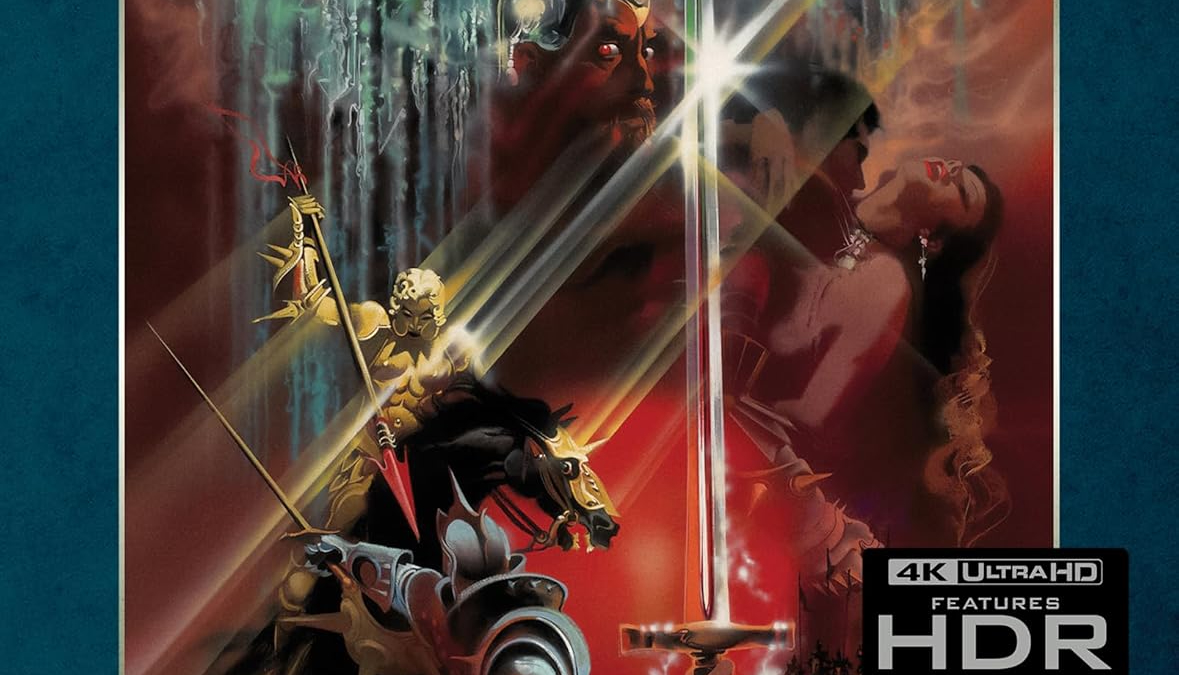
John Boorman brings the Arthurian Legend to R-Rated 1980s life in his fantasy masterpiece Excalibur. New to 4K UHD from Arrow Video.
The Films
It’s wild to think how close John Boorman came to making his Lord of the Rings. Sets were built. Costumes made. Scripts written. Actors were being cast. Out of that failure came Excalibur, one of the great High Fantasy Epics of the 1980s. The film was something that Boorman had been trying to make a version of since the release of Point Blank. The result is a film steeped in as much of the grit and grime of medieval lore as it is in the fantasy of swords and sorcery.
Boorman approached Excalibur with the right kind of seriousness that the best genre material of the era was approached with. The director working with screenwriter Rospo Pallenberg did not see a difference between this text and The Lion in the Winter. Where that sort of tone did not work for the director’s wild sci-fi epic Zardoz, in Excalibur, it’s perfect and allows for a film that even now still is one of the foundational films of the genre.
Adding to the text are the striking visuals that were the collaborative work of cinematographer Alex Thompson, production designer Anthony Pratt, art director Tim Hutchinson, and costume designer Bob Ringwood. Working in unison, they create a world that is grounded to the point of being steeped in bone-chilling earth. One where the knight’s armor impedes fighting as much as it does movement. Where the castles are as mighty as they are dank and unforgiving.
That work went beyond just the visuals and text, but also with the casting as well. Led by Nigel Terry as Arthur, there isn’t a single cast member who does not bring a weight and heft to their performance. The film’s cast reads like a who’s who of British (and Irish) acting royalty; Nicol Williamson, Helen Mirren, Patrick Stewart, Liam Neeson, Gabriel Byrne, Nicholas Clay, Cherie Lunghi, Ciaran Hinds, and Paul Geoffery all put in sterling work. Though it is Nicol Williamson as Merlin that steals the show. There’s a sly wit, both hope and disgust for humanity that Williamson brings to the role that feels like the template for so many other Wizards and how they were played throughout pop culture history.
Excalibur’s R-Rated treatment of the Arthurian legend remains fresh and appealing as the day it was released. Maybe even more so, considering the renewed interest in high fantasy with Game of Thrones being omnipresent in pop culture over the last decade.
The Transfers
The all-new 4K restoration from the original 35mm negative by Arrow Films, presented in its original aspect ratio of 1.66:1 for the first time on home video in Dolby Vision (HDR10 compatible), is an excellent iteration of the film. Having seen Excalibur on the big screen multiple times, the Alex Thompson photography has always lost something of an issue, even on Blu-ray, for home video. It’s the diffusion that’s almost oppressively present throughout the entirety of the film. That diffusion (e.g., smoke, fog, rain, all the elements that Ireland threw at this notoriously difficult shoot) just creates digital noise that makes things almost unwatchable at certain points. This is all but resolved with 4K UHD’s transfer from the OCN with the use of Dolby Vision Encoding, which brings a level of fine detail that, for the first time, not on 35mm, there is a sense of clarity even in the worst scenes. The transfer is not unlike seeing the film for the first time and is even better than any of the 35mm prints this reviewer has seen. Arrow Video is starting off with a truly revelatory transfer in 2026 with Excalibur.
The Extras
They include the following;
DISC 1 – FEATURE (4K ULTRA HD BLU-RAY)
DISC 2 – EXTRAS (BLU-RAY)
DISC 3 – BONUS (LIMITED EDITION EXCLUSIVE BLU-RAY)
DISC 1 – FEATURE (4K ULTRA HD BLU-RAY)
The first of three audio commentary tracks is an archival one by director John Boorman. The director begins with how Orion Pictures finally financed the picture through their relationship with Warner Bros after his 20-year journey in making this film. Some of the details include how his first cinematographer had a breakdown in the first two days of the shoot and was replaced by Alex Thompson; his original idea was to have Geoffrey Unsworth shoot the film, but he passed away; the work of Terry English, the film’s armorer, and how English sold armor to Museums around the world; the problem around casting Nicol Williamson; the making of the Excalibur and the Holy Grail for the film and where they currently reside; how they managed all of the Excalibur effects in the film; how they accomplished some of the visually striking looks in the film with lighting; a larger discussion of the action scenes, the Irish stunt team, and the fight coordination and his theories on building character within the sword fights and action scenes throughout; a larger discussion of the various actors, many of whom this was the first film they worked on, would end up becoming huge stars, how he found them, cast them, and how it was working with them; a larger discussion of the challenges of filming in the green forests of Ireland and how much they contended with weather; the various castles and how they were achieved with real locations and studio work; and much more.
The second audio commentary is an all-new track by Brian Hoyle, author of The Cinema of John Boorman. Hoyle opens with his credentials before his opening thesis for his own commentary track on what he will be covering. Some of the details include a discussion of the use of Wagner in the soundtrack and why he was used so much; how the film’s themes, visual style, and storytelling is an amalgam of many Arthurian sources/materials to create a super text; a larger discussion of Boorman’s visual style and how it adjusts to Excalibur; how Boorman’s experience on Deliverance and location shooting informed the director’s getting rid of sync/direct sound and the benefits of approaching the sound like the Italians had; the framing and how Boorman had shot at 1.66 but the film was released theatrically and on home video 1.85 and the practical reason why Boorman chose not to shoot 2.39 widescreen; the production design/art direction of Anthony Pratt – which leads to a larger discussion throughout about what is location and what is studio bound sets; the casting of the film and how they got a cast that would eventually become a very well-known respected actors and stars; the adaptation of the novel Le Morte d’Arthur by Thomas Malory; the use of color in both this film and Boorman’s use of color in his visual style; the casting of Nicol Williamson as Merlin – and a disputed fact that Boorman wanted him for Gandalf in his failed Lord of the Rings, and a discussion of Williamson being a problem and the trouble in casting him because of Orion Pictures; the casting and work of Nigel Terry; the score by Trevor Jones both is original composition and his adaptation of the Wagner compositions; the influence of Monty Python and the Holy Grail on Boorman; the Lancelot character and who invented him and the specific reasons why; a discussion of the other sources that that Excalibur is pulled from – which leads to a larger discussion of how Boorman includes every part of the Arthurian story; a discussion of the various filmed version of the Arthurian legend and other medieval films at the time and how Hollywood had not tackled, with few exceptions, the genre until Excalibur; the Neil Jordan documentary on the making of the film is referenced multiple times; and much more.
The third audio commentary is an all-new track by filmmaker David Kittredge, director of Boorman and the Devil. Kittredge opens with how, as of the recording of the commentary track, he is finishing the documentary Boorman and the Devil, and how Excalibur is a summation of all of director John Boorman’s career and films. Some of the details include how the filming of Excalibur was as hard and cost as much as Exorcist II: The Heretic; a history of the career and personal history of John Boorman; the development of the Excalibur script over the years; the original title for Excalibur; a discussion of the abandoned Boorman’s Lord of the Rings film; the visual style and symbolism Boorman employs throughout the film; a discussion of the PG and R rated versions; the importance the film is to the Irish film production; the score by Trevor Jones and the use of Wagner’s compositions; a larger discussion of the cast and most being of relatively unknown status and their roles in the film and their careers post-Excalibur; and much more.
DISC 2 – EXTRAS (BLU-RAY)
The Making of Excalibur: Myth into Movie (48:19) – this archival documentary, directed by Neil Jordan during the production of the film, is a never-before-released and fascinating piece of ephemera. Shot on film by Jordan, this is an old-school making-of look at a big-budget production shot on location in Ireland. The director, a young film student at the time, was given full access by Boorman (who saw it as a chance to help a fellow Irish filmmaker get his start) to the cast and crew. Using a larger interview with Boorman as a spine, the documentary charts Boorman’s obsession with the Arthurian legend and how (in his own words) he has placed its themes in all of his early work, eventually getting into the production itself. Once the stage is set, the look into the production is truly fascinating, as so much of the production was physical and real, done in camera. The result is a truly wonderful old-school look at the filming of a big-budget production we rarely get nowadays. Featuring interviews with director Boorman, stars Nigel Terry, Nicol Williamson, Helen Mirren, cinematographer Alex Thompson, and others.
To Be a Knight and Follow a King: An Interview with John and Charley Boorman (28:12) – is an all-new interview with the director and actor of Excalibur. Boorman begins with how Lee Marvin backed him for Point Blank, and eventually several films. Charley does come in about midway through the interview and joins the interview. The director goes on to discuss his obsession with the Arthurian legend, so much so that he “threaded” the legend through many of his films; the years it took to eventually make the film; the struggles to get the vision he had on screen; the casting and direction of his children in Excalibur and other films; and much more. Charley discusses how he became involved with the project and other films, and how the family was always a part of the films, either acting, writing, or, in the case of his mother and John’s wife, the costuming; the opening of the film at the Cannes Film Festival and the chaos of the premiere; a great story how his sister voiced his part; a great story of how Boorman got the real budget for his film and how stressful it was for his father; another great story about Helen Mirren and his scenes with her; his father’s touch nature as he expected people to be prepared and raised hell when they were not, and how that relates to him as his son doubly so; and much more.
When Death Was but a Dream: An Interview with Neil Jordan (25:07) – in this all-new interview, creative associate Neil Jordan begins with how much he loved films but had no pathway into film in Ireland at the time, in the 1970s, into the 1980s. Jordan goes into his first experience writing a film was not what he wanted or intended; how the troubles in Ireland and tragedy forced him to England; how Boorman helped him begin to make films and got him his start directing; their first project together was a screenplay they wrote together, which eventually turned into collaborating on the screenplay of Excalibur, helping rewrite it into a more manageable form – which got him his creative associate credit on the film; how Jordan was asked to be on the set and he turned that into the making-of documentary; Boorman’s obsessive nature in his research and understanding of basically all the various versions Arthurian legends and how he brought that to the screen; what he felt the power of Excalibur and Boorman’s work; how this began Jordan’s journey in eventually making Michael Collins with Liam Neeson; how fantasy has influence both he and Boorman’s work even their most realistic work; upon a recent rewatch what he loved about the film and the power of the film; and much more.
The Charm of Making: An Interview with Production Designer Anthony Pratt (26:11) – in this all-new interview, production designer Anthony Pratt begins with what an art director is and who they work with on the production. Pratt goes on to discuss how he eventually got into art direction/production design because of a specific book – a book he actually still has his original copy of; his first film he worked in the art department (which was The Life of Suzie Wong); how he met Boorman and his first credit as the art director on Hell in the Pacific and would go on to work with the director multiple times include Zardoz; how he was brought on to do Excalibur and what Boorman wanted visually – a discussion of the work that the art department had to do and their collaboration with cinematographer Alex Thompson and armorer Terry English; and much more.
Confessions of a Professional “Pain-in-the-ass”: An Interview with Peter MacDonald (1:15:44) – this all-new interview with 2nd unit director Peter MacDonald begins with a title card that explains the importance of MacDonald to the British Film Industry and his contributions. This hour-plus-long interview is culled from a four-and-a-half-hour interview, and one suspects that it is as interesting as its abridged form (and Arrow rightfully has held back most of it to be included on other releases). MacDonald opens with his early life and how lies got him his first job in the film industry, including a hilarious first day in the camera department. The 2nd unit director goes on to discuss how B-movies at his first job eventually led to his first big studio picture, the Titanic drama A Night to Remember with Geoffrey Unsworth – including a truly hilarious story about his first interaction with the legend; and more. MacDonald’s interview is a pleasure as the man is a true raconteur with stories from films as varied as Cabaret, Blowup, The Bliss of Mrs. Blossom, Murder on the Orient Express, The Reckoning, The Assassination Bureau, Royal Flash, 2001: A Space Odyssey, Zardoz, A Bridge Too Far, and eventually discussing his experience on Excalibur.
Anam Cara: A Consideration of Rospo Pallenberg & John Boorman (37:34) – is an all-new visual essay by Howard Berger about the collaboration between co-writer/director John Boorman and co-writer Rospo Pallenberg, featuring a newly filmed interview with Pallenberg. Berger begins with a deep dive into Boorman’s career and his personal relationship with his films and what made them so special, and a discussion of Boorman’s life as it informed his work. Berger then dives into the various writing collaborators that the director worked with through the years and what worked and did not work for those. Eventually, Berger begins a discussion with co-writer Rospo Pallenberg, not just his collaboration with Boorman, but his personal life, his early life in Italy, beginning as a writer, meeting Boorman, beginning the collaboration first on their ultimately abandoned version of The Lord of the Rings (including how they broke down the book and developed the screenplay), Pallenberg’s work on Deliverance, Zardoz, and Exorcist II, both the script (uncredited) and production, eventually leading to their work on Excalibur. Adroitly written by and edited by Berger and produced by Neil Snowdon.
Divided Nature: The Death and Life of Cinematic Illusion in the Kingdom of John Boorman
(30:07) – is another all-new visual essay. This one by film historians Howard S. Berger and Kevin Marr. This essay looks into Boorman’s body of work and the themes within, especially during the apex of his career in the 1970s and 1980s. Berger and Marr dive into the violence (in all of its forms) and its use by men, showing their enlightenment, savagery, and its spiritual divide. The essay uses examples from not just Excalibur but all of Boorman’s work, including and not limited to Zardoz, Leo the Prince, Point Blank, Deliverance, and Hell in the Pacific. Written by Marr and Berger, Edited by Berger, and Produced by Neil Snowdon.
Teaser Trailer (1:48)
Theatrical Trailer (2:28)
Image galleries – the image galleries consist of five galleries that you can access from a submenu.
DISC 3 – BONUS (LIMITED EDITION EXCLUSIVE BLU-RAY)
120-minute TV Version of the film (2:00:09) – this version is what many of us experienced as our first introduction to the film when we saw it on cable – in this reviewer’s case, on HBO in the late 80s – which cuts all of what makes Excalibur a truly great adult and mature epic. Boorman’s use of sex and violence never felt anything but accurate and necessary as it’s a contextual part of the story. It never felt excessive. This version of the film still has the grime and dirt of the film, but the grit and danger are absent. Especially the danger and folly of violence and its use of sex in the story, which is omnipresent in the best of Boorman’s work. It feels exactly what it is, an abbreviated version of a now classic masterpiece that has inspired many works of fantasy fiction, not the least of which (along with the equally brilliant Dragonslayer) was George RR Martin’s A Song of Fire and Ash series, which Game of Thrones is based on. There aren’t full scenes or extended scenes added into this version, though there are additional shots added for context (which, in the reconstruction of this version, Arrow has kept in the 4:3 aspect ratio because they had to pull them from the only existing copy of the TV version, which was an SD version). Though interestingly enough, this version adds a voiceover by Merlin, which oddly makes the film feel more like Merlin’s and less Arthur and the Knights’ film. They have also kept the commercial break fadeouts. This version also provides a strong contrast to the new 4K UHD Dolby Vision master’s color grading. Note: this version has been previously unavailable on home video.
Excalibur: Behind the Movie (52:24) – is an archival retrospective making-of documentary from 2013, looking back at Boorman’s medieval epic. Using interviews, documentary footage from the shoot, and scenes from the film, to discuss the notoriously difficult shoot. The making-of covers everything from the development, casting, shooting, editing, and release of the film. There are some truly great anecdotes from the production, but also the amount of discussion about how much Boorman taught many of these actors, who were experienced on stage but not screen, and what a difference this was. There is a level of honesty in the doc that’s refreshing about the difficulty of the shooting, the type of director Boorman was, work from the other films, et. al. This is truly one of the better making-of documentaries of recent memory, not because they were able to get everyone involved (including the biggest stars) but the content of the featurette and some of the great anecdotes like a man trying to buy Liam Neeson’s horse while the actor was in full armor; the fact they made real armor (not stage armor) and the challenges posed to the cast and crew; the unique character that was Niccol Williamson; how they achieved the unique visual style and look to the film; what Boorman loved in the action/stunts; the use of Wagner in the film; and much more. Featuring interviews with director John Boorman, stars Nigel Terry, Liam Neeson, Helen Mirren, Patrick Stewart, Gabriel Byrne, Paul Geoffrey, Cherie Lunghi, Charley Boorman, Katrine Boorman, Clive Swift, “creative associate” Neil Jordan, armorer Terry English, 3rd assistant director John Lawlor, location manager Kevin Moriarty, composer Trevor Jones, and others.
The Final Thought
Arrow Video has given us the first great box set of 2026 with Excalibur. Highest Possible Recommendations!!
Arrow Video’s 4K UHD Edition of Excalibur is out now.
Share this:
Like this:
Discover more from The Movie Isle
Subscribe to get the latest posts sent to your email.