Dark City opened the same weekend I started as a projectionist at my local multiplex. Even in its truncated form, it was love at first sight. Director Alex Proyas’s noir sci-fi mystery was the kind of film that I grew up on. It was Metropolis. It was Bladerunner. It was Batman ’89. It was a film with big visuals and even better ideas. I must have watched the film at least a dozen times during its run at my theater from the projection booth. Even more so when it came to DVD, in fact, it was one of the first DVDs I purchased after getting my first DVD player. When it came to Blu-ray in its director’s cut form, it went into steady rotation of films that I rewatched.
Like Bladerunner, there is an inherent mystery that makes Dark City so inherently rewatchable. There are negative spaces. Unanswered questions are purposely left unanswered. In its director’s cut form with the voice over narration gone there it the space for ambiguity is even wider now. The reasons for how and why this rat maze came to be and who these strangers are, are a fascinating cinematic Rorschach test. The script by Proyas, Lem Dobbs, and David Goyer is oblique in the best way possible, using the cinematic language of noir and detective fiction to create a film that builds mysteries both in the traditional sense and reflexively into the larger themes of the film.
Dark City, at its heart, is a science fiction film. One that takes its entry into the genre in such an adroit manner that it never feels like sci-fi. Even when the film reveals itself, and in its showstopping movement of what and where the unnamed city of the film is. It still feels wholly a part of the noir traditions it begins in. It helps that the film is cast to perfection with faces and actors that feel like they’re more at home in 1938 than 1998. Rufus Sewell, William Hurt, Keifer Sutherland, and Jennifer Connelly all feel perfectly at home in their opening moments of the film. They understand the tone of the film and even when it morphs beyond the noirish conventions, they never seem out of place.
In the end, Alex Proyas’s Dark City is a unique, uncommon masterpiece of style, tone, and storytelling. One that, even thirty years later, has the ability to surprise.
Note: The review is of the director’s cut.
The Transfer
The all-new 4K restoration from the original 35mm camera negatives, approved by director of photography Dariusz Wolski, presentations of both the Director’s Cut and Theatrical Cut of the film in Dolby Vision (HDR10 compatible) are the kind of excellent presentations that will win awards come 2026. The flawless image looks as good, if not better, than the film did opening day back in 1998. The film’s presentation in Dolby Vision is near flawless. The film looks luminous with the HDR encoding giving the low-light photography extra depth and definition throughout. The transfer’s color reproduction and film grain are so good that it looks like a freshly struck archival 35mm print. There is nary a scratch, blemish, or speck of dirt to be found during the runtime. Fans and non-fans alike, jaws will drop at just how stunning Dark City looks and will more than likely have another demo disc to show off the virtues of 4K UHD.
The Extras
They include the following;
DISC 1: DIRECTOR’S CUT
Brand new audio commentary by director Alex Proyas
Brand new audio commentary with Craig Anderson, Bruce Isaacs, and Herschel Isaacs, co-hosts of the Film Versus Film podcast
Archive audio commentary by director Alex Proyas
Archive audio commentary by film critic Roger Ebert
Archive audio commentary by writers Lem Dobbs and David S. Goyer
Archive introduction by Alex Proyas
Return to Dark City, a new hour-long documentary
Rats in a Maze
I’m as Much in the Dark as You Are
Design & Storyboards
DISC 2: THEATRICAL CUT
Archive audio commentary by director Alex Proyas, writers Lem Dobbs & David S. Goyer, director of photography Dariusz Wolski, and production designer Patrick Tatopoulos
Archive audio commentary by film critic Roger Ebert
Memories of Shell Beach
Architecture of Dreams
Theatrical trailer
Image gallery
DISC 1: DIRECTOR’S CUT
The first of five audio commentaries is an all-new track by director Alex Proyas opens with a discussion of how he views his films as a “series of compromises”. Some of the details include a discussion of how he melded the noir mystery genre with the science fiction genre, and his visual touches he added to support these; the casting process for the various actors in the film (e.g., Rufus Swell, Jennifer Connelly, William Hurt, et. al.), including the studio mandates for a star in the lead role, and how that would work against the film; a discussion of the test screening process – and the changes mandated from that process, his reaction to the process, the release, Ebert’s support of the film; working with William Hurt and the challenging collaboration; a discussion of how on this film helped evolved his directorial style – which leads to a discussion of his theories on direction (especially with actors) throughout the commentary track; a discussion of the backstory and background of the world Dark City – his admission that The Knowing (a truly delirious Nic Cage film) is his head cannon prequel to Dark City and was his intent when making The Knowing; a discussion of production design, sets, and how clever use of these helped their budget which was not huge; a larger discussion of the differences between the director’s cut and the theatrical cut; and much more. Proyas provides a thoughtful, updated commentary track that has no real crossover with his archival tracks.
The second audio commentary is an all-new track with Critics/Podcasters Craig Anderson, Bruce Isaacs, and Herschel Isaacs, co-hosts of the Film Versus Film podcast. The track opens with their introductions and bonafides before diving into Dark City’s inspirations and use of German Expressionism. Some of the other details include the influence of Dark City on The Matrix – and a larger discussion of the similarities of the two, which were developed around the same time, and the themes they both deal with; a discussion of Proyas personal history, growing up at the same time as he did and also a larger discussion of cultural identity; the production history of the film – shooting in 1996, post-production in 1997 and finally released in 1998; the release and failure of the film at the box office; Roger Ebert’s appraisal of the film and helping it be finding a second life; the reasons why that the film used the green tint in its initial release; a great side discussion of VHS released and how it was stocked in video store under what genres; a larger discussion of the Strangers; a larger discussion of the various themes, influences and influential reach Dark City has over the last twenty five plus years; and much more.
The third audio commentary is the second by director Alex Proyas, recorded for the 2008 Blu-ray release. The track begins with the opening, which was a reshoot intended to have a voice-over (which it did within the theatrical cut) and what shot actually opened the film. Some of the other details include how closely the director’s cut resembles his initial cut of the film that was test-screened; a detailed discussion of the test screening process – and his experience on the ground floor after a bad one and studio interference; a discussion of the process of post-production on The Crow and Dark City and how much they varied; a larger discussion of what was cut from the theatrical and the way that the director cut’s adds to the whole of the film with regards to theme and style; a larger discussion of the various characters, themes, and plot points and how they tie into the larger narrative in the director’s cut and what was lost in the theatrical cut; and much more. Proyas’ track from the initial Blu-ray release is more focused on the changes and the processing of making the film, rather than the themes and directorial authorship that his newest track offers.
The fourth audio commentary by writers Lem Dobbs and David S. Goyer, recorded for the initial DVD release but expanded for the 2008 Blu-ray. The duo was recorded separately. Goyer opens the track by working with both Dobbs and Proyas and discusses how collaborative a process it was. Dobbs opens his portion of the track with how he loves the opening with Dr. Schreber (Keifer Sutherland). Some of the other details include a discussion of where the humans came from, including Proyas’, Goyer’s, and Dobbs’ thoughts on the matter; Goyer and Dobbs’ thoughts on the symbolism of the spirals throughout the film; Dobbs’ unique inspirations he took from non-traditional sources; Dobbs’ thoughts on Jennifer Connelly and her being cast; the use of “Lem-isms” – dialog that was confounding to Proyas and Goyer; Dobbs’ perspective on the “Lem-isms”; why Dobbs thought Proyas wanted to work with him – discussion of what he brought to the script; the development of the screenplay – how focus shifted from Bumstead to Murdoch and other plot and subplots changed and evolved; how Goyer/Dobbs respectively got involved, which is a greater discussion of the development process, and turnarounds by two studios (first Disney then Fox – this was before they merged) and it eventually came to New Line; the inception of the idea for Dark City; the casting what-ifs for the role that eventually went to Rufus Swell; a discussion of the genres that the film plays in from Dobbs and Goyer’s perspectives; and much more. Rarely do we get screenwriters being able to discuss their craft and the film they helped produce (unless they’re the writer/director), having two truly great writers in Dobbs and Goyer is a treat. They provide an insightful and entertaining track with quite a bit of honesty (especially from Dobbs, whose track with Soderberg on The Limey is an all-timer in that regard).
The fifth and final audio commentary by film critic Roger Ebert and an archival one the critic recorded for the 2008 release of the film. Ebert opens his secondary commentary track about the excitement when he announced the director’s cut was being made. Some of the details include the use of lighting for tone and also for story points; the use of space for effect – e.g., the use of claustrophobic and open spaces; various visual motifs that play through out and more so in the director’s cut adds to the overall storytelling and themes of the film; a larger discussion of the various characters and the actors portray them; a larger discussion of the various changes made between the theatrical and director’s cut; and much more.
Archive introduction by Alex Proyas (4:51) – not just an introduction by Proyas, but includes discussion points by Roger Ebert. Proyas and Ebert delve into the director’s cut, and as Ebert puts it, “generosity” allows for it in the film and its visual style.
Return to Dark City (58:55) – is an all-new hour-long retrospective documentary about the making of Dark City. The featurette is a deep dive into the production and release of the now cult classic sci-fi noir. The documentary dives into all aspects of Dark City, beginning with development and going to its current status and reappraisal in filmdom. The doc is wonderfully produced by Heather Buckley and sharply edited by Jamie Lockhart. Some of the highlights of the featurette include the early scripts (dating as far back as 1990); the development process; Dennis Potter’s reaction to the original script when Proyas sent it to him; the visual art, and collaboration between Proyas, Wolski, and the artists; the studios that were involved during the development process; the casting process – including the “Uncle Freddy” rule; shooting in Sydney, Australia – finding the space and using what eventually because the Fox Sydney studio space, also including a discussion of budget and its increase; a discussion of the costuming, production design, visual effects work; the studio-bound shoot and anecdotes from the set from the cast and crew; the post-production – which was still done on film which caused work flow issues with visual effects, the use of optical printer use, and analog color correction – and its hybrid approach; the test screening process – and how the film changed; the release of the film and its critical reappraisal and the release of the director’s cut; and much more.
I’m as Much in the Dark as You Are (19:50) – is an all-new visual essay by film scholar Josh Nelson on the influence of film noir and the role of identity in Dark City. Nelson goes on to discuss the tropes of film noir (and the critical disagreements on what defines film noir itself – a mystery he compares to Dark City’s elusive Shell Beach) and how they relate to the film’s characters, themes, visual style, production design, and storytelling. Nelson goes on to discussion the late 90s anxiety of impending Y2K to the post-War anxiety that Noir thrived in and how the rise of Cyber Punk Virtual Reality in the 90s related to Dark City. The essay was written and narrated by Nelson, edited by Jamie Lockhart, and produced by Neil Snowdown and Alexandra Heller-Nicholas.
Rats in a Maze (14:33) – is another all-new visual essay by film scholar Alexandra West using the work of psychologist Edward C. Tollman on cognitive mapping with rats in mazes as a reference point, West dives into the symbolism and story of Dark City. The visual essay is beautifully produced, providing context for the mazes (and spirals) that emerge from the visual cues, architecture, and ultimately the huge reveal of the film. The visual essay was written and narrated by West, edited by Jamie Lockhart, and produced by Neil Snowdown and Alexandra Heller-Nicholas.
Design & Storyboards (14:08) – this all-new featurette showcases the work of some of the artists who brought Dark City’s world to life. Featuring Art by Patrick Tatopoulos, George Liddle’s Production Design Guide, storyboards by Peter Pound and Mark Sexton. Rather than a still gallery, editor Jamie Lockhart and producer Heather Buckley have created a video set to Trevor Jones’ iconic score that feels more like a guided tour of the origins of the film.
DISC 2: THEATRICAL CUT
The first audio commentary is by director Alex Proyas, writers Lem Dobbs & David S. Goyer, director of photography Dariusz Wolski, and production designer Patrick Tatopoulos, which is a compilation of the archival full commentaries in the director’s cut by Proyas, Dobbs, Goyer, with additional comments by Wolski and Tatopoulos.
The second audio commentary by film critic Roger Ebert is much like his 2008 commentary track on the director’s cut. The critic dissects the film much in a similar manner to his other track. It may be, in fact the same track, just adjusted with new comments for his director’s cut commentary.
Memories of Shell Beach (43:26) – is an archival featurette looking at the making of the film, covering the origins, development, casting, pre-production, production, post-production, release, reception, and eventual reappraisal. The level of detail that this featurette covers the making of the film is only eclipsed by the honesty with which the participants discuss the film’s march to the big screen. They do cover various casting what-ifs, shifting three studios, production anecdotes, and more. The featurette combines interviews, scenes from the film, storyboards, behind-the-scenes photos (many of which were taken by Sewell himself – a great anecdote in the doc) to accomplish it as a visual component. Comments by co-screenwriter/director Alex Proyas, co-screenwriter Lem Dobbs, co-screenwriter David Goyer, actors Rufus Sewell, Richard O’Brien, cinematographer Dariusz Wolski, costume designer Liz Keogh, and 2ndunit director Bruce Hunt.
Architecture of Dreams (33:41) – is an archival featurette presenting five different viewpoints on the themes and meanings of the film. Divided into five chapters, each with an interview by a specific person going in-depth on their viewpoint of the film. 1 – A Postmodern Film (Lem Dobbs), 2 – Identity Theft (Vivian Sobchak), 3 – Worlds Constructed (Dana Polan), 4 – Cities as Spectacle & Collective Memories (Dobbs and Roger Ebert), 5 – Memoirs of my Nervous Illness by Paul Schreber (Alex Proyas and Rosemary Dinnage).
Theatrical trailer (2:23)
Image gallery – the image gallery consists of 293 production stills, behind-the-scenes photos, and poster art.
The Final Thought
Arrow has outdone themselves with this massive 4K UHD set, which is in the running for one of the best sets of 2025. Highest Possible Recommendations!!!

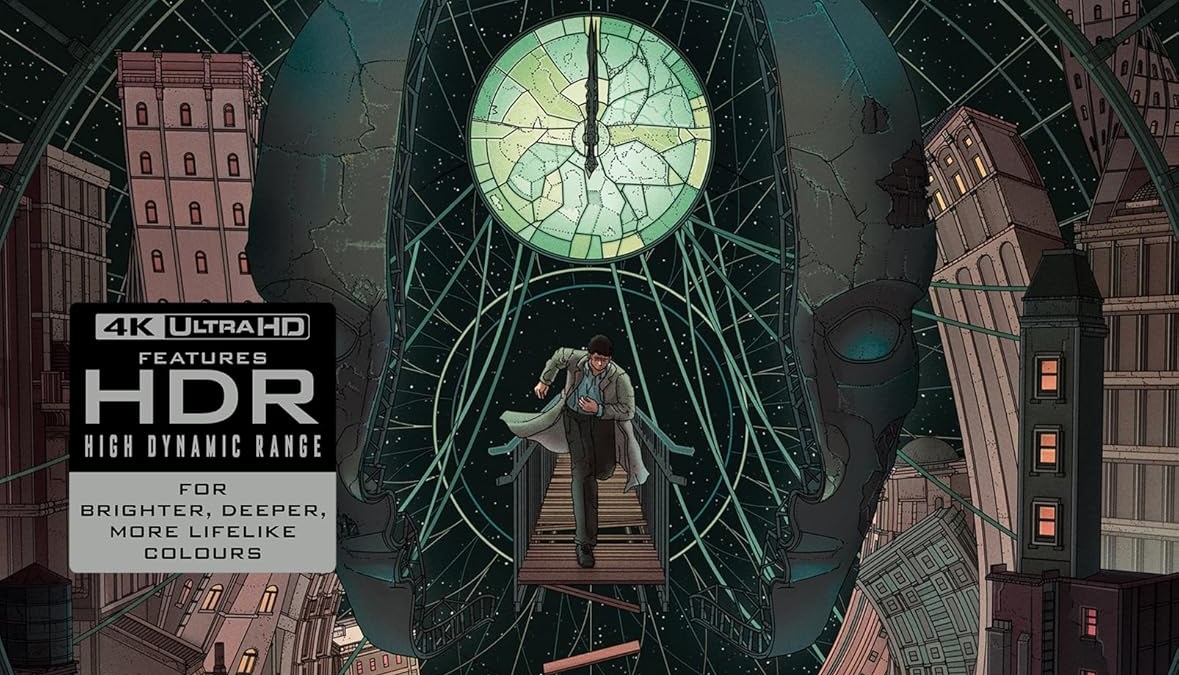
Alex Proyas’ Sci-fi Classic Dark City comes to 4K UHD with an all-new 4K Restoration and Special Features thanks to Arrow Video.
The Film
Dark City opened the same weekend I started as a projectionist at my local multiplex. Even in its truncated form, it was love at first sight. Director Alex Proyas’s noir sci-fi mystery was the kind of film that I grew up on. It was Metropolis. It was Bladerunner. It was Batman ’89. It was a film with big visuals and even better ideas. I must have watched the film at least a dozen times during its run at my theater from the projection booth. Even more so when it came to DVD, in fact, it was one of the first DVDs I purchased after getting my first DVD player. When it came to Blu-ray in its director’s cut form, it went into steady rotation of films that I rewatched.
Like Bladerunner, there is an inherent mystery that makes Dark City so inherently rewatchable. There are negative spaces. Unanswered questions are purposely left unanswered. In its director’s cut form with the voice over narration gone there it the space for ambiguity is even wider now. The reasons for how and why this rat maze came to be and who these strangers are, are a fascinating cinematic Rorschach test. The script by Proyas, Lem Dobbs, and David Goyer is oblique in the best way possible, using the cinematic language of noir and detective fiction to create a film that builds mysteries both in the traditional sense and reflexively into the larger themes of the film.
Dark City, at its heart, is a science fiction film. One that takes its entry into the genre in such an adroit manner that it never feels like sci-fi. Even when the film reveals itself, and in its showstopping movement of what and where the unnamed city of the film is. It still feels wholly a part of the noir traditions it begins in. It helps that the film is cast to perfection with faces and actors that feel like they’re more at home in 1938 than 1998. Rufus Sewell, William Hurt, Keifer Sutherland, and Jennifer Connelly all feel perfectly at home in their opening moments of the film. They understand the tone of the film and even when it morphs beyond the noirish conventions, they never seem out of place.
In the end, Alex Proyas’s Dark City is a unique, uncommon masterpiece of style, tone, and storytelling. One that, even thirty years later, has the ability to surprise.
Note: The review is of the director’s cut.
The Transfer
The all-new 4K restoration from the original 35mm camera negatives, approved by director of photography Dariusz Wolski, presentations of both the Director’s Cut and Theatrical Cut of the film in Dolby Vision (HDR10 compatible) are the kind of excellent presentations that will win awards come 2026. The flawless image looks as good, if not better, than the film did opening day back in 1998. The film’s presentation in Dolby Vision is near flawless. The film looks luminous with the HDR encoding giving the low-light photography extra depth and definition throughout. The transfer’s color reproduction and film grain are so good that it looks like a freshly struck archival 35mm print. There is nary a scratch, blemish, or speck of dirt to be found during the runtime. Fans and non-fans alike, jaws will drop at just how stunning Dark City looks and will more than likely have another demo disc to show off the virtues of 4K UHD.
The Extras
They include the following;
DISC 1: DIRECTOR’S CUT
DISC 2: THEATRICAL CUT
DISC 1: DIRECTOR’S CUT
The first of five audio commentaries is an all-new track by director Alex Proyas opens with a discussion of how he views his films as a “series of compromises”. Some of the details include a discussion of how he melded the noir mystery genre with the science fiction genre, and his visual touches he added to support these; the casting process for the various actors in the film (e.g., Rufus Swell, Jennifer Connelly, William Hurt, et. al.), including the studio mandates for a star in the lead role, and how that would work against the film; a discussion of the test screening process – and the changes mandated from that process, his reaction to the process, the release, Ebert’s support of the film; working with William Hurt and the challenging collaboration; a discussion of how on this film helped evolved his directorial style – which leads to a discussion of his theories on direction (especially with actors) throughout the commentary track; a discussion of the backstory and background of the world Dark City – his admission that The Knowing (a truly delirious Nic Cage film) is his head cannon prequel to Dark City and was his intent when making The Knowing; a discussion of production design, sets, and how clever use of these helped their budget which was not huge; a larger discussion of the differences between the director’s cut and the theatrical cut; and much more. Proyas provides a thoughtful, updated commentary track that has no real crossover with his archival tracks.
The second audio commentary is an all-new track with Critics/Podcasters Craig Anderson, Bruce Isaacs, and Herschel Isaacs, co-hosts of the Film Versus Film podcast. The track opens with their introductions and bonafides before diving into Dark City’s inspirations and use of German Expressionism. Some of the other details include the influence of Dark City on The Matrix – and a larger discussion of the similarities of the two, which were developed around the same time, and the themes they both deal with; a discussion of Proyas personal history, growing up at the same time as he did and also a larger discussion of cultural identity; the production history of the film – shooting in 1996, post-production in 1997 and finally released in 1998; the release and failure of the film at the box office; Roger Ebert’s appraisal of the film and helping it be finding a second life; the reasons why that the film used the green tint in its initial release; a great side discussion of VHS released and how it was stocked in video store under what genres; a larger discussion of the Strangers; a larger discussion of the various themes, influences and influential reach Dark City has over the last twenty five plus years; and much more.
The third audio commentary is the second by director Alex Proyas, recorded for the 2008 Blu-ray release. The track begins with the opening, which was a reshoot intended to have a voice-over (which it did within the theatrical cut) and what shot actually opened the film. Some of the other details include how closely the director’s cut resembles his initial cut of the film that was test-screened; a detailed discussion of the test screening process – and his experience on the ground floor after a bad one and studio interference; a discussion of the process of post-production on The Crow and Dark City and how much they varied; a larger discussion of what was cut from the theatrical and the way that the director cut’s adds to the whole of the film with regards to theme and style; a larger discussion of the various characters, themes, and plot points and how they tie into the larger narrative in the director’s cut and what was lost in the theatrical cut; and much more. Proyas’ track from the initial Blu-ray release is more focused on the changes and the processing of making the film, rather than the themes and directorial authorship that his newest track offers.
The fourth audio commentary by writers Lem Dobbs and David S. Goyer, recorded for the initial DVD release but expanded for the 2008 Blu-ray. The duo was recorded separately. Goyer opens the track by working with both Dobbs and Proyas and discusses how collaborative a process it was. Dobbs opens his portion of the track with how he loves the opening with Dr. Schreber (Keifer Sutherland). Some of the other details include a discussion of where the humans came from, including Proyas’, Goyer’s, and Dobbs’ thoughts on the matter; Goyer and Dobbs’ thoughts on the symbolism of the spirals throughout the film; Dobbs’ unique inspirations he took from non-traditional sources; Dobbs’ thoughts on Jennifer Connelly and her being cast; the use of “Lem-isms” – dialog that was confounding to Proyas and Goyer; Dobbs’ perspective on the “Lem-isms”; why Dobbs thought Proyas wanted to work with him – discussion of what he brought to the script; the development of the screenplay – how focus shifted from Bumstead to Murdoch and other plot and subplots changed and evolved; how Goyer/Dobbs respectively got involved, which is a greater discussion of the development process, and turnarounds by two studios (first Disney then Fox – this was before they merged) and it eventually came to New Line; the inception of the idea for Dark City; the casting what-ifs for the role that eventually went to Rufus Swell; a discussion of the genres that the film plays in from Dobbs and Goyer’s perspectives; and much more. Rarely do we get screenwriters being able to discuss their craft and the film they helped produce (unless they’re the writer/director), having two truly great writers in Dobbs and Goyer is a treat. They provide an insightful and entertaining track with quite a bit of honesty (especially from Dobbs, whose track with Soderberg on The Limey is an all-timer in that regard).
The fifth and final audio commentary by film critic Roger Ebert and an archival one the critic recorded for the 2008 release of the film. Ebert opens his secondary commentary track about the excitement when he announced the director’s cut was being made. Some of the details include the use of lighting for tone and also for story points; the use of space for effect – e.g., the use of claustrophobic and open spaces; various visual motifs that play through out and more so in the director’s cut adds to the overall storytelling and themes of the film; a larger discussion of the various characters and the actors portray them; a larger discussion of the various changes made between the theatrical and director’s cut; and much more.
Archive introduction by Alex Proyas (4:51) – not just an introduction by Proyas, but includes discussion points by Roger Ebert. Proyas and Ebert delve into the director’s cut, and as Ebert puts it, “generosity” allows for it in the film and its visual style.
Return to Dark City (58:55) – is an all-new hour-long retrospective documentary about the making of Dark City. The featurette is a deep dive into the production and release of the now cult classic sci-fi noir. The documentary dives into all aspects of Dark City, beginning with development and going to its current status and reappraisal in filmdom. The doc is wonderfully produced by Heather Buckley and sharply edited by Jamie Lockhart. Some of the highlights of the featurette include the early scripts (dating as far back as 1990); the development process; Dennis Potter’s reaction to the original script when Proyas sent it to him; the visual art, and collaboration between Proyas, Wolski, and the artists; the studios that were involved during the development process; the casting process – including the “Uncle Freddy” rule; shooting in Sydney, Australia – finding the space and using what eventually because the Fox Sydney studio space, also including a discussion of budget and its increase; a discussion of the costuming, production design, visual effects work; the studio-bound shoot and anecdotes from the set from the cast and crew; the post-production – which was still done on film which caused work flow issues with visual effects, the use of optical printer use, and analog color correction – and its hybrid approach; the test screening process – and how the film changed; the release of the film and its critical reappraisal and the release of the director’s cut; and much more.
I’m as Much in the Dark as You Are (19:50) – is an all-new visual essay by film scholar Josh Nelson on the influence of film noir and the role of identity in Dark City. Nelson goes on to discuss the tropes of film noir (and the critical disagreements on what defines film noir itself – a mystery he compares to Dark City’s elusive Shell Beach) and how they relate to the film’s characters, themes, visual style, production design, and storytelling. Nelson goes on to discussion the late 90s anxiety of impending Y2K to the post-War anxiety that Noir thrived in and how the rise of Cyber Punk Virtual Reality in the 90s related to Dark City. The essay was written and narrated by Nelson, edited by Jamie Lockhart, and produced by Neil Snowdown and Alexandra Heller-Nicholas.
Rats in a Maze (14:33) – is another all-new visual essay by film scholar Alexandra West using the work of psychologist Edward C. Tollman on cognitive mapping with rats in mazes as a reference point, West dives into the symbolism and story of Dark City. The visual essay is beautifully produced, providing context for the mazes (and spirals) that emerge from the visual cues, architecture, and ultimately the huge reveal of the film. The visual essay was written and narrated by West, edited by Jamie Lockhart, and produced by Neil Snowdown and Alexandra Heller-Nicholas.
Design & Storyboards (14:08) – this all-new featurette showcases the work of some of the artists who brought Dark City’s world to life. Featuring Art by Patrick Tatopoulos, George Liddle’s Production Design Guide, storyboards by Peter Pound and Mark Sexton. Rather than a still gallery, editor Jamie Lockhart and producer Heather Buckley have created a video set to Trevor Jones’ iconic score that feels more like a guided tour of the origins of the film.
DISC 2: THEATRICAL CUT
The first audio commentary is by director Alex Proyas, writers Lem Dobbs & David S. Goyer, director of photography Dariusz Wolski, and production designer Patrick Tatopoulos, which is a compilation of the archival full commentaries in the director’s cut by Proyas, Dobbs, Goyer, with additional comments by Wolski and Tatopoulos.
The second audio commentary by film critic Roger Ebert is much like his 2008 commentary track on the director’s cut. The critic dissects the film much in a similar manner to his other track. It may be, in fact the same track, just adjusted with new comments for his director’s cut commentary.
Memories of Shell Beach (43:26) – is an archival featurette looking at the making of the film, covering the origins, development, casting, pre-production, production, post-production, release, reception, and eventual reappraisal. The level of detail that this featurette covers the making of the film is only eclipsed by the honesty with which the participants discuss the film’s march to the big screen. They do cover various casting what-ifs, shifting three studios, production anecdotes, and more. The featurette combines interviews, scenes from the film, storyboards, behind-the-scenes photos (many of which were taken by Sewell himself – a great anecdote in the doc) to accomplish it as a visual component. Comments by co-screenwriter/director Alex Proyas, co-screenwriter Lem Dobbs, co-screenwriter David Goyer, actors Rufus Sewell, Richard O’Brien, cinematographer Dariusz Wolski, costume designer Liz Keogh, and 2ndunit director Bruce Hunt.
Architecture of Dreams (33:41) – is an archival featurette presenting five different viewpoints on the themes and meanings of the film. Divided into five chapters, each with an interview by a specific person going in-depth on their viewpoint of the film. 1 – A Postmodern Film (Lem Dobbs), 2 – Identity Theft (Vivian Sobchak), 3 – Worlds Constructed (Dana Polan), 4 – Cities as Spectacle & Collective Memories (Dobbs and Roger Ebert), 5 – Memoirs of my Nervous Illness by Paul Schreber (Alex Proyas and Rosemary Dinnage).
Theatrical trailer (2:23)
Image gallery – the image gallery consists of 293 production stills, behind-the-scenes photos, and poster art.
The Final Thought
Arrow has outdone themselves with this massive 4K UHD set, which is in the running for one of the best sets of 2025. Highest Possible Recommendations!!!
Arrow Video’s 4K UHD Edition of Dark City is out June 24th
Share this:
Like this:
Discover more from The Movie Isle
Subscribe to get the latest posts sent to your email.