
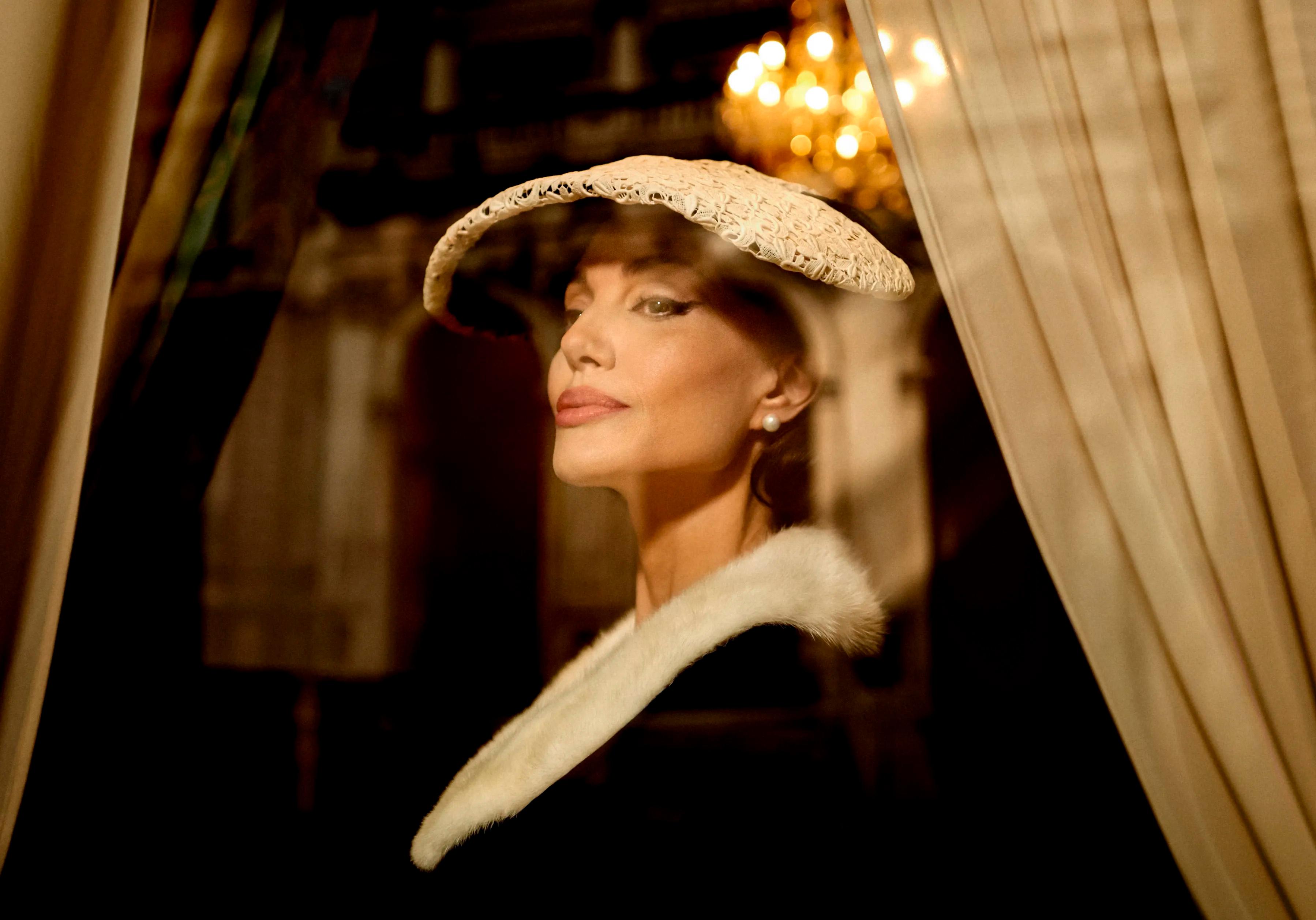
Pablo Larraín wraps up his trilogy of female icon-centred biopics with Maria, set during the last days of Maria Callas’ life in 1970s Paris. Cunard Headline Gala at the London Film Festival 2024.
There’s almost a hint of the creation of a Pablo Larraín cinematic universe in Maria as, due to La Callas’ relationship with a certain Greek shipping magnate in the 1960s, the spectre of Jackie Kennedy Onassis is hiding in a number of scenes. If Larraín ever met all of his muses, I think they would tear him to shreds.
In Maria, Pablo Larraín allows Maria Callas (Angelina Jolie) to tell her story as she roams around her apartment and walks the avenues of Paris in the week before she dies at the age of just 53. Except just how much of what she tells us is the truth is constantly in question, due to her use of Mandrax and other substances.
Callas recounts to a ‘journalist’ named Mandrax (Kody Smit-McPhee) how she views her art, her life, and the loss of her voice, each episode enveloped in a sumptuous score of orchestral overtures and arias, which then vanish.
It may not be fair to compare Larraín’s three women-centred films and yet it’s impossible not to, given that the characters involved were all pictured at a time when they were more or less isolated and had lost control over their own lives and image. We know that Diana Spencer was ostracised from the royal family, and the film shows us why. The interview style of Jackie allows a brittle Natalie Portman to convey how she had no control over decisions at the most traumatic time of her life. The difference with Maria is that we can see that Callas is in despair, but the film delivers only the shallowest of hints as to why. A montage of operatic successes does not convey the depths of a life that has brought the diva to where she is in 1977.
On top of that, while there is much praise for Angelina Jolie’s performance and she may well receive nominations come award season, I don’t think I am alone in feeling that I couldn’t forget that it was Jolie I was watching. The emotionless delivery of lines and the serene wandering around in beautiful costumes failed to bring Callas alive. At one point her sister Yakinthi (Valeria Golino) calls her a doll and, well, that about sums it up.
Callas has some nicely performed, sadly devoted domestic support from her butler Ferruccio (Pierfrancesco Favino) and housekeeper Bruna (Alba Rohrwacher – in a role which for some reason I could easily imagine being played by Andrea Riseborough), who tolerate her most diva-like behaviour. I can only hope that she treated them better in her will than she did in life.
Maria is the Cunard Headline Gala film at the London Film Festival 2024.
Discover more from The Movie Isle
Subscribe to get the latest posts sent to your email.
Pingback: Marie’s Top Ten Films of 2024 – The Movie Isle