Everyone knows Rodriguez’s debut feature as the “$7,000.00 wonder” but many forget that it’s actually a great action thriller. What separates El Mariachi from other like-minded no-budget wonders is its sense of humor and brevity that’s brought to it. There isn’t a scene or moment in the film that doesn’t feel fresh or at a minimum funny.
Yes, the story is paper thin – a Mariachi is mistaken for a hitman with a guitar case full of guns, and chaos ensues – but that isn’t the point. The point is the dare to be great storytelling. You’re rooting for the Mariachi (Carlos Gallardo) to survive but at the same time we’re rooting for Rodriguez to meet every challenge with a win… fortunately for film history, they both do. From the smallest moments to the big action scenes, there isn’t anything that doesn’t get pulled off successfully and stylishly in the film.
Even now, thirty years later, El Mariachi is a testament to the independent spirit of Rodriguez and filmmakers everywhere daring to be great (or at least bigger than the merger budgets they have).
Desperado
Robert Rodriguez does the Evil Dead 2 makeover on El Mariachi and creates both sequel and remake with Desperado. The stroke of genius was trading up for Superstar in waiting Antonio Banderas at the right moment in his career. Watching Banderas in this film is to see a man forge his own path to superstardom with the help of a young Genius (yes, Genius with a capital “G”) director equally as hungry. The result is a film that’s the Latino equivalent of what John Woo and Chow Yun-Fat did with The Killer.
Though Banderas is not the only superstar at the beginning of their career. Selma Hayek with her Gilda-inspired opening scorches onto the screen and film was never the same. Hayek’s role is slightly underwritten and a bit of a cliché but make no mistake – the star elevates the film and the role. The chemistry between Banderas and Hayek burns up the screen as few onscreen couples do. One wonders why the two were never cast together all the time they were so good.
Desperado is all about the action … and Rodriguez and company deliver the goods. There isn’t an action scene that doesn’t manage to be five times bigger than you expect it to be. Not just influenced by Woo’s slow-mo blood-drenched bullet ballets – the humor and cheekiness that Rodriguez infused in the first is omnipresent here.
As with the first, the daringness of the production that only cost $7 million in 1994 dollars is as thrilling to watch just how Rodriguez and the production got the most out of the budget making it look like a film five times the cost. That dual layer even today after seeing the film multiple times gives this reviewer that jolt of inspiration that anything is possible.
Once Upon a Time in Mexico
The finale of the series plays like a fourth film in a series that we never got the third film for. Rodriguez working super-fast and with half a script (by his own admission) creates a freewheeling tale that both serves as a recap (for that missing movie) and sequel to end all sequels for the Mariachi, now simply dubbed EL. The result is a film that plays fast and loose – the first improvisational action film ever made – by a filmmaker who was at the height of his prowess and inventiveness as a filmmaker.
Once Upon a Time in Mexico and its coupe and rebellion for the soul of Mexico is as fun and inventive as El Mariachi and Desperado but adds a scale and literate wittiness to the proceedings. The ever-evolving and changing points of view of the narrative feel more complex than the first two’s revenge a-b-c plots. Rodriguez involves the president, a rogue general, a sociopathic drug lord into the mix along with a Rogue CIA and Retired FBI agent all in the mix with EL as the eye of the storm.
The way that Rodriguez creates action scenes here with car chases, gun battles in the middle of a church, or a full-on military uprising feels like a hyped-up kid in a candy store. There isn’t any moment that isn’t a bullseye on the money success. The film has only gotten better with age with truly wonderful performances by Cheech Marin, Eva Mendes, Ruben Blades, Willem Dafoe, Danny Trejo, and Willem Dafoe. Though at the end of it all it’s Antonio Banderas’s film and what a true send-off for the actor and the role that defined the first part of his English language career. If only Rodriguez and Banderas had found another project to work on after this. If only…
The Transfer(s)
I wish I had more information on the transfers other than Desperado’s New 4K restoration from the original camera negative by Sony Pictures. The films all look lovely on Blu-Ray. The standout of course is Desperado and its new 4K Restoration. The restoration and the HDR encoding that comes with it respects the warm color palette that Rodriguez and cinematographer Guillermo Navarro used. The result is a wonderful image that looks better than it did on opening day back in August of 1995 (I was there in Westwood for this one). There isn’t a scratch or issue with the image. Comparing it to the Blu-ray edition of the film that came out a decade ago there isn’t a comparison both the 4K and new Blu-ray are miles away from that transfer.
Having seen all the films in all of their home video iterations since El Mariachi was on Laserdisc (I owned it!!!), the films all respectively look amazing. These appear to be different transfers to the original Blu-rays with the color palettes still intact but more closely hued to one another. El Mariachi looks gorgeous here on Blu-ray. Comparisons to the original Blu-ray do show a huge uptick and quality. Once Upon a Time in Mexico does look fantastic but losing the 2.39 widescreen framing for a more consistent 1.78 open matte frame to mimic the first two films is a loss but one that is acceptable. The film as compared to the original Blu-ray shows an uptick in not just image clarity but the film looks less “video-like” and more filmic in this iteration thus a more pleasing image. The ghosting present on the original Blu-ray isn’t present here. One will gladly take the quality over the framing in the Arrow version.
All around these are magnificent transfers and upgrades all around.
The Extras
Illustrated collector’s booklet featuring new writing by Carlos Aguilar and Nicholas Clement; Reversible sleeves featuring original and newly commissioned artwork by Paul Shipper; Double-sided posters featuring original and newly commissioned artwork by Paul Shipper; Collectable poster featuring Robert Rodriguez’s original poster concept for El Mariachi
Audio commentary by writer-director Robert Rodriguez
Lean and Mean with Robert Rodriguez
Shoot Like Crazy with Bill Borden
Kill Count with Steve Davison
Lock and Load with Bob Shelley
Game Changer with Gareth Evans
Ten More Minutes: Anatomy of a Shootout
Textless opening (“Morena de mi Corazón”)
Theatrical trailers
DISC 4 – ONCE UPON A TIME IN MEXICO (BLU-RAY)
Commentary by writer-director Robert Rodriguez
The Revolution Will Be Digitized with Rodriguez
Troublemaking with editor Ethan Maniquis
Eight deleted scenes
Ten Minute Flick School
Inside Troublemaker Studios
Ten Minute Cooking School
Film is Dead: An Evening with Robert Rodriguez
The Anti-Hero’s Journey
The Good, the Bad and the Bloody: Inside KNB FX
Theatrical trailers
DISC 1 – EL MARIACHI (BLU-RAY)
The archival Commentary by writer-director Robert Rodriguez is possibly one of the great commentaries of all time. Full stop. No joke. No hyperbole. Rodriguez specifically recorded this commentary himself and made sure to edit out all the pauses, so the commentary had the maximum amount of information and the minimum amount of lack of time. I would normally recount some of the details of the commentary track, yes even thirty years later, but it is more of an experiential track that feels like a true early-era masterclass on low-budget directing. Anyone who wants to make a lowest of the low budget feature this track SHOULD be required listening for indie filmmakers if not for the tricks he used but also for the inspiration Rodriguez is able to give to anyone listening.
Big Vision Low Budget with Robert Rodriguez (14:41) – an all-new interview with Rodriguez begins with his love of many artistic forms and how he saw filmmaking as a way to do them all. Some of the other details include John Carpenter’s heavy influence on his career and films; how he and Carlos Gallardo came up with the idea for a feature-length film; the way that friends and family helped make the film in the small town in Mexico that Gallardo was from; the casting of Peter Marquand – the main villain; how he felt he got so many good natural performances; the reason why he didn’t want a crew or need a crew; the need for great sound – and how they accomplished that; the rule of three’s – something he was not aware of but followed strictly in El Mariachi; and much more.
The Original Mariachi with Carlos Gallardo (15:21) – a newly filmed interview with producer/star discussing the times prior to El Mariachi and how he met Rodriguez at a private school his parent sent him. Gallardo discusses their shared love of films; the first film he made without Rodriguez; the first short film he made with Rodriguez; what he did as “producer” on the film; some practical advice about friends and using crew; the casting and how he approached the casting; how some of the stunts were accomplished – including the iconic zipline in front of the; how the film took Hollywood by storm; and much more.
A Band of Misfits: The Music of El Mariachi (12:41) – an all-new featurette discussing the musical score and music in the film. Beginning with Rodriguez stating that he knew he would need someone to do music. The featurette focuses on the various musicians and how Rodriquez managed to group these various musicians together to compose sections and eventually editing them together. Everyone has a truly wonderful and interesting story of how they all became involved. Many of the participants get very technical with how they accomplished their sections of score – which will delight music fans. Featuring interviews with composers Eric Guthrie, Chris Knudson, Alvaro Rodriguez, and Marc Trujillo.
Ten Minute Film School, an archive featurette produced and narrated by Rodriguez (14:38) – if you haven’t seen this master course on inventive filmmaking style Rodriguez produced years ago you are in for a treat. Rodriguez has created an effective How to Make Your Own $7000 going through how he accomplished much of the film. Using raw footage, he compiles a featurette on how they did some of the more bravado scenes. Even if you’re not a wannabe filmmaker (he would hate me saying that you are a filmmaker) this featurette is truly wonderful and inspiring – letting you behind the curtain on the filmmaking he developed – out of necessity.
Bedhead, a 1991 short film by Rodriguez (9:09) – is a comedy short that pits the younger sister against her annoying older brother with a serious case of bedhead after he ruins her only untouched doll that leaves her with a head injury but also – superpowers? One only needs to watch this short to realize that Rodriguez would eventually make a kid’s film. The genesis of the style attitude of the Spy Kids films and his segment in Four Rooms (“The Misbehavers”) is all here and ready for a bigger budget. One does have to love the Carpenter-inspired score and the literal hand-drawn opening title sequence.
Note: Special Features appear on both the Blu-Ray and 4K UHD discs.
Another legendary archival Audio commentary by writer-director Robert Rodriguez. Again, Rodriguez has created a commentary track that should be required listening to anyone planning on making an independently produced action picture. The director has scaled everything up as the film was now $7 million instead of $7,000. Rodriguez specifically recorded this commentary himself, as he did on El Mariachi, so he could specifically edit out all the pauses, so the commentary has the maximum amount of information and the minimum amount of lag time. This is definitely a track that must be listened to rather than recount it, as the track feels like a true masterclass on low-budget genre directing. Again, this one is required listening for anyone who wants to get into low-budget filmmaking. This is indeed a complimentary track to the one recorded for El Mariachi.
Lean and Mean with Robert Rodriguez (17:19) – an all-new interview with Rodriguez is a continuation of the one from the first disc. He opens with the goal of Desperado being a film that would rival John Woo. Rodriguez discusses writing Desperado as a remake but then El Mariachi became both sequel and remake starring Antonio Banderas; what made him choose Banderas; working with Banderas as a collaborator; the casting Selma Hayek – including his work with her on Roadracers because the studio lack of faith; the casting of Danny Trejo – and just how much he stood out and the genesis of Machete; the casting of Cheech Marin – and his being supportive from the beginning with one of the first screening of El Mariachi; shooting Steadicam himself – taking a course and the “crash course” on set; collaborating with cinematographer Guillermo Navarro – and the surprising visual reference and how they set up lighting to ensure that Rodriguez could shoot upwards of 50 setups; editing – and how he had never edited on film and how Desperado was one of the first Sony films edited digital; how digital editing helped with creating visuals while in production to show cast and crew; how finishing Desperado completed so early he was able to film Four Rooms and From Dusk Till Dawn; and much more.
Shoot Like Crazy with Bill Borden (11:21) – an all-new interview with producer Bill Borden discusses how he became involved with Desperado and Rodriguez after a screening of El Mariachi after Sony purchased it. Borden discusses his history with the film he produced; how Rodriguez wanted to shoot in the same town in Mexico – and the logistical problems of getting trucks and crew into the country; the collaboration between Rodriguez and Antonio Banderas; the casting of Selma Hayek; the directorial style and energy that Rodriguez brought to a studio production – including Rodriguez handling the camera constantly; discussing with various production challenges – like getting the prop and real guns, stunt work, VFX, and more; a crazy story about getting the guns to the location and the ATF; and much more.
Kill Count with Steve Davison (8:10) – an all-new interview with stunt coordinator Steve Davison discusses how he approaches stunt work after reading the script. Davidson discusses how unique a challenge stunt work and how his work with Borden on a prior film got him work on Desperado; his meeting Rodriguez and the collaboration – how Rodriguez was already adept at directing action; the number of actual stunt men he had during the shoot – including the various day players being cast for lighter stunt work; a fun anecdote about the Kill Count – you’ll have to watch the interview to hear the number; the hardest stunts during the production; and much more.
Lock and Load with Bob Shelley (8:50) – an all-new interview with special effects coordinator Bob Shelley begins with a definition of what he does on set – e.g., explosions, gunfire, et. al. Shelley discusses how he began in the Army based out of Atlanta and how Hollywood production changed the course of his career; how Borden brought him and he met Rodriguez; the challenges that Rodriguez put forth caused him to invent some new items he created – including showing us the actual pieces; the various weapons and mechanical tricks they used to create for various set pieces – like Danny Trejo’s knives and stunt knives; and what separates a director like Rodriguez and lesser directors in his opinion; and much more.
Game Changer with Gareth Evans (6:42) – an all-new appreciation by filmmaker Gareth Evans. Like many of us, Evans is a huge fan and became inspired by Rodriguez’s story and the films. Here he discusses not just El Mariachi and Desperado but his love for it and how the special features helped him make his own film The Raid.
Ten More Minutes: Anatomy of a Shootout (10:33) – like the first installment of Ten-Minute Film School including on the El Mariachi disc, Rodriguez gives a master course, this time, on how to shoot an action scene. The genius of this featurette is that Rodriguez is using industry standards for shooting action (e.g., pre-vis, storyboards – if you can draw) a decade until we’d really see it take hold. Rodriguez focuses on the Bar shootout to take you behind his process to ensure costs are at a minimum and was able to produce a film for $7 million that looks like it cost five times that (in 1994 dollars). Even if you’re not a fledging filmmaker this and the other featurette are truly wonderful and inspiring – letting you behind the curtain on the evolution of Rodriguez’s filmmaking style developed.
Textless opening (“Morena de mi Corazón”) (2:38) – it should be noted that they made sure this was in 4K, which is wonderful.
Theatrical teaser (1:34)
Theatrical trailer (2:05)
TV spot (0:33)
DISC 4 – ONCE UPON A TIME IN MEXICO (BLU-RAY)
The final archival Commentary by writer-director Robert Rodriguez is another required listening for filmmakers and fans alike. Rodriguez, along with George Lucas – actually because of him, was a super early adopter of digital film cameras. The director has scaled everything up to digital cinema and what effective cost-cutting techniques he incorporated. Rodriguez specifically recorded this and all the commentary himself, so he could specifically edit out all the pauses, so the commentary has the maximum amount of information and the minimum amount of lag time. This is definitely a track that must be listened to rather than recount it, as the track feels like a true masterclass on digital filmmaking – even now more than a decade later is still vital. Again, this one is required listening for anyone who wants to get into the current era of low-budget filmmaking. This is indeed a complimentary track to the one recorded for Desperado and El Mariachi.
The Revolution Will Be Digitized with Rodriguez (12:41) – a newly filmed interview with Rodriguez and the final part of the interview that ran through El Mariachi and Desperado. The interview opens with how the final film’s production felt more like El Mariachi because of the digital cameras and the speed at which they could move. Rodriguez discusses how quickly pre-Writer strike the film came together with Bandaris and how Sony was all for it; how the script came together by some of the keystone moments he had (e.g., the three-handed man), how Tarantino came up with the title for the film and inspiration for the third film; a funny anecdote about studio head Amy Pascal’s thoughts once they finished production in 30 days; the lack of slow motion in the film and reason why; the actual digital cameras – which he owns and the other film he used years later; how Danny Elfman inspired him to do the score on this film – including how he let some of the actors write their own themes; the trouble with post-production – editing after shooting another movie; a discussion of the framing – including his preference to 2.39; and much more.
Troublemaking with editor Ethan Maniquis (9:50) – a newly filmed interview with visual effects editor Ethan Maniquis begins with why he thinks these films endure. Maniquis discusses how he met Rodriguez on the Sony Studio Lot while he was editing Desperado – and the trouble with first-generation digital editing and his place during that time; his time editing with Rodriguez and transferring over to Post Production at Miramax; going to Troublemaker Studios – and the evolution of his role in editing and becoming a VFX editor and what it meant; how they changed the post-production workflow with Once Upon a Time in Mexico – and the challenges; and much more.
Eight deleted scenes (7:47) – The submenu for the deleted scenes gives you the option to PLAY ALL or PLAY ALL with optional commentary by Rodriguez. Each scene can be played individually;
Sands Phones Dead Man (045)
Mariachi in the Desert (207)
Sands Outside Restaurant (048)
Goat Milk, Cold (105)
Sands on Internet (042)
One Arm (040)
Jorge (108)
Spy Dog (036)
Ten Minute Flick School (9:05) – final Ten-Minute Film School of the Mexico trilogy Rodriguez gives a master course, this time, on the various tricks he’s learned and incorporated for digital filmmaking. Rodriguez focuses on the various tricks (e.g., how to shoot actors weeks apart, composing shots for VFX for cost-effectiveness, how reference shots are of supreme importance, et. al.) to save money by being smart (e.g., the rubber guns and adding squibs and hits in post, wire removal for stunt work, et. al.) and even being improvisational with additional shots because of how quickly they move. Even if you’re not a fledging filmmaker this and the other featurette are truly wonderful and inspiring – letting you behind the curtain on the evolution of Rodriguez’s filmmaking style developed.
Inside Troublemaker Studios (11:24) –an archive featurette where Rodriguez takes you on a tour of his Troublemaker Studios in Austin. More than just a tour, Rodriguez takes you to the various areas of the studio and how he approaches the various post-production areas including examples of how he edits picture, sound, music, visual effects, and more. This could have been a vanity tour but Rodriguez shows how he uses it for production and cost effectiveness. Even over two decades on this is a fascinating featurette on making a “home” movie studio.
Ten Minute Cooking School (5:50) – taking a cue from his 10-minute film school Rodriguez (a known foodie) shows you how to cook Puerco Pibil. I can attest that this is a great dish as before my vegetarian days I had made this multiple times, using his recipe. It is a bit of work but trust in the fact that this may become your favorite pork dish.
Film is Dead: An Evening with Robert Rodriguez (13:20) – in this archival featurette Rodriguez gives a presentation on the Sony Lot (the Cary Grant theater to be specific) to discuss the future of digital filmmaking. Even back in 2003, was years ahead of studios and most forward-thinking filmmakers (exceptions at the time were Lucas, Cameron, and Soderbergh), with what has become basically industry standards. In fact, he’s very forthright about how Lucas inspired him by showing him the digital test footage from Attack the Clones. Still a great discussion and revealing b-roll footage as Rodriguez talks the gospel of digital cinema. Bonus points for Danny Trejo showing up at the presentation.
The Anti-Hero’s Journey (18:05) – an archive featurette looking at the Mariachi legacy and the three films and how each was built and created – also a look at the story for the film and the success of each one. The featurette does a great job of charting the history of the making of the films and some of the most iconic moments of the films. Featuring comments by Rodriguez, Carlos Gallardo, Antonio Banderas, Johnny Depp, Willem Dafoe, Selma Hayek, and more.
The Good, the Bad and the Bloody: Inside KNB FX (19:04) – an archive featurette taking a deep dive into the various special effects employed on Once Upon a Time in Mexico. Beginning with the origins of KNB FX moving to their work in the modern era to their relationship with Robert Rodriguez beginning with From Dusk till Dawn and how it evolved though this film. The featurette covers the quickness of the production, the challenges for makeup FX, and much more. The featurette has some truly great b-roll/behind-the-scenes footage. Featuring comments by Greg Nicotero, Robert Rodriguez, Jake Garber, and others.
Theatrical Trailer (2:37) – the Red Band version
Theatrical Trailer (2:19) – the Green Band version
The Final Thought
Arrow Video and Robert Rodriguez have done right by fandom putting together this amazing box set. Filled with new and archival special features, great picture, and sound – The Mexico Trilogy Box Set is one of the year’s best physical media releases. Highest possible recommendations!!!

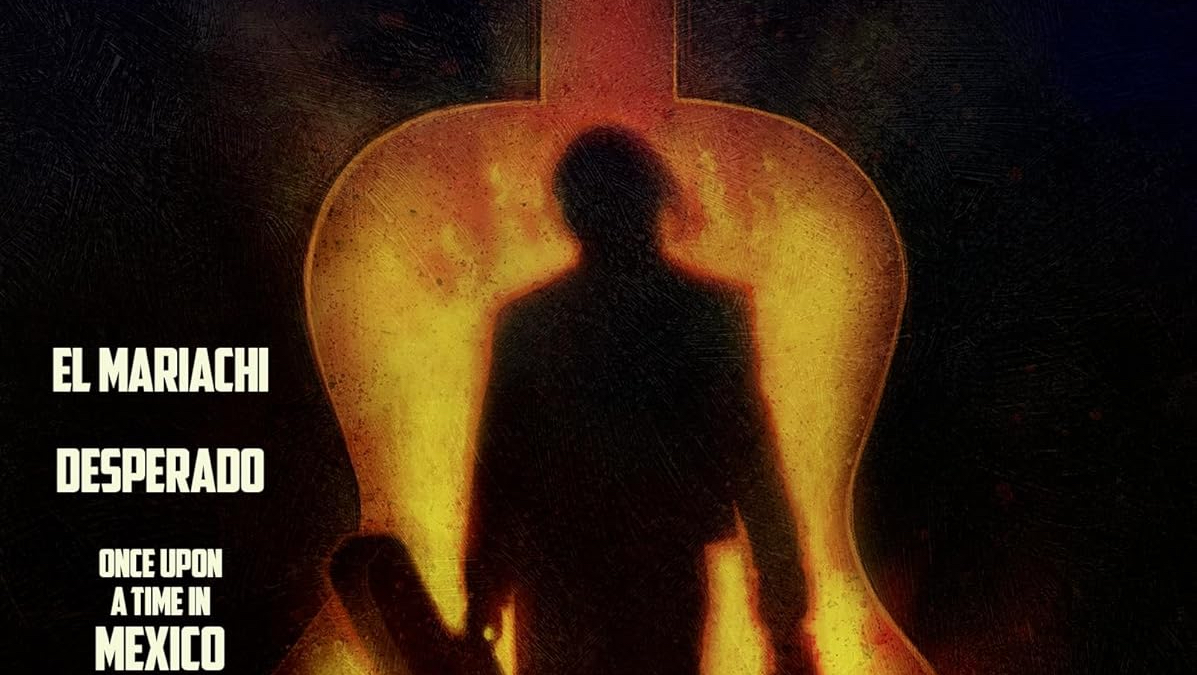
Filmmaker Robert Rodriguez and Arrow Video have collaborated on The Mexico Trilogy box set. The set comes locked and loaded with explosive extras.
The Film(s)
El Mariachi
Everyone knows Rodriguez’s debut feature as the “$7,000.00 wonder” but many forget that it’s actually a great action thriller. What separates El Mariachi from other like-minded no-budget wonders is its sense of humor and brevity that’s brought to it. There isn’t a scene or moment in the film that doesn’t feel fresh or at a minimum funny.
Yes, the story is paper thin – a Mariachi is mistaken for a hitman with a guitar case full of guns, and chaos ensues – but that isn’t the point. The point is the dare to be great storytelling. You’re rooting for the Mariachi (Carlos Gallardo) to survive but at the same time we’re rooting for Rodriguez to meet every challenge with a win… fortunately for film history, they both do. From the smallest moments to the big action scenes, there isn’t anything that doesn’t get pulled off successfully and stylishly in the film.
Even now, thirty years later, El Mariachi is a testament to the independent spirit of Rodriguez and filmmakers everywhere daring to be great (or at least bigger than the merger budgets they have).
Desperado
Robert Rodriguez does the Evil Dead 2 makeover on El Mariachi and creates both sequel and remake with Desperado. The stroke of genius was trading up for Superstar in waiting Antonio Banderas at the right moment in his career. Watching Banderas in this film is to see a man forge his own path to superstardom with the help of a young Genius (yes, Genius with a capital “G”) director equally as hungry. The result is a film that’s the Latino equivalent of what John Woo and Chow Yun-Fat did with The Killer.
Though Banderas is not the only superstar at the beginning of their career. Selma Hayek with her Gilda-inspired opening scorches onto the screen and film was never the same. Hayek’s role is slightly underwritten and a bit of a cliché but make no mistake – the star elevates the film and the role. The chemistry between Banderas and Hayek burns up the screen as few onscreen couples do. One wonders why the two were never cast together all the time they were so good.
Desperado is all about the action … and Rodriguez and company deliver the goods. There isn’t an action scene that doesn’t manage to be five times bigger than you expect it to be. Not just influenced by Woo’s slow-mo blood-drenched bullet ballets – the humor and cheekiness that Rodriguez infused in the first is omnipresent here.
As with the first, the daringness of the production that only cost $7 million in 1994 dollars is as thrilling to watch just how Rodriguez and the production got the most out of the budget making it look like a film five times the cost. That dual layer even today after seeing the film multiple times gives this reviewer that jolt of inspiration that anything is possible.
Once Upon a Time in Mexico
The finale of the series plays like a fourth film in a series that we never got the third film for. Rodriguez working super-fast and with half a script (by his own admission) creates a freewheeling tale that both serves as a recap (for that missing movie) and sequel to end all sequels for the Mariachi, now simply dubbed EL. The result is a film that plays fast and loose – the first improvisational action film ever made – by a filmmaker who was at the height of his prowess and inventiveness as a filmmaker.
Once Upon a Time in Mexico and its coupe and rebellion for the soul of Mexico is as fun and inventive as El Mariachi and Desperado but adds a scale and literate wittiness to the proceedings. The ever-evolving and changing points of view of the narrative feel more complex than the first two’s revenge a-b-c plots. Rodriguez involves the president, a rogue general, a sociopathic drug lord into the mix along with a Rogue CIA and Retired FBI agent all in the mix with EL as the eye of the storm.
The way that Rodriguez creates action scenes here with car chases, gun battles in the middle of a church, or a full-on military uprising feels like a hyped-up kid in a candy store. There isn’t any moment that isn’t a bullseye on the money success. The film has only gotten better with age with truly wonderful performances by Cheech Marin, Eva Mendes, Ruben Blades, Willem Dafoe, Danny Trejo, and Willem Dafoe. Though at the end of it all it’s Antonio Banderas’s film and what a true send-off for the actor and the role that defined the first part of his English language career. If only Rodriguez and Banderas had found another project to work on after this. If only…
The Transfer(s)
I wish I had more information on the transfers other than Desperado’s New 4K restoration from the original camera negative by Sony Pictures. The films all look lovely on Blu-Ray. The standout of course is Desperado and its new 4K Restoration. The restoration and the HDR encoding that comes with it respects the warm color palette that Rodriguez and cinematographer Guillermo Navarro used. The result is a wonderful image that looks better than it did on opening day back in August of 1995 (I was there in Westwood for this one). There isn’t a scratch or issue with the image. Comparing it to the Blu-ray edition of the film that came out a decade ago there isn’t a comparison both the 4K and new Blu-ray are miles away from that transfer.
Having seen all the films in all of their home video iterations since El Mariachi was on Laserdisc (I owned it!!!), the films all respectively look amazing. These appear to be different transfers to the original Blu-rays with the color palettes still intact but more closely hued to one another. El Mariachi looks gorgeous here on Blu-ray. Comparisons to the original Blu-ray do show a huge uptick and quality. Once Upon a Time in Mexico does look fantastic but losing the 2.39 widescreen framing for a more consistent 1.78 open matte frame to mimic the first two films is a loss but one that is acceptable. The film as compared to the original Blu-ray shows an uptick in not just image clarity but the film looks less “video-like” and more filmic in this iteration thus a more pleasing image. The ghosting present on the original Blu-ray isn’t present here. One will gladly take the quality over the framing in the Arrow version.
All around these are magnificent transfers and upgrades all around.
The Extras
They include the following;
DISC 1 – EL MARIACHI (BLU-RAY)
DISCS 2 & 3 – DESPERADO (BLU-RAY / 4K ULTRA HD BLU-RAY)
DISC 4 – ONCE UPON A TIME IN MEXICO (BLU-RAY)
DISC 1 – EL MARIACHI (BLU-RAY)
The archival Commentary by writer-director Robert Rodriguez is possibly one of the great commentaries of all time. Full stop. No joke. No hyperbole. Rodriguez specifically recorded this commentary himself and made sure to edit out all the pauses, so the commentary had the maximum amount of information and the minimum amount of lack of time. I would normally recount some of the details of the commentary track, yes even thirty years later, but it is more of an experiential track that feels like a true early-era masterclass on low-budget directing. Anyone who wants to make a lowest of the low budget feature this track SHOULD be required listening for indie filmmakers if not for the tricks he used but also for the inspiration Rodriguez is able to give to anyone listening.
Big Vision Low Budget with Robert Rodriguez (14:41) – an all-new interview with Rodriguez begins with his love of many artistic forms and how he saw filmmaking as a way to do them all. Some of the other details include John Carpenter’s heavy influence on his career and films; how he and Carlos Gallardo came up with the idea for a feature-length film; the way that friends and family helped make the film in the small town in Mexico that Gallardo was from; the casting of Peter Marquand – the main villain; how he felt he got so many good natural performances; the reason why he didn’t want a crew or need a crew; the need for great sound – and how they accomplished that; the rule of three’s – something he was not aware of but followed strictly in El Mariachi; and much more.
The Original Mariachi with Carlos Gallardo (15:21) – a newly filmed interview with producer/star discussing the times prior to El Mariachi and how he met Rodriguez at a private school his parent sent him. Gallardo discusses their shared love of films; the first film he made without Rodriguez; the first short film he made with Rodriguez; what he did as “producer” on the film; some practical advice about friends and using crew; the casting and how he approached the casting; how some of the stunts were accomplished – including the iconic zipline in front of the; how the film took Hollywood by storm; and much more.
A Band of Misfits: The Music of El Mariachi (12:41) – an all-new featurette discussing the musical score and music in the film. Beginning with Rodriguez stating that he knew he would need someone to do music. The featurette focuses on the various musicians and how Rodriquez managed to group these various musicians together to compose sections and eventually editing them together. Everyone has a truly wonderful and interesting story of how they all became involved. Many of the participants get very technical with how they accomplished their sections of score – which will delight music fans. Featuring interviews with composers Eric Guthrie, Chris Knudson, Alvaro Rodriguez, and Marc Trujillo.
Ten Minute Film School, an archive featurette produced and narrated by Rodriguez (14:38) – if you haven’t seen this master course on inventive filmmaking style Rodriguez produced years ago you are in for a treat. Rodriguez has created an effective How to Make Your Own $7000 going through how he accomplished much of the film. Using raw footage, he compiles a featurette on how they did some of the more bravado scenes. Even if you’re not a wannabe filmmaker (he would hate me saying that you are a filmmaker) this featurette is truly wonderful and inspiring – letting you behind the curtain on the filmmaking he developed – out of necessity.
Bedhead, a 1991 short film by Rodriguez (9:09) – is a comedy short that pits the younger sister against her annoying older brother with a serious case of bedhead after he ruins her only untouched doll that leaves her with a head injury but also – superpowers? One only needs to watch this short to realize that Rodriguez would eventually make a kid’s film. The genesis of the style attitude of the Spy Kids films and his segment in Four Rooms (“The Misbehavers”) is all here and ready for a bigger budget. One does have to love the Carpenter-inspired score and the literal hand-drawn opening title sequence.
Theatrical trailer (1:38)
TV spot (0:32)
DISCS 2 & 3 – DESPERADO (BLU-RAY / 4K ULTRA HD BLU-RAY)
Note: Special Features appear on both the Blu-Ray and 4K UHD discs.
Another legendary archival Audio commentary by writer-director Robert Rodriguez. Again, Rodriguez has created a commentary track that should be required listening to anyone planning on making an independently produced action picture. The director has scaled everything up as the film was now $7 million instead of $7,000. Rodriguez specifically recorded this commentary himself, as he did on El Mariachi, so he could specifically edit out all the pauses, so the commentary has the maximum amount of information and the minimum amount of lag time. This is definitely a track that must be listened to rather than recount it, as the track feels like a true masterclass on low-budget genre directing. Again, this one is required listening for anyone who wants to get into low-budget filmmaking. This is indeed a complimentary track to the one recorded for El Mariachi.
Lean and Mean with Robert Rodriguez (17:19) – an all-new interview with Rodriguez is a continuation of the one from the first disc. He opens with the goal of Desperado being a film that would rival John Woo. Rodriguez discusses writing Desperado as a remake but then El Mariachi became both sequel and remake starring Antonio Banderas; what made him choose Banderas; working with Banderas as a collaborator; the casting Selma Hayek – including his work with her on Roadracers because the studio lack of faith; the casting of Danny Trejo – and just how much he stood out and the genesis of Machete; the casting of Cheech Marin – and his being supportive from the beginning with one of the first screening of El Mariachi; shooting Steadicam himself – taking a course and the “crash course” on set; collaborating with cinematographer Guillermo Navarro – and the surprising visual reference and how they set up lighting to ensure that Rodriguez could shoot upwards of 50 setups; editing – and how he had never edited on film and how Desperado was one of the first Sony films edited digital; how digital editing helped with creating visuals while in production to show cast and crew; how finishing Desperado completed so early he was able to film Four Rooms and From Dusk Till Dawn; and much more.
Shoot Like Crazy with Bill Borden (11:21) – an all-new interview with producer Bill Borden discusses how he became involved with Desperado and Rodriguez after a screening of El Mariachi after Sony purchased it. Borden discusses his history with the film he produced; how Rodriguez wanted to shoot in the same town in Mexico – and the logistical problems of getting trucks and crew into the country; the collaboration between Rodriguez and Antonio Banderas; the casting of Selma Hayek; the directorial style and energy that Rodriguez brought to a studio production – including Rodriguez handling the camera constantly; discussing with various production challenges – like getting the prop and real guns, stunt work, VFX, and more; a crazy story about getting the guns to the location and the ATF; and much more.
Kill Count with Steve Davison (8:10) – an all-new interview with stunt coordinator Steve Davison discusses how he approaches stunt work after reading the script. Davidson discusses how unique a challenge stunt work and how his work with Borden on a prior film got him work on Desperado; his meeting Rodriguez and the collaboration – how Rodriguez was already adept at directing action; the number of actual stunt men he had during the shoot – including the various day players being cast for lighter stunt work; a fun anecdote about the Kill Count – you’ll have to watch the interview to hear the number; the hardest stunts during the production; and much more.
Lock and Load with Bob Shelley (8:50) – an all-new interview with special effects coordinator Bob Shelley begins with a definition of what he does on set – e.g., explosions, gunfire, et. al. Shelley discusses how he began in the Army based out of Atlanta and how Hollywood production changed the course of his career; how Borden brought him and he met Rodriguez; the challenges that Rodriguez put forth caused him to invent some new items he created – including showing us the actual pieces; the various weapons and mechanical tricks they used to create for various set pieces – like Danny Trejo’s knives and stunt knives; and what separates a director like Rodriguez and lesser directors in his opinion; and much more.
Game Changer with Gareth Evans (6:42) – an all-new appreciation by filmmaker Gareth Evans. Like many of us, Evans is a huge fan and became inspired by Rodriguez’s story and the films. Here he discusses not just El Mariachi and Desperado but his love for it and how the special features helped him make his own film The Raid.
Ten More Minutes: Anatomy of a Shootout (10:33) – like the first installment of Ten-Minute Film School including on the El Mariachi disc, Rodriguez gives a master course, this time, on how to shoot an action scene. The genius of this featurette is that Rodriguez is using industry standards for shooting action (e.g., pre-vis, storyboards – if you can draw) a decade until we’d really see it take hold. Rodriguez focuses on the Bar shootout to take you behind his process to ensure costs are at a minimum and was able to produce a film for $7 million that looks like it cost five times that (in 1994 dollars). Even if you’re not a fledging filmmaker this and the other featurette are truly wonderful and inspiring – letting you behind the curtain on the evolution of Rodriguez’s filmmaking style developed.
Textless opening (“Morena de mi Corazón”) (2:38) – it should be noted that they made sure this was in 4K, which is wonderful.
Theatrical teaser (1:34)
Theatrical trailer (2:05)
TV spot (0:33)
DISC 4 – ONCE UPON A TIME IN MEXICO (BLU-RAY)
The final archival Commentary by writer-director Robert Rodriguez is another required listening for filmmakers and fans alike. Rodriguez, along with George Lucas – actually because of him, was a super early adopter of digital film cameras. The director has scaled everything up to digital cinema and what effective cost-cutting techniques he incorporated. Rodriguez specifically recorded this and all the commentary himself, so he could specifically edit out all the pauses, so the commentary has the maximum amount of information and the minimum amount of lag time. This is definitely a track that must be listened to rather than recount it, as the track feels like a true masterclass on digital filmmaking – even now more than a decade later is still vital. Again, this one is required listening for anyone who wants to get into the current era of low-budget filmmaking. This is indeed a complimentary track to the one recorded for Desperado and El Mariachi.
The Revolution Will Be Digitized with Rodriguez (12:41) – a newly filmed interview with Rodriguez and the final part of the interview that ran through El Mariachi and Desperado. The interview opens with how the final film’s production felt more like El Mariachi because of the digital cameras and the speed at which they could move. Rodriguez discusses how quickly pre-Writer strike the film came together with Bandaris and how Sony was all for it; how the script came together by some of the keystone moments he had (e.g., the three-handed man), how Tarantino came up with the title for the film and inspiration for the third film; a funny anecdote about studio head Amy Pascal’s thoughts once they finished production in 30 days; the lack of slow motion in the film and reason why; the actual digital cameras – which he owns and the other film he used years later; how Danny Elfman inspired him to do the score on this film – including how he let some of the actors write their own themes; the trouble with post-production – editing after shooting another movie; a discussion of the framing – including his preference to 2.39; and much more.
Troublemaking with editor Ethan Maniquis (9:50) – a newly filmed interview with visual effects editor Ethan Maniquis begins with why he thinks these films endure. Maniquis discusses how he met Rodriguez on the Sony Studio Lot while he was editing Desperado – and the trouble with first-generation digital editing and his place during that time; his time editing with Rodriguez and transferring over to Post Production at Miramax; going to Troublemaker Studios – and the evolution of his role in editing and becoming a VFX editor and what it meant; how they changed the post-production workflow with Once Upon a Time in Mexico – and the challenges; and much more.
Eight deleted scenes (7:47) – The submenu for the deleted scenes gives you the option to PLAY ALL or PLAY ALL with optional commentary by Rodriguez. Each scene can be played individually;
Ten Minute Flick School (9:05) – final Ten-Minute Film School of the Mexico trilogy Rodriguez gives a master course, this time, on the various tricks he’s learned and incorporated for digital filmmaking. Rodriguez focuses on the various tricks (e.g., how to shoot actors weeks apart, composing shots for VFX for cost-effectiveness, how reference shots are of supreme importance, et. al.) to save money by being smart (e.g., the rubber guns and adding squibs and hits in post, wire removal for stunt work, et. al.) and even being improvisational with additional shots because of how quickly they move. Even if you’re not a fledging filmmaker this and the other featurette are truly wonderful and inspiring – letting you behind the curtain on the evolution of Rodriguez’s filmmaking style developed.
Inside Troublemaker Studios (11:24) –an archive featurette where Rodriguez takes you on a tour of his Troublemaker Studios in Austin. More than just a tour, Rodriguez takes you to the various areas of the studio and how he approaches the various post-production areas including examples of how he edits picture, sound, music, visual effects, and more. This could have been a vanity tour but Rodriguez shows how he uses it for production and cost effectiveness. Even over two decades on this is a fascinating featurette on making a “home” movie studio.
Ten Minute Cooking School (5:50) – taking a cue from his 10-minute film school Rodriguez (a known foodie) shows you how to cook Puerco Pibil. I can attest that this is a great dish as before my vegetarian days I had made this multiple times, using his recipe. It is a bit of work but trust in the fact that this may become your favorite pork dish.
Film is Dead: An Evening with Robert Rodriguez (13:20) – in this archival featurette Rodriguez gives a presentation on the Sony Lot (the Cary Grant theater to be specific) to discuss the future of digital filmmaking. Even back in 2003, was years ahead of studios and most forward-thinking filmmakers (exceptions at the time were Lucas, Cameron, and Soderbergh), with what has become basically industry standards. In fact, he’s very forthright about how Lucas inspired him by showing him the digital test footage from Attack the Clones. Still a great discussion and revealing b-roll footage as Rodriguez talks the gospel of digital cinema. Bonus points for Danny Trejo showing up at the presentation.
The Anti-Hero’s Journey (18:05) – an archive featurette looking at the Mariachi legacy and the three films and how each was built and created – also a look at the story for the film and the success of each one. The featurette does a great job of charting the history of the making of the films and some of the most iconic moments of the films. Featuring comments by Rodriguez, Carlos Gallardo, Antonio Banderas, Johnny Depp, Willem Dafoe, Selma Hayek, and more.
The Good, the Bad and the Bloody: Inside KNB FX (19:04) – an archive featurette taking a deep dive into the various special effects employed on Once Upon a Time in Mexico. Beginning with the origins of KNB FX moving to their work in the modern era to their relationship with Robert Rodriguez beginning with From Dusk till Dawn and how it evolved though this film. The featurette covers the quickness of the production, the challenges for makeup FX, and much more. The featurette has some truly great b-roll/behind-the-scenes footage. Featuring comments by Greg Nicotero, Robert Rodriguez, Jake Garber, and others.
Theatrical Trailer (2:37) – the Red Band version
Theatrical Trailer (2:19) – the Green Band version
The Final Thought
Arrow Video and Robert Rodriguez have done right by fandom putting together this amazing box set. Filled with new and archival special features, great picture, and sound – The Mexico Trilogy Box Set is one of the year’s best physical media releases. Highest possible recommendations!!!
Arrow Video’s Blu-ray/4K UHD Edition of The Mexico Trilogy Box Set is out August 27th
Share this:
Like this:
Discover more from The Movie Isle
Subscribe to get the latest posts sent to your email.