
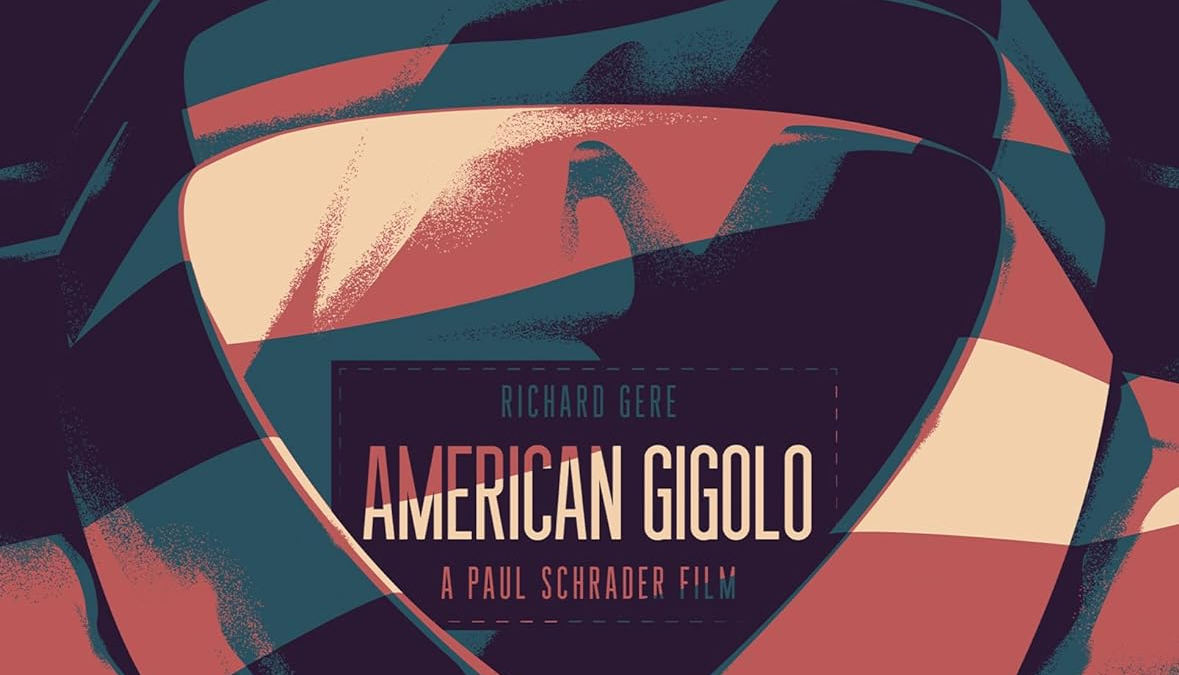
Richard Gere is the epitome of style and sexuality of the early 1980s in Paul Schrader’s highly influential American Gigolo. Arrow Video’s new 4K Restoration Dazzles.
The Film
I remember the first time I saw American Gigolo. Let me correct that. The first time I saw the first twenty minutes of American Gigolo.
Let us cut to 1991. A thirteen-year-old reads the short description in TV Guide about this film called American Gigolo that’s showing on HBO at around 2:30 am. The short blip sounded enticing about the life of a sex worker. Imagine the thirteen-year-old’s reaction when it came time for the sexy time … there was no sexy time.
Disappointed. Turned off the film.
Thirteen-year-old self was not ready for American Gigolo. As enlightened as I like to think I was as a kid, watching American Gigolo now, I realized how immature and unenlightened a film viewer I was. No matter how much I loved and could discuss Ken Russell’s The Devils and why it was such a defiant piece of cinema. What that thirteen-year-old never understood was that Paul Schrader was using the luridness of the concept of American Gigolo to discuss our society’s obsession with the surfaces and so much more.
That isn’t to say that the film is some sort of boring dissection of America’s rise into the decadence and violence of the 1980s. Rather contrary the film at face value is a crackling good noir mystery. One where our title character, Julian (Richard Gere), finds himself embroiled in the murder of one of his wealthy and powerful clients. As Julian begins to look for an alibi, the sex worker begins to find that people he called his friends see him as an egomaniacal social climber. One that they have no intention of helping.
Within that descent into purgatory, Schrader is able to look at Julian’s lifestyle but an entire decade’s values ahead of the decade itself. Filmed in 1979 and released in 1980, American Gigolo is scarily prescient about what would happen in America throughout the decade. Reaganism, Greed is Good, Homophobia, Drug Abuse, Materialism, and Surface over Depth are all critiqued and viewed through Julian’s wanton need to be more than his current station.
Richard Gere is masterful in the role. Everything Gere does is magnetic here and wildly daring – a complicit partner in everything that Schrader has built into American Gigolo. The way he internalizes and shows those critiques is amazing for an actor not even close to thirty yet. Julian is a complex construction and collaboration between Schrader and Gere. One that is at once shallow but highly complex in its shallowness. A role so perfectly chiseled to his aura and strengths as an actor it felt like the next decade was Gere apologizing for turning the mirror so harshly at young white males willing to do anything and everything to get to the top of Excess Mountain. In fact, Gere wouldn’t hit this sort of peak for another decade until Mike Figgis’s Internal Affairs (another truly wonderful ahead-of-its-time neo-noir).
American Gigolo is fairly devoid of sex though there is a fair amount of nudity, most male. In that void, Schrader has created a film that sizzles for different reasons. It isn’t concerned with sensuality or sexuality (they are different) but the commodities we trade in as humans. Even its supposed “happy ending” with declarations of love feels like Schrader having a go at audiences. Giving the lesser adept thinking Julian and his paramour are to live happily ever after. Those more keenly aware see it for what it is. Another trade in commodities.
The Transfer
The all-new 4K remaster from the original negative by Arrow Films in Dolby Vision (HDR10 compatible) is one of the best transfers of 2024 so far. The Dolby Vision/HDR gives the film’s lighting scheme more depth in the contrast and black levels that’s just amazing causing subtlety in the blacks – and they never get the dreaded crushed blacks. The film’s grain retains all of its beauty and activeness. The poppy neon glow 80s color scheme is perfectly reproduced. Arrow’s 4K disc for American Gigolo continues to show how they are cornering the market in revelatory 4K UHD upgrades.
The Extras

They include the following;
- Brand new audio commentary with film critic Adrian Martin
- Interviews
- Below the Surface
- Six Ways to Sunday
- The Business of Pleasure
- Montages and Monologues
- The Non-Conformist
- Man Machine
- American Icon
- Original trailer
- Image galleries
The all-new audio commentary with film critic Adrian Martin opens with the fact that one of his first articles posted was about American Gigolo and his wrong assessment of the film and what he was wrong about the film. Some of the details include a discussion of where Schrader was in his career and how he calls this his first film that he had “confidence” in making after two previous directing effort; the relationship Schrader has to other films – as a filmmaker and critic; how this is the origins of Schrader’s style and subjects (aka Bresson’s “man in a room”) and how it’s defined in both this film and in others of his work; a discussion of Film Noir, which this film a part of, as Schrader has defined it as a critic (in his book); the style and fashion of the film and the Fashion Houses that helped make the film (e.g., Armani, Yes Saint Laurent, etc.); the aspect of LBGTQ+ of the film both coded and homophobic aspects – that cultural critics have discussed about the film; how the film is constructed with a key scene that is the inciting incident is left out and the reasons why it’s done for storytelling reasons; critic Robin Wood’s distaste for Schrader’s work and why he was so super critical; the character Julian’s surface/shallowness; if someone so vapid has a “soul” which Schrader has been concerned with for most of his career after this film was a success; a discussion of John Travolta had already been cast and dropped out at the last minute, for Gere to take over; Gere’s discussion, including quotes, about the role as he felt about it; the way that Schrader constructs characters and story that creates the buildup of the Julian character and his downfall; the lack of sex in the film and the proposed reasons that it could have been; the various contributors to the film like cinematographer John Baily, art director Ed Richardson, and visual consultant Ferdinando Scarfiotti; and much more. Martin does an excellent job of providing a deeply researched track for the film, specifically the work of Paul Schrader and where it lines up in his career. A vital track.
Below the Surface (19:37) – is an all-new interview with writer/director Paul Schrader. Schrader discusses how the origins of the film while he was teaching a screenwriting class at UCLA. The writer/director discusses the superficial life he created with Julian and American Gigolo. Some of the other details include Nic Roeg’s initial reaction to the script; using up his “three chances” as a director, and how American Gigolo saved his career by being an unexpected hit; how The Conformist was a cornering stone for not just him and the film but much of his generation in the 1970s; the casting and dropping out of initial star John Travolta – and the reasons why; the recasting of the role – and the fascinating lengths that Schrader to ensure he got someone he wanted that was studio approved; the how and whys they got full male nudity in the film as opposed to full female nudity; the European style of the film – locations, costuming, and music/score; the great way that Moroder proof that Call Me was going to be a hit song; how the ending was constructed and his thoughts on it now that time has passed; a great story about Brent Easton Ellis discussing who could be the next “Richard Gere”; and much more. In lieu of a commentary track, Schrader delivers a truly fascinating interview
Six Ways to Sunday (10:46) – is an all-new interview with actor Héctor Elizondo. The actor opens with his initial dreams of wanting to play Baseball and Jazz, not an actor. Some of the details include how he started his career early in his life; how he became drawn to the stage over movies and television; how he was cast in the role of Det. Sunday; his thoughts on working with Paul Schrader; his thoughts on working with Richard Gere; working with cinematographer John Bailey; playing the character in the film; and much more.
The Business of Pleasure (15:26) – is an all-new interview with actor Bill Duke. The actor begins with how he got his start on the stage during college. Some of the other details include how closely hued he was to his character in his debut feature Car Wash; how that role turned into various other roles allowing him the opportunity to be cast in American Gigolo; his initial thoughts on the script; the casting process; how he approached his character; working with Richard Gere – including a great story about Menace II Society that illustrates his point about the actor; working with Schrader; and much more.
Montages and Monologues (7:15) – is an all-new interview with editor Richard Halsey. Opens with the editor’s adherence to doing lower budgeted character pictures during his post Rocky Oscar win for best editing. Some of the other details include working with Schrader and his love for the work he does as a director and writer; the first cut being 2 hrs and 45 minutes; the trouble as an editor he faced with the work and style of cinematographer John Bailey; the various difficulties in the editing room the film had; and much more.
The Non-Conformist (25:05) – is an all-new interview with camera operator King Baggot. The operator opens with the importance of the responsibilities of the Camera operator and how movement can change so much in film. Some of the other details include that he’s a third generation Hollywood – and discussion of his grandfather and father’s careers; how he got into Hollywood – and his rise through the ranks first in TV News and eventually to film; how he was involved with the Manson murder trial; how he got into film work by learning Steadicam – which was new at the time; how he was hired for the film by John Bailey; the discussion of the opening moment with Gere on the car and just how dangerous it was; his relationship with Schrader during the production – including some great anecdotes about the director and production; Bailey and Baggot bonding over a screening during pre-production of The Conformist; and much more. This is truly a great and oftentimes wild interview with Baggot that should definitely be at the top of your list to watch if you purchase this edition.
Man Machine (15:03) – is an all-new interview with music supervisor & KCRW DJ Dan Wilcox on the music of Giorgio Moroder for American Gigolo. Some of the details include how the score and songs were a perfect distillation of style for the film; his first viewing of the film at a very early age; a discussion of where music was at the time and where Gorgio Moroder was and how forward thinking he was with the score; how Call Me came to be performed by Blondie and how he turned into the opening song – including a great what if first pick as a singer; a what if of Blondie being produced Moroder – but never happened for reasons; the song Love and Passion by Sheryl Barnes – the second single, and how it fits perfectly into the club scene if plays over, and the fact that Schrader wrote the lyrics; the work that Moroder did post-American Gigolo – including his next work with Schrader for Cat People; and much more. Wilcox does a great job of explaining how influential Moroder’s work for American Gigolo has been for the last forty years.
American Icon (18:54) – is an all-new interview with Professor Jennifer Clark on American Gigolo and the fashion landscape of the 80s. The interview opens with Clark discussing the context (politically, socially, and culturally) in which American Gigolo was released. Some of the details include the rise of Rodeo Drive – which plays a huge factor in the film; the rise of Giorgio store – including details of how a customer was treated and the escalation of the elite class treatment; the eventual catering to men and men’s wear – how this relates to the film and the infamous Juschi brand that features prominently in the film; the rise of Armani and its relationship with American Gigolo – how Schrader worked and decided collaborate with Armani and initial star John Travolta, when he leaves the role Gere takes over and Armani clothes him; how Armani was not the costumer but the suits that are designed for Gere’s character; how the suits fit and how they conform to the visual style of the film and what makes it so unique; and much more. Clark dissects almost every aspect of fashion within the film and giving it a larger context to how influential American Gigolo.
Original trailer (1:57)
Image galleries – There are three galleries housed in this menu.
- Stills – consisting of 26 different behind-the-scenes stills, production stills, and press stills.
- Posters and Press – consisting of 8 various posters from various countries.
- Lobby Cards – consisting of 8 various lobby cards.
The Final Thought
Arrow has given American Gigolo a truly great special edition. Highest Possible Recommendations!!!
Arrow Video’s 4K UHD Edition of American Gigolo is out June 18th
Discover more from The Movie Isle
Subscribe to get the latest posts sent to your email.
Pingback: 4K UHD Review: Kino Lorber’s Internal Affairs (Special Edition) – The Movie Isle